Amazon’s flywheel
Jeff Bezos and the napkin that built an empire
Description
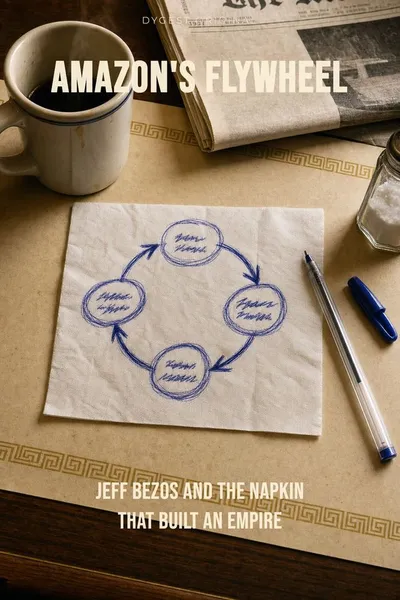
Sometime around 2001, in a coffee shop in Seattle, Jeff Bezos sat with several of his senior Amazon executives and drew a diagram on a paper napkin. Amazon had been operating for about seven years. The company had survived the dot-com crash that had wiped out most of its competitors, but it was still losing money, still searching for a coherent strategic argument about why it would eventually be profitable, and still encountering skepticism from investors who had grown tired of waiting. The diagram Bezos drew that day was a simple loop with five elements: lower prices, more customers, more sellers on the platform, lower cost structure, and back to lower prices. The loop ran in one direction. Each element fed the next. The flywheel, as Bezos called it, was the company’s strategic argument compressed into a single diagram.
The flywheel was not original. The general concept came from Jim Collins’s 2001 book Good to Great, which had used the flywheel as a metaphor for how compounding strategic momentum operates in successful companies. What Bezos did was apply the framework specifically to Amazon’s business and use it as the operating logic for every major decision the company made over the following two decades. The flywheel diagram became the most cited strategic document in the company’s history, taught to new executives, referenced in shareholder letters, invoked in operational decisions about whether to pursue particular initiatives. Amazon’s growth from a $4 billion company in 2001 to a $1.5 trillion company by 2025 was, in significant part, the working out of the implications of that napkin diagram.
The flywheel has become one of the most quoted strategic frameworks in modern business, replicated and adapted across hundreds of companies in dozens of industries. The reasons it worked at Amazon, and the conditions under which it has continued to work, are worth examining beyond the napkin. The framework was elegant. The implementation was not.
The question we’re asking: what did Bezos actually draw on that napkin, how did Amazon translate the framework into operational decisions, and what does the flywheel reveal about how compounding business strategy actually works?
What we’ll see: the strategic context that produced the diagram, the components of the loop, how Amazon operated against it, and what survives.
Table of contents
01 A bookseller with a strategic problem
Amazon had been founded in 1994 as an online bookseller. The thesis was that books were a category well-suited to internet retail they were standardized commodities with no need for physical inspection before purchase, they were easy to ship, and the catalog was vast enough that no physical store could match the selection an online retailer could offer. The bookselling business grew quickly across the late 1990s and went public in 1997. The dot-com period gave Amazon access to substantial capital, which the company used to expand into music, then video, then electronics, then eventually toward what Bezos called the everything store.
The strategic problem by 2000 was that the diversification had not produced profitability. Amazon was losing money in every category. The dot-com crash in 2000 destroyed most of the internet retailers that had been Amazon’s competitors, but it also forced Amazon to demonstrate, to the investors who remained, that the business would eventually generate cash. The stock price fell from over $100 in 1999 to under $10 by late 2001. The company laid off about fifteen percent of its workforce. The strategic question — what was Amazon, and why would it eventually work was urgent.

02 The components and how they worked
The lower-prices element was the foundation of the flywheel. Amazon committed, as a strategic principle, to passing scale advantages to customers in the form of lower prices rather than retaining them as profit margin. The commitment was unusual. Most retailers, given a cost advantage, will use part of it to lower prices and part of it to widen margins. Amazon chose, deliberately, to pass nearly all of it through. The result was prices that competitors could not match without losing money, and the inability to match the prices made the competitors progressively less attractive to customers.
The third-party seller element was the operational innovation that made the flywheel work at scale. Amazon launched its Marketplace product in 2000, allowing outside sellers to list products on the Amazon platform in exchange for a commission. The Marketplace was initially controversial within the company; the third-party sellers were, in many cases, competing directly with Amazon’s own first-party sales. Bezos’s argument was that the customer experience came first, and that a wider selection on the platform was worth the competitive cannibalization. The argument was correct. By 2025, third-party sellers accounted for over 60 percent of Amazon’s gross merchandise volume.
03 The strategic implications and the AWS pivot
The flywheel framework had specific implications for how Amazon made decisions. The company evaluated potential initiatives by asking whether they would feed the flywheel. Initiatives that lowered prices, expanded selection, or improved the customer experience were prioritized. Initiatives that protected margins, complicated the platform, or improved short-term profitability at the expense of customer experience were deprioritized. The framework gave Amazon a unified strategic logic across an unusually wide range of business decisions, and the consistency of application was part of what made the strategy effective.
The launch of Amazon Web Services in 2006 was, on the surface, a substantial departure from the flywheel framework. AWS was a cloud-computing business that had little to do with online retail. The decision to launch it was, in retrospect, one of the most consequential strategic moves in business history. By 2025, AWS generated annual revenue exceeding $100 billion and a substantial majority of Amazon’s operating profit. The retail flywheel produced the customers; AWS produced the cash that funded the retail flywheel.
04 What the flywheel reveals, and what it does not
The Amazon flywheel has been imitated extensively since the 2010s, with limited success. The framework is elegant enough to be memorable and specific enough to guide individual decisions. The conditions under which it actually works, however, turn out to be narrower than the framework’s popularity suggests. The flywheel requires substantial upfront capital, a willingness to operate at low margins for years, and a strategic commitment to customer experience that competitors cannot easily match. Most companies that have attempted to operate flywheel strategies have lacked one or more of these conditions, and the strategies have not produced Amazon-level results.
The structural feature the flywheel exploited at Amazon was the asymmetry between scale-based and conventional retailers. Amazon could operate at substantial losses for years because the capital markets were willing to finance the losses on the strategic argument the flywheel provided. The competitors could not match the loss tolerance because their investors expected near-term profitability. The asymmetry was, in many ways, the central competitive advantage. The flywheel was the framework that made the asymmetry strategically coherent.
05 Conclusion
Jeff Bezos stepped down as Amazon CEO in 2021 and as chairman in 2023, leaving the company to Andy Jassy, who had previously run AWS. The flywheel framework has continued to be cited in Amazon’s strategic communications under the new leadership, with the additional commentary that the framework now applies across multiple business segments rather than only to the original retail operation.
Related books