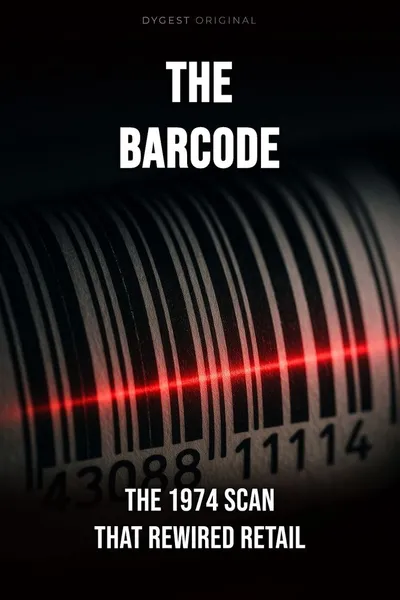
The barcode
The 1974 scan that rewired retail
Description
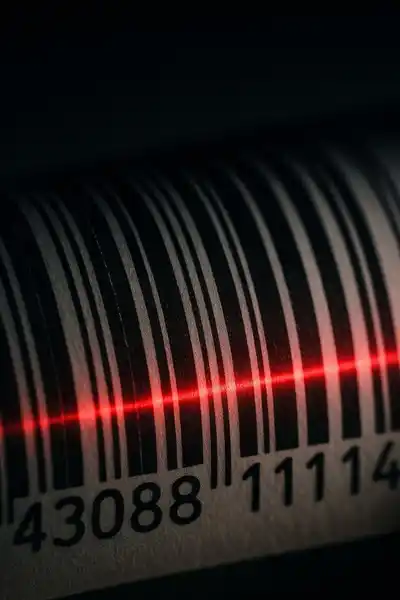
At 8:01 in the morning on June 26, 1974, a cashier named Sharon Buchanan ran a ten-pack of Wrigley's Juicy Fruit gum across a scanner at Marsh Supermarket in Troy, Ohio. It cost 67 cents. The pack of gum is now in the Smithsonian. The receipt, the scanner, and the laser diode that read the thirteen black stripes on the wrapper are collectively the starting point of modern global retail.
Most people experience the barcode as the beep at the checkout — invisible infrastructure, so ordinary that it's hard to remember it was ever missing. But before 1974, there was no standard way to scan a product anywhere in the world. Cashiers entered prices manually, inventory was counted by hand, and a large grocery store might spend hundreds of hours a week just on the accounting of what had come in and what had gone out.
The barcode looks like a technical artifact. It is really a political achievement — a decision by a consortium of competing American retailers in the early 1970s to adopt a single shared standard, accept the cost of the transition, and give up some competitive ambiguity in exchange for a better-functioning industry. That one decision is the hidden scaffolding behind Walmart, Amazon, just-in-time logistics, and most of what modern consumer retail has become.
● The question we're asking: how did a group of competing American retailers invent a shared standard that quietly restructured the global economy of selling?
● What we'll see: the checkout problem before 1974, the industry committee that designed the UPC, the first scan in Troy, Ohio, and the way Walmart turned the barcode into a data infrastructure that reshaped global retail.
Table of contents
01 The problem before the barcode
The problem the barcode was solving is easy to miss today. In the 1960s, the average transaction at a supermarket checkout took between fifteen and thirty seconds per item. A cart with sixty items took most of half an hour to ring up. Cashiers made constant errors — wrong prices, wrong totals, missed items. Inventory was an end-of-month guess based on physical counts, and stock-outs and overstocks were permanent features of grocery operations.
The idea of machine-readable product codes wasn't new. In 1948, Bernard Silver and Norman Woodland, two graduate students at the Drexel Institute of Technology in Philadelphia, had heard a supermarket executive complain about the checkout problem. They began experimenting with a code made of concentric rings that could be read by a light-reflective scanner. Woodland filed the patent in 1949. It was granted in 1952. Nothing happened.

02 The consortium that agreed on a standard
The committee evaluated seven proposals from different companies. The winning design came from IBM, and it was drafted by an engineer named George Laurer. Laurer rejected the circular bullseye pattern that had descended from the Silver-Woodland patent because it was too easy to misread at the angles scanners faced in real checkout conditions. He proposed a rectangular pattern of vertical black and white stripes of varying widths, readable by a laser passing in any direction.
Laurer's design encoded twelve digits. The first digit identified the type of product (grocery, meat, pharmacy, coupon). The next five digits identified the manufacturer. The next five identified the specific product. The twelfth was a check digit, a mathematical verification that the other eleven had been read correctly. The format was called the Universal Product Code, or UPC. It was adopted by the committee in 1973 and endorsed by the Grocery Manufacturers of America the same year.
03 What the scan enabled
The first retailer to extract serious value from the barcode wasn't a grocer. It was Walmart. Sam Walton had been building a discount retail empire out of Arkansas since the early 1960s, and he saw in the UPC a new kind of informational raw material. Every scan was a data point — which product, when, where, at what price. Aggregated across thousands of stores, those data points were something no retailer had ever had before: a real-time picture of what Americans were buying.
Walton mandated UPC adoption across Walmart's supply chain in the early 1980s. He built a private satellite communications network in 1987 — the largest in the world at the time — to move scanning data from stores to a central computing facility in Bentonville, Arkansas. From there, Walmart could reorder from suppliers based on actual demand, not forecasts. The result was the just-in-time inventory system that has since been copied by every large retailer.
04 The lesson of invisible infrastructure
What makes the barcode a useful case is how small the underlying invention is. George Laurer's design is not a breakthrough of physics or materials science. It is a mapping of twelve digits onto a readable pattern of stripes. The intellectual content would fit on an index card. What made it globally transformative was not the design itself but the agreement — by an entire industry — to use it.
This is a pattern that shows up across infrastructure. The value of a standard comes from the fact that it is shared. HTTP is not a technically brilliant protocol; it is the protocol everyone agreed to use. The shipping container is a steel box; its power comes from every port in the world being equipped to handle it. GPS is thirty-one satellites; it matters because every device agrees on what GPS coordinates mean. A standard is worth what its adoption is worth.
05 Conclusion
On June 26, 1974, a pack of chewing gum passed across a laser in a supermarket in Troy, Ohio, and produced a small beep. It was the first of what is now roughly five billion barcode scans per day worldwide. The technology that made that beep possible was designed by one engineer, adopted by a committee of retailers, and deployed over twenty years by an industry that had agreed, in advance, to share it.
Related books