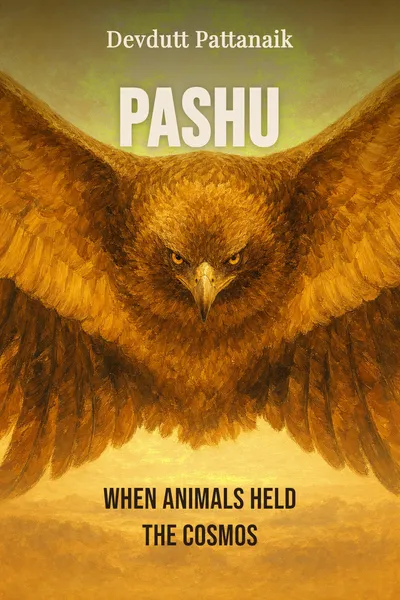
Pashu
When animals held the cosmos
Description
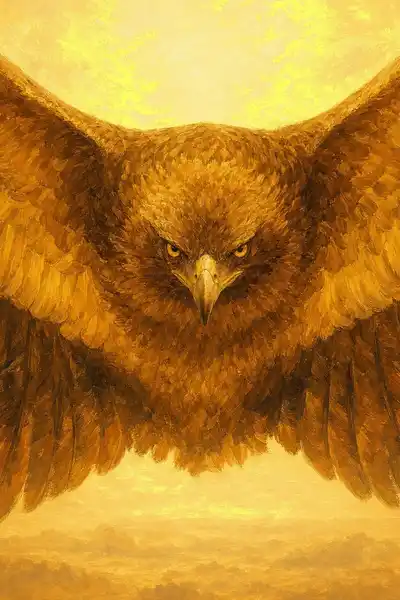
Walk into almost any Hindu temple and the animals arrive before the gods do. A stone bull sits patiently facing the inner sanctum, waiting. A mouse is carved at the foot of an elephant-headed deity. An eagle spreads its wings above a doorway; a snake coils around a stone column, its hood raised. Long before you reach the image of the god you came to see, you have passed through a menagerie — and none of it is decoration. In the mythologist Devdutt Pattanaik's telling, these creatures are load-bearing, in the literal and the cosmic sense. They carry the deities on their backs, and they carry the ideas the deities stand for.
Pattanaik, who has spent decades retelling Indian myths in a plain, illustrated, deliberately un-academic style, devotes his book Pashu — the Sanskrit word for animal, for beast, for creature — to exactly these figures. Not the humans, not even the gods, but the pashu: the tiger under the goddess, the swan carrying the creator, the fish that becomes the first avatar of Vishnu. He gathers the stories scattered across the Vedas, the epics, the regional folk traditions, and asks a question that sounds simple and turns out not to be. Why are there so many animals in these sacred stories, and what are they doing there?
Because in this tradition the animals are rarely incidental. They are chosen, and the choice means something. A god who rides a rat is telling us something a god who rides a lion is not. To read the beasts is to read the cosmology sideways — through its edges rather than its center — and to find that the edges were holding the whole thing up.
The question we’re asking : Why does Hindu mythology place animals at the heart of its sacred stories, and what do those creatures reveal about how Indian thought imagines the world?What we’ll see : How the pashu carries meaning — riding beneath the gods, standing in for cosmic forces, and quietly rearranging where humans think they sit.
Table of contents
01 Chapter 1 — The animal was never just an animal
The word gives Pattanaik his frame. Pashu, in Sanskrit, means animal — but it also means the one who is bound, tethered, caught in the web of instinct and appetite. Its counterpart is Pashupati, lord of the animals, a title given to Shiva: the being who is not bound, who has mastered what the pashu is ruled by. From the start, then, the animal is not the opposite of the divine. It sits on a spectrum with it. The creature is what the god has transcended, which means the creature is where every story of transcendence has to begin.
This is why, in Pattanaik's reading, you cannot skip past the beasts to get to the meaning. In the Hindu imagination an animal is a compression of a quality. The tiger is raw, untamed power. The elephant is memory and abundance. The snake is desire that both threatens and renews. When a myth places one of these creatures beside a god, it is not adding local color. It is saying something precise about the force the god embodies or the force the god has subdued.

02 Chapter 2 — Vahanas — why the gods travel on backs
The clearest place to watch the pashu do its work is the vahana, the animal vehicle. Nearly every major Hindu deity has one, and the pairing is never arbitrary. Shiva rides Nandi, the white bull — steadfast, patient, the embodiment of controlled strength and devotion. Vishnu is carried by Garuda, the great eagle, sworn enemy of serpents, a creature of speed and sky and sovereignty. Durga, the warrior goddess, rides a lion or a tiger, sitting composed on the very force that ought to devour her. The mount is a statement about the god who sits on it.
Pattanaik lingers on the pairings that seem, on the surface, mismatched — because those are the ones that teach the most. Ganesha, the elephant-headed remover of obstacles, immense and beloved, travels on a mouse. A god the size of a mountain, borne by the smallest thing that can slip through any gap. The reading writes itself once you see it: no obstacle is too small to matter, nothing is beneath the god's reach, and greatness does not require a grand vehicle. Saraswati, goddess of knowledge, rides a swan, said to separate milk from water — discernment made visible, the mind's ability to draw out truth from a mixture.
03 Chapter 3 — The bull, the cow, and the serpent that holds the world
Some animals in the tradition grow past being any single god's companion and become forces in their own right — hinges on which the whole cosmos turns. The cow is the obvious case, and Pattanaik is careful to unpick why. She is not sacred because of a rule handed down from above. She becomes sacred because of what she does: she gives without taking, offering milk, dung for fuel, labor in the field, asking almost nothing back. In an agrarian imagination she is generosity itself, the earth in animal form, and reverence follows the giving rather than preceding it.
The serpent carries a heavier cosmic load. Snakes — the nagas — thread through the mythology as guardians of treasure, of water, of the underworld's hidden wealth. Vishnu sleeps on the coils of the great serpent Shesha, whose name means 'the remainder,' the residue that survives when the universe dissolves. Shesha floats on the cosmic ocean between one creation and the next, and the god rests on him in the interval. The world, in this image, is held up by a snake — the very creature that elsewhere signals danger and death. That doubleness is not a contradiction to be resolved. It is the point.
04 Chapter 4 — A worldview where nothing is only human
Step back from the individual beasts and a shape appears — the thing Pattanaik is really after. Read together, the pashu describe a cosmos with no ladder in it. Or rather, a ladder that everyone can climb and no one owns. The animal is not the bottom rung with the human comfortably above and the divine at the top. The animal is woven into the divine, and the human is just one more form a soul might take on its long circuit through existence. In a worldview built on rebirth, you may have been the tiger; you may be the swan next time. The creature is not the other. The creature is a version of you.
That is a quietly radical proposition, and it sets this tradition against the arrangement most readers inherited from elsewhere — the one where humans are granted dominion, where animals are resources or lessons or backdrop, where the sacred lives strictly above the natural rather than inside it. Pattanaik never sermonizes about this. He simply lays the stories out until the difference becomes impossible to miss. When your gods ride, sleep on, and turn into animals, you cannot easily hold the animal at arm's length.
05 Conclusion
Return to the temple, and the stone bull facing the sanctum. He is not waiting to be let in. He is already where he belongs — at the threshold, holding it, an animal placed at the exact seam between the human world and the divine one. Pattanaik's Pashu is, in the end, an invitation to notice the figures we walk past. The mouse under Ganesha, the eagle over the door, the snake around the column: each is a compressed thought, and together they compose a picture of the world the gods alone could never have carried.
Related books