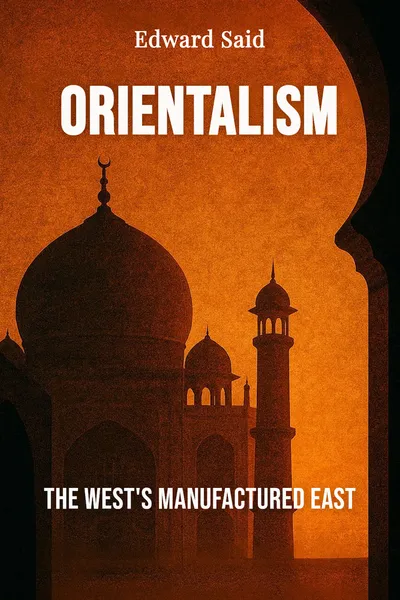
Orientalism
The West's manufactured East
Description
In 1978, a professor of comparative literature at Columbia named Edward Said published a book with a deceptively dusty title. Orientalism sounded like a survey of nineteenth-century watercolors and travel diaries — camels, minarets, the whole Romantic postcard. It was nothing of the sort. Said, a Palestinian raised in Cairo and Jerusalem and educated at Princeton and Harvard, had taken a word that scholars used to describe themselves with pride and turned it into an accusation. An Orientalist, in the old sense, was simply someone who studied the languages and cultures of the East. After Said, the word carried a charge it has never quite lost.
His claim was large and unsettling. The West, he argued, had not merely studied the East — it had produced it. Across two centuries of poems, novels, dictionaries, colonial reports, and academic lectures, Europe had assembled a coherent portrait of "the Orient" as sensual, despotic, irrational, timeless, and permanently in need of Western management. This portrait told you very little about the actual societies of North Africa and Asia. It told you a great deal about the Europe doing the looking, and about the empires that funded the looking in the first place.
The book landed like a depth charge across half a dozen disciplines. It was praised, attacked, misread, canonized, and argued over with a heat that rarely fades. Nearly fifty years later, it remains one of the most cited works in the humanities — and one of the most fiercely contested. To understand why, we have to follow what Said actually said, rather than what people remember him saying.
The question we’re asking : How does a body of scholarship end up producing the very thing it claims only to describe?What we’ll see : How Said turned a scholarly discipline into a case study in the marriage of knowledge and power — and the storm that followed.
Table of contents
01 Chapter 1 — A word that used to just mean scholarship
Before Said, Orientalism was an honorable job title. From the late eighteenth century onward, European universities produced generations of specialists who learned Arabic, Persian, and Sanskrit, edited ancient manuscripts, and built the grammars and dictionaries that made the East legible to the West. Napoleon sailed to Egypt in 1798 with a small army of these scholars in tow, and the result — the vast Description de l'Égypte, published across the following decades — was as much a monument to European learning as to French conquest. To be an Orientalist was to belong to a respectable, even glamorous, branch of knowledge.
Said did not deny the erudition. He knew these texts intimately — Silvestre de Sacy's philology, Ernest Renan's linguistics, the sweeping travel writing of figures like Richard Burton and Gustave Flaubert. His point was subtler and more damaging. Underneath the scholarship, he argued, ran a shared set of assumptions so deep that nobody thought to state them: that there was a stable thing called "the Orient," that it was fundamentally different from and inferior to "the Occident," and that Westerners were uniquely qualified to explain it to itself.

02 Chapter 2 — The three things Said meant by one word
Part of why the book provoked such confusion is that Said used "Orientalism" to mean three things at once, and readers often seized on one while ignoring the others. Untangling them is the key to the whole argument. First, and most narrowly, Orientalism is an academic discipline — the actual departments, chairs, journals, and learned societies devoted to studying the East. This is the sense the professors themselves would have recognized.
Second, and more broadly, Orientalism is a style of thinking founded on the basic distinction between East and West. In this sense it runs far beyond the universities. It shows up in Dante and in Marx, in Verdi's operas and in Delacroix's paintings, in the offhand assumptions of politicians who never read a word of Arabic. It is a habit of imagination, a way the Western mind organizes the world that persists whether or not anyone is doing formal scholarship.
03 Chapter 3 — Knowledge that comes with a fleet behind it
The heart of the book is the claim that this knowledge was never innocent, because it never operated in a vacuum. When a European scholar sat down to describe Egyptian society, he did so from a position of overwhelming power — his country's gunboats were in the harbor, its administrators in the ministries, its language in the schools. The East he described was an East already conquered, or about to be. Description and domination arrived together.
Said's sharpest example is a speech Arthur Balfour gave to the British Parliament in 1910, defending Britain's rule in Egypt. Balfour did not argue that occupation was good for the Egyptians in the ordinary way of politics. He argued that England knew Egypt better than the Egyptians knew themselves — that Western knowledge conferred a natural right to govern. The logic is perfectly circular and perfectly Orientalist: we understand you, you cannot understand yourselves, therefore we must rule you. The scholarship licensed the empire, and the empire funded the scholarship.
04 Chapter 4 — The argument that never really closed
What Orientalism did, beyond its specific case, was open a question that has refused to go away: who has the right to describe whom, and what happens when the describer holds the power? The book effectively founded a field — postcolonial studies — and its influence spread far past its original subject, into anthropology, history, art criticism, and the study of how any dominant group represents any subordinate one. The template proved almost endlessly portable, which is both its strength and, its critics say, its weakness.
Because the objections came fast and they were serious. The historian Bernard Lewis, one of the scholars Said had targeted, accused him of caricaturing the entire Western tradition, ignoring the many Orientalists who admired the cultures they studied, and getting basic facts wrong. Others pointed out that Said drew almost entirely on British and French sources while barely mentioning German scholarship, which had been enormous and had no colonies attached to it — an awkward gap for a theory about knowledge and empire. Still others noted a strange silence: Said criticized the West for essentializing the East, yet the East itself, and its own thinkers and resistances, remained oddly absent from his pages.
05 Conclusion
Edward Said died in 2003, and the old, innocent sense of Orientalism died with him. The word can no longer be used the way the nineteenth-century professors used it — as a neutral badge of learning. It now names a suspicion that any confident account of a distant people, delivered from a position of strength, may be describing the observer's needs as much as the observed reality. Whether one accepts his full argument or picks it apart line by line, the suspicion has proven impossible to unlearn.
Related books