Oran, 5 July 1962
A massacre at independence
Description
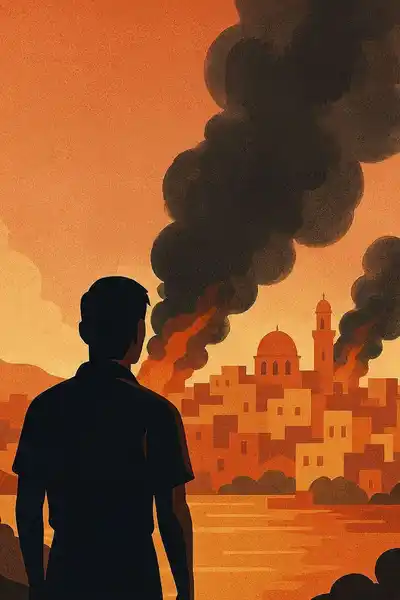
On the morning of 5 July 1962, Oran was a city holding its breath. Two days earlier, on 3 July, France had formally recognized the independence of Algeria, ratifying the overwhelming yes of the self-determination referendum held that spring. The eight-year war was, on paper, finished. And 5 July was no ordinary date: it marked, to the day, the anniversary of the French landing of 1830, the beginning of the conquest. The Front de Libération Nationale had chosen it deliberately as the day of celebration. Crowds poured into the streets carrying green-and-white flags, and Oran — a city with one of the largest European populations in Algeria, a place where the two communities had lived side by side and increasingly apart — prepared to mark the birth of the new state.
By the end of that day, an unknown number of people were dead, most of them Europeans, some of them Muslims taken for traitors or caught in the confusion. Bodies were carried to the Petit Lac district. Witnesses spoke of Europeans dragged from cafés, of shooting that no one seemed to be able to stop, of French troops confined to barracks while it happened. What no one has ever been able to establish, with anything like certainty, is how many died, who gave the orders, and whether anyone tried to prevent it. The figures that circulate — from a few dozen to several thousand — say more about the people quoting them than about the day itself.
This is the puzzle the historian Guy Pervillé set out to work through: not to deliver a verdict, but to reconstruct, hour by hour and source by source, a day that everyone remembers and no one agrees on. What can be pinned down, what cannot, and why the gaps have never closed.
The question we’re asking : What actually happened in Oran on 5 July 1962 — and why has it been impossible to agree on it ever since?What we’ll see : A careful reconstruction of a single contested day, and the two national memories that grew out of its silences.
Table of contents
01Chapter 1 — The day the war was supposed to be over
To understand 5 July, we have to sit inside the strange interval that Algeria occupied that summer. The Évian Accords of March 1962 had arranged a ceasefire and a path to independence. But a ceasefire is not peace, and the months that followed were among the most violent of the whole war. The Organisation Armée Secrète — the OAS, the underground movement of Europeans determined to keep Algeria French — had waged a campaign of bombings and killings, then, as its cause collapsed, a scorched-earth policy against the country it was losing. The FLN answered. Between the two, the promised calm never arrived.
Oran was the flashpoint of this endgame. The city held one of the densest concentrations of pieds-noirs — Europeans of French, Spanish and other Mediterranean origin, many families settled for generations. Through the spring, the OAS had been strong there, and the reprisals and counter-reprisals had hardened both communities into fear. By early summer the Europeans were leaving in enormous numbers, boats and planes packed, apartments abandoned. The exodus that would empty Algeria of nearly a million people was already under way, and Oran was emptying faster than most.

02Chapter 2 — What happened in the streets
The accounts of the morning agree on the opening scene and almost nothing after it. Crowds filled the center of Oran, jubilant, flags everywhere. Then, at some point in the late morning, shots were fired downtown. Where they came from has never been settled. Some witnesses said OAS gunmen or isolated Europeans fired on the marchers from windows; others heard nothing but the crowd's own celebratory shooting. Whatever the trigger, the mood turned in minutes, and rumor did the rest: word spread that Europeans were shooting at the crowd.
What followed was not a battle but a hunt. Europeans were seized in the streets, pulled from cafés and cars, marched away. Some were killed on the spot. Others were taken toward the Petit Lac, a district on the edge of the city that would become the grim center of the day's memory, where bodies were gathered and, in some accounts, prisoners held and executed. Muslims suspected of sympathy with the French, or simply in the wrong place, were caught in it too. The violence was patchy, moving neighborhood to neighborhood, sparing one street and engulfing the next.
03Chapter 3 — Who fired, and who let it happen
Two questions have dominated every argument about 5 July, and Pervillé takes them apart carefully. The first is who unleashed the violence. The second is why it was allowed to run. Neither has a clean answer, and the honest reconstruction is a matter of weighing probabilities rather than naming culprits.
On the first, the picture is one of collapse rather than conspiracy. There is little evidence that the FLN leadership planned a massacre of Europeans for the day of celebration; a coordinated slaughter fits poorly with a movement that wanted, above all, an orderly transfer of power and a functioning state. What the evidence supports is a crowd tipped into panic and vengeance by a spark — real or rumored gunfire — with armed men, some in FLN uniform, some belonging to the shadowy auxiliaries and the local security apparatus, joining or leading the reprisals once they began. Eight years of war do not switch off at midnight. The rage that surfaced in Oran had been accumulating a long time.
04Chapter 4 — A day two nations cannot agree on
Step back from the streets of Oran and the day becomes something larger than itself: a fixed point around which two national memories have organized in opposite directions. This is what makes 5 July so combustible, and why a book that merely tries to establish the facts lands in a minefield. The event is not only unresolved historically; it has been made to carry meanings that each side cannot surrender without giving up part of its own story.
For the pieds-noirs and the harkis who left, Oran is proof and symbol at once — proof that the departure was not a choice but a flight from mortal danger, symbol of a France that abandoned its own on the last morning. The day validates the exodus, indicts General Katz and the government that gave him his orders, and answers those who would call the settlers' fear a myth. To lower the number, or to describe the violence as chaotic rather than orchestrated, feels to this memory like a second abandonment.
05Conclusion
Sixty years on, Oran on 5 July 1962 remains one of the hardest dates in the whole history of the Algerian war to pin down. We can place the crowds, the flags, the anniversary chosen on purpose. We can place the first shots and the panic, the hunt through the streets, the Petit Lac, the French troops kept in their barracks while the city turned on itself. What we cannot place, still, is the number of the dead, the chain of decisions behind the violence, and the full measure of what General Katz could or could not have done.
Related books