
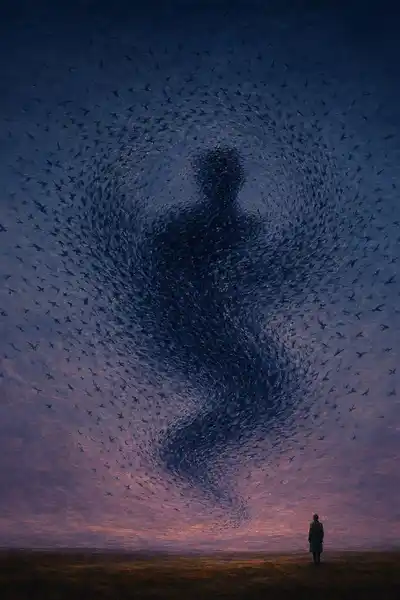
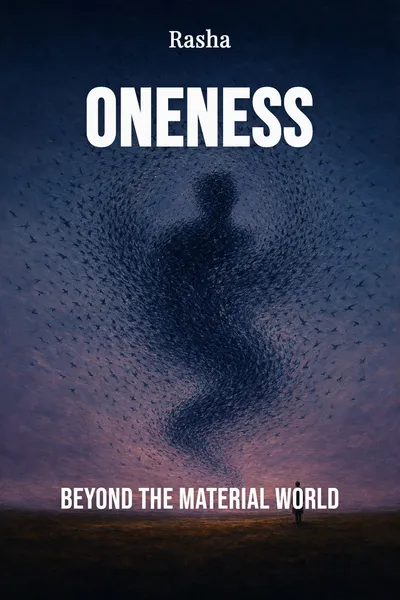
Oneness
Beyond the material world
Description
Somewhere in the late 1990s, a woman who wrote under the single name Rasha reported that a voice had begun speaking to her — not a person, not a spirit with a biography, but something that identified itself simply as Oneness. What came out of those sessions became a book, published in 2003, written almost entirely in that voice's first person. The pages don't argue for God the way a theologian would. They address the reader directly, warmly, as if picking up a conversation already in progress. The premise is disarming before it is anything else: the divine is not out there being described. It is here, doing the describing.
That framing puts the book in an old and slightly awkward category — channeled literature, teachings claimed to come from beyond the person writing them down. It is easy to file such a thing away and move on. But the ideas inside, stripped of the claim about their source, belong to a lineage far older than any of us: the intuition that separation is the illusion and connection the underlying fact, that the boundary between self and world is thinner than it feels. Mystics of every tradition have said versions of this. Rasha's contribution is the register — intimate, unhurried, closer to a letter than a sermon.
What makes it worth sitting with is not whether one believes a disembodied intelligence dictated the text. It is the picture of reality the text assembles, and what that picture asks of the ordinary business of being alive — the fear, the striving, the sense of being a separate someone pushing through a world of separate things. Rasha's Oneness takes all of that and calls it a misunderstanding, gently, and then spends its length trying to talk the reader out of it.
The question we’re asking : What does it mean to build a spiritual life on the felt sense that everything is one, rather than on doctrine or proof?What we’ll see : How a channeled voice reframes the self, the fear that keeps it separate, and the return it keeps pointing toward.
Table of contents
01Chapter 1 — A book that speaks in the first person of the divine
The most striking thing about Oneness is grammatical. Most spiritual books talk about the sacred; this one claims to be the sacred talking. Rasha describes herself less as an author than as a scribe — she sat, the voice came, she transcribed. The result reads like the transcript of a long, patient monologue addressed to no one in particular and to the reader in particular at the same time. There are no chapters full of citations, no lineage of quoted masters. The text simply speaks, and it speaks as "I" meaning the whole of everything.
This is the convention of channeled literature, a genre that runs through the twentieth century from A Course in Miracles to the various "Seth" and "Abraham" materials. The claim is always the same and always unprovable: the words originate somewhere the writer's own mind does not fully reach. A skeptical reader will locate that somewhere in Rasha's own unconscious, and nothing in the book can settle the question. Rasha, for her part, doesn't spend energy defending the mechanism. The voice asks only to be heard on its own terms, the way a friend asks you to hear them out before you decide.

02Chapter 2 — The self we mistook for the whole of us
At the center of the book is a claim about identity. What we call "me" — the bounded person with a name, a history, a set of wants and fears — is, in Rasha's telling, a partial thing mistaken for the whole thing. The voice returns to this again and again: the individual self is real enough as an experience, but it is a kind of local weather within a much larger climate. We have taken the weather for the sky.
The larger climate is what the book calls Oneness — a single field of consciousness that every apparently separate life is an expression of. The soul, in this picture, is not a private possession lodged inside one body. It is the point where the one field looks out through a particular pair of eyes. This is the old non-dual intuition, familiar from the Vedantic traditions of India and from the mystical strands of nearly every faith, that behind the many there is one, and that the sense of being fundamentally apart is the error to be undone.
03Chapter 3 — Fear, separation, and the long detour home
If separation is the wound, fear is how the wound announces itself. Rasha's voice spends much of the book on fear, treating it as the emotional signature of a consciousness that believes it stands alone against a world that could take everything from it. Fear is not, in this account, an enemy to be conquered by willpower. It is a symptom — the felt consequence of a wrong idea about what you are. Address the idea and the symptom loosens on its own.
The remedy the book offers is not a technique so much as a reorientation. Rather than gripping tighter, the voice counsels a kind of yielding — a willingness to trust that the larger field one belongs to is not hostile, that letting go is not falling but being held. This is where the intimate register does its heaviest lifting. A cold treatise on non-duality convinces no one to release their fear. A voice that speaks the way a trusted presence speaks, patiently, without urgency, can make the letting-go feel like something other than danger.
04Chapter 4 — What a metaphysics of union asks of a life
Set aside the question of where the words came from, and Oneness poses a genuine question about how anyone builds a spiritual life. The book rests on nothing that could be proven or refuted. There is no argument here in the philosophical sense, no chain of premises. There is instead an invitation to recognize something as already true from the inside — to feel the unity rather than be persuaded of it. That is a different kind of knowing than the one we usually trust, and the book stands or falls on whether that kind of knowing counts.
A metaphysics of union has recurred across human history without ever winning by evidence. It shows up in the Upanishads, in Sufism, in Meister Eckhart, in the writing of contemplatives who describe, in language that overlaps remarkably across centuries and continents, the dissolving of the boundary between the self and everything else. Rasha's book is a recent, deliberately accessible entry in that very long conversation. Its channeled framing is unusual; the intuition it carries is among the oldest we have.
05Conclusion
The book ends where it began, in the voice's steady first person, still addressing the reader as if the conversation could simply continue past the last page. Nothing has been demonstrated in the way a court or a laboratory would recognize. What has been offered is a picture — of a single field of consciousness wearing countless faces, of a self that is a costume rather than a cage, of fear as the ache of a forgetting that can be undone. Rasha's contribution to a very old intuition is the register: close, unhurried, more letter than lecture.