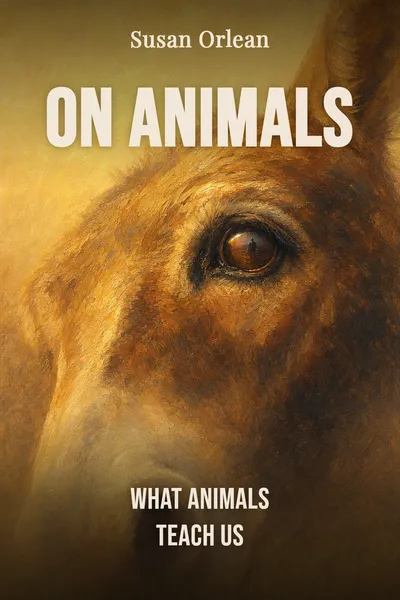
On Animals
What animals teach us
Description
Susan Orlean has spent decades as a reporter for the New Yorker, chasing subjects most people would consider too small to bother with: an orchid thief in Florida, a nine-year-old boy, a taxidermy convention. Somewhere along the way, she noticed that a strange number of her stories had animals in them. Not as metaphors, not as background, but as the actual pull of the piece. In 2021 she gathered a good part of that lifetime of noticing into a book called On Animals, a collection of essays about the creatures that had wandered through her reporting and, increasingly, through her own backyard.
The book is not a manifesto about animal rights, and it is not a nature documentary in prose. It is something looser and, in a way, harder to pull off: a set of pieces held together by one person's genuine, unforced fascination. Orlean writes about the twenty-three chickens she once kept, about a donkey she couldn't quite figure out, about a mule named Sherman who walked across America, about the lions of a private menagerie and the tigers hidden in suburban New Jersey. The through-line isn't an argument. It's an attention.
That attention turns out to be the whole game. Orlean rarely tells us what to think about the animals she meets, and she almost never lands on a lesson. What she does instead is stay in the room longer than most of us would, watching, asking, admitting when she's baffled. The result is a book that keeps circling one quiet puzzle: what exactly is going on between people and the animals we insist on living alongside.
The question we’re asking : What does a career spent following animals actually reveal about the bond between them and us?What we’ll see : How one reporter's stubborn curiosity turns companionship, wildness, and the muddle in between into something worth sitting with.
Table of contents
01 Chapter 1 — The reporter who kept following the animals home
Orlean did not set out to be a writer about animals. She set out to be a writer about people, which is a different thing, except that she kept finding the two impossible to separate. Over the years her assignments dropped her among show dogs, racing pigeons, escaped tigers, and a taxidermist's convention, and each time the animal turned out to be a door into a human obsession. The people she profiled loved these creatures with an intensity that was, frankly, a little mysterious, and Orlean's instinct was never to explain the mystery away. She reported it.
What holds the collection together is her posture. She arrives curious rather than certain. When she meets a woman breeding rare chickens or a man who has decided to walk a rescued mule across the country, she doesn't reach for the easy read — the eccentric, the hoarder, the crank. She sits with the person long enough to see the logic of the thing from the inside. That patience is the reason the essays don't flatten into human-interest filler. The animals stay strange, and so do the people, and Orlean lets both keep their strangeness.

02 Chapter 2 — Chickens, donkeys, and the farm as an ongoing question
The most personal essays come from Orlean's own property, and they're the ones where the reporter's distance thins out. She keeps chickens, and she writes about the peculiar spell they cast — how she started with a few and ended up with a couple dozen, how the whole enterprise made no economic sense, how she couldn't stop. Chicken-keeping, she notices, has become a small cultural movement, and she's honest that part of the appeal is aesthetic, part is nostalgic, and part is simply the pleasure of watching creatures who owe her nothing go about their business in the yard.
Then there is the donkey. Orlean writes about wanting a donkey, getting a donkey, and slowly realizing she has almost no idea what the donkey wants or thinks. The animal is affectionate and opaque in equal measure. This is where her method pays off: rather than pretending to have decoded the relationship, she stays inside the confusion, describing the gap between her intentions and the animal's reality. The donkey does not become a symbol. It stays a donkey, which is somehow more moving than any metaphor would be.
03 Chapter 3 — The line between wild and ours keeps moving
Away from the farm, Orlean is drawn to the places where domestication gets blurry. She writes about the tigers that turn up, improbably, in ordinary American homes — big cats kept as pets in backyards and basements, a phenomenon that is far larger and far less regulated than most people assume. The essay is not a scolding. It's an attempt to understand the impulse: what makes a person want to own a piece of the wild, and what happens when the wild declines to be owned. The animals in these stories are neither villains nor victims, just tigers, being tigers, in the wrong place.
She follows the same thread through show animals and working animals, creatures bred and trained toward human ends yet never quite converted. A prize dog is still a dog. A pigeon flown in races still navigates by instincts we can measure but not fully explain. Orlean keeps noticing the residue of wildness inside the most managed animals, the part that our breeding and training never reaches. That residue is what fascinates her, because it marks the limit of human control — the point where the animal remains its own thing.
04 Chapter 4 — A curiosity that refuses to look away
Step back from the individual essays and what's striking about On Animals is what it declines to do. It doesn't build toward a thesis about our duties to other species, though Orlean plainly has feelings. It doesn't sort animals into a moral hierarchy or hand us a program. Instead it models a way of knowing that runs on sustained curiosity rather than conclusion — and that turns out to be an argument in itself, made by demonstration rather than assertion.
The claim buried in Orlean's method is that we come to understand animals mostly by staying near them and paying attention, not by deciding in advance what they mean. Her donkey stays unreadable; her chickens keep surprising her; the tigers refuse to fit the story. Each time she resists the urge to resolve the animal into a lesson, she preserves something true — that other creatures have interiors we can approach but not fully enter. The not-knowing isn't a failure of the reporting. It's the finding.
05 Conclusion
The chickens are still in the yard, the donkey still unreadable, the tiger still in the wrong basement. Orlean ends more or less where she began: among creatures she has come to love and never entirely figured out. What her decades of following animals home add up to is not a verdict but a habit of attention — a willingness to stay curious about lives that run on logic she can only partly translate. The bond between people and animals, in her telling, is less a relationship we master than one we keep showing up for.
Related books