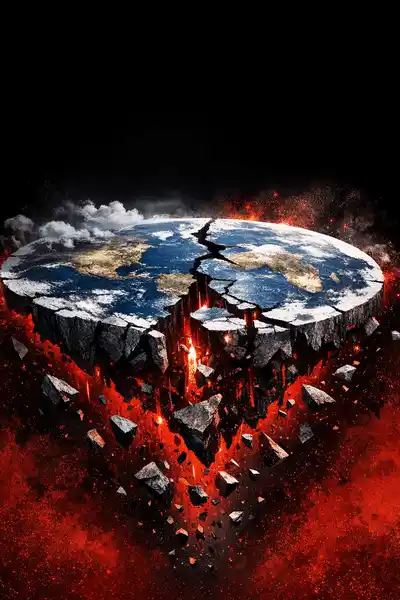
Off the Edge
Flat-earthers and the appeal of dissent
Description
In November 2017, a few hundred people gathered in a Raleigh, North Carolina hotel for the first Flat Earth International Conference. They were software engineers, retirees, welders, YouTubers, a rapper. On stage, speakers walked through their proofs that the world is a disc ringed by an ice wall, that NASA is a fraud, that the sun and moon circle overhead like lamps on a track. In the hallways, people who had spent years being laughed at by their families found others who understood. One attendee told the journalist Kelly Weill, who had come to report on the movement, that finding flat earth was the best thing that ever happened to him. He meant the people, not the geometry.
Weill, a reporter who covers extremism and online conspiracy, spent years among flat-earthers for her book Off the Edge. She expected to find gullibility. What she found was more unsettling: warmth, community, a whole social world built around a claim that any child with a boat and a horizon can disprove. These were not, for the most part, people who could not think. They were people who had decided, often after some private rupture, that the official version of reality could no longer be trusted — and who had found, in that refusal, both a tribe and a purpose.
The temptation is to treat flat earth as a story about stupidity, or about the internet breaking people's brains. Weill's reporting resists both. The belief is old, older than YouTube, and its believers are ordinary. What draws them in is rarely the shape of the planet at all. It is something the shape of the planet stands in for — a way of belonging, of mattering, of being right when the world has told you that you are not.
The question we’re asking : Why would anyone hold a belief they can watch reality contradict — and what does the belief actually give them?What we’ll see : An inside report on a modern fringe movement, its unlikely nineteenth-century roots, and the machinery of doubt that keeps pulling people in.
Table of contents
01 Chapter 1 — The convention that felt like a homecoming
The Raleigh conference is the scene Weill keeps returning to, because it is where the movement stops being an abstraction and becomes a room full of people. The vendors sold T-shirts and models of the disc. The talks ranged from earnest attempts at physics to full-blown claims about a global cover-up. And threading through all of it was a mood she did not expect: relief. For many attendees, this was the first time they had said out loud, to strangers who nodded along, the thing that had cost them friends and marriages.
That is the detail that reorganizes the whole story. Flat earth is not, for most of its adherents, a lonely obsession pursued in a basement. It is a social identity. People described the same arc again and again — a period of watching videos, a growing conviction, and then the slow loss of everyone in their old life who thought they had gone insane. The movement filled the hole those losses left. It offered new friends, a shared language, inside jokes, a sense of being awake among the sleeping.

02 Chapter 2 — How a 19th-century con man drew the map
The modern flat earth did not begin online. It begins, in Weill's telling, with a Victorian Englishman named Samuel Rowbotham, who in the 1830s and after went by the pseudonym "Parallax." Rowbotham built a public career out of insisting the earth was a flat plane centered on the North Pole, ringed by ice, with the sun a small local light. He staged experiments, most famously along a straight six-mile stretch of water called the Bedford Level, and toured the country as a showman-lecturer, out-talking anyone who challenged him.
Rowbotham was, by most accounts, part genuine believer and part hustler — a man who sold quack medicines under other names and knew how to work a crowd. His system, which he called Zetetic Astronomy, dressed up the claim in the language of pure observation: trust only what your own senses report, never what authorities tell you. It is a seductive pitch, and it is essentially the same pitch flat-earthers make today. See for yourself. Don't take their word for it.
03 Chapter 3 — The pipeline runs on doubt, not physics
The engine of the modern revival, Weill reports, was YouTube. Around the mid-2010s, the platform's recommendation system began serving flat-earth videos to people who had come looking for something adjacent — chemtrails, faked moon landings, questions about NASA. One video led to another, and another, each confirming the last, until a curious viewer had spent dozens of hours inside a sealed world of mutually reinforcing content. Interviewed at conventions, believer after believer named the same origin: a video, and then the algorithm that kept feeding them more.
The genius of the content is that it never leads with the wild claim. It leads with a question. Why does the horizon look flat? Why can't you feel the earth spinning? Why would you trust NASA, an agency with every reason to lie? None of these questions requires you to believe anything yet. They only require you to distrust — and distrust, once activated, is easy to extend. If they lied about that, what else? The flat earth is the destination, but doubt is the road, and the road is open to anyone with a grievance against experts.
04 Chapter 4 — Why belonging beats the horizon
Step back from the ice wall and the same shape appears in movements that have nothing to do with the earth. The people Weill met did not fall for flat earth because they were uniquely foolish; they fell for it because it answered needs that mere facts cannot touch. It gave them a story in which they were the heroes — the awake few who had seen through the lie. It gave them enemies grand enough to explain their disappointments. And it gave them, above all, a place to belong.
This is the uncomfortable core of her reporting. We tend to imagine that conspiracy belief is a problem of information: people have the wrong facts, so give them the right ones and they will come around. But information was never the currency. The flat-earther who loses his family and finds a convention full of new friends has made a trade that, on his own terms, improved his life. Correcting his geometry offers him nothing to replace what the belief provides. You cannot argue someone out of a community.
05 Conclusion
The man in the Raleigh hallway who called flat earth the best thing that ever happened to him was, in a sense, telling the truth. Not about the planet — the planet is round, and he could confirm it with a long enough drive down a coast. But about his life, he was being honest. Before the belief, he had been unremarkable and largely unheard. After it, he had comrades, a mission, and the conviction that he mattered. The geometry was the price of admission to something he wanted much more.
Related books