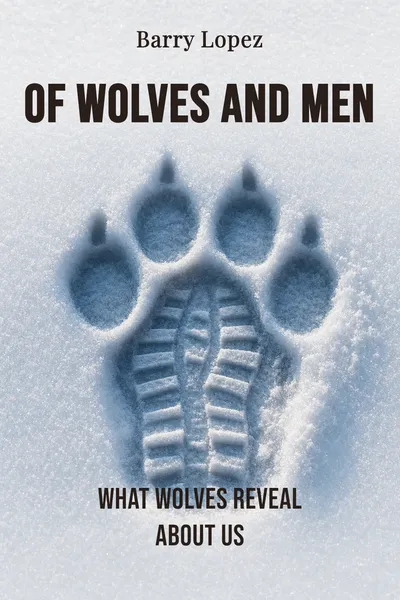
Of Wolves and Men
What wolves reveal about us
Description
In the mid-1970s, Barry Lopez spent stretches of time in Alaska and Minnesota watching wolves — living near a captive pair, tracking wild packs across snow, talking to biologists who had spent careers on the animal. He came away with a book, published in 1978, that refuses to do the one thing a book about wolves is supposed to do. It does not tell us what the wolf is. It tells us, patiently and with unusual care, that we have almost never been talking about the wolf at all.
The animal Lopez found in the field was a social creature of startling subtlety — a hunter that fails far more often than it succeeds, a pack member bound by loyalty and ritual, an animal that seems to negotiate with the moose and caribou it stalks before deciding whether to give chase. The animal he found in books, laws, folktales and bounty records was something else entirely: a slavering devil, a coward, a baby-stealer, a symbol of everything a frightened civilization wanted to place outside its walls. The gap between the two is the whole subject.
Lopez, who died in 2020, was a nature writer with the instincts of a moral philosopher. Of Wolves and Men braids biology, Inuit and Native testimony, medieval history and his own fieldwork into something that keeps circling back to a single unease. We have hunted this animal to the edge of extinction across most of its old range, and we did it, he suggests, less for what it did than for what it meant to us.
The question we’re asking : Why have humans spent centuries hating an animal they barely bothered to observe?What we’ll see : How Lopez sets the living wolf against the imaginary one, and follows that gap all the way to the bounty gun and back to ourselves.
Table of contents
01 Chapter 1 — The animal science can describe
Start with what can actually be observed, because Lopez is careful to. A wolf pack is a family — usually a breeding pair and their offspring across a few years, not the ranked army of popular imagination. The relationships inside it run on gesture and restraint: the tail carried high or tucked, the muzzle nudged, the elaborate greeting when a hunter returns. Lopez watched this in captivity and in the wild, and what strikes him is how much of pack life is communication rather than domination, a constant tuning of who is at ease with whom.
The hunt undoes most of what we assume. Wolves are not efficient killers. They test far more animals than they take, and they lose most of the encounters they start — a healthy moose can simply stand its ground and win. Lopez describes something he calls the conversation of death: a moment when predator and prey seem to lock eyes and take each other's measure, and the wolves, reading some signal of strength or resolve, turn away. The animal that gets caught is often the old, the sick, the young, the one that runs when it should have stood.

02 Chapter 2 — The wolf we invented instead
The wolf of Western imagination is a different beast, and Lopez traces where it came from. Medieval Europe, plague-ridden and forested, made the wolf a figure of dread — the eater at the edge of the village, the shape a witch or a damned soul might take. The werewolf trials were real: people were tried and executed for supposedly becoming wolves and killing under a full moon. The fairy tales that survive, the grandmother-devourer of Red Riding Hood, are the polished remains of a much larger machinery of fear.
Lopez's point is not that these fears were baseless in every case. He takes seriously the accounts of wolves that killed people, and he refuses the easy modern reflex of pretending it never happened. But he shows how thoroughly the fear outran the facts — how the wolf became a container for whatever a culture most needed to expel. Greed, lust, savagery, the wilderness itself: all of it got poured into the animal until the animal disappeared beneath its symbolism.
03 Chapter 3 — Killing a thing we made up
The story became policy, and the policy became a slaughter. As European settlement spread across North America, the wolf was marked for elimination with a thoroughness that Lopez documents in cold detail. Bounties were paid territory by territory. By the twentieth century the campaign had become systematic — trapping, shooting, and above all poison, strychnine laced into carcasses and scattered across the land, killing not only wolves but eagles, foxes, and anything else that fed on the bait.
What Lopez lingers on is the tone of the killing. This was not the wary defense of livestock a rancher might mount; it carried a moral fury out of all proportion to any damage a wolf could do. Men wrote of the wolf as an enemy to be punished, described killings with something close to relish, invented cruelties — wolves set on fire, wolves left crippled — that no economic account can explain. The animal was being punished for what it represented, for standing in as wilderness itself while the continent was being tamed.
04 Chapter 4 — The mirror in the tracks
The real subject of the book, it turns out, was never only the wolf. Lopez is interested in what the wolf reveals about the animal doing the looking. Whenever we confront a creature complex enough to resist us, we seem to reach for a story instead of a description — we make the animal a screen, and then we react to the projection as though it were the beast. The wolf simply happens to be the clearest case, an animal onto which the West poured its darkest self-image for a thousand years.
That habit has a cost beyond the wolf. When we replace an animal with a symbol, we lose the ability to see it, and losing the ability to see is the first step toward feeling free to destroy. The bounty hunter and the fairy tale are not separate phenomena in Lopez's account; they are the same act at different scales. The poison follows from the story as naturally as a conclusion follows from a premise, once the animal has been emptied of its own reality.
05 Conclusion
Lopez ends where he began, with the living animal rather than the idea of it — the wolf on the ridge, watching a herd it will mostly fail to catch, bound to a family by rituals we can observe but not quite enter. Between that creature and the devil of the fairy tales lies the whole distance the book has traveled. The wolf never asked to carry our fears; we loaded them onto it because it was large enough, wild enough, and near enough to serve. The tragedy is that the burden was invisible to us, mistaken for a fact about the animal.
Related books