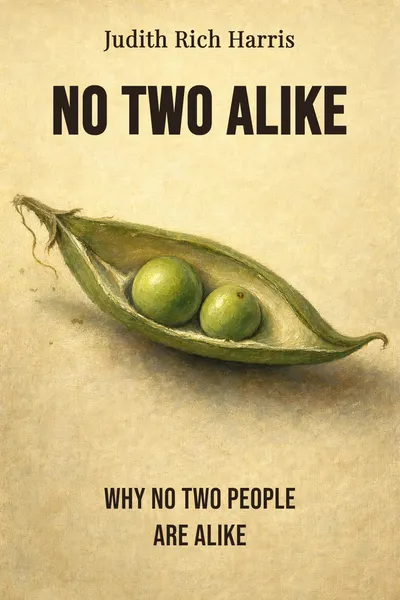
No Two Alike
Why no two people are alike
Description
In 1998, a former textbook writer with no university post and no laboratory published a book arguing that parents have far less influence on how their children turn out than almost everyone assumed. The book was The Nurture Assumption, and its author was Judith Rich Harris — decades earlier, she had been dismissed from a Harvard psychology PhD program, a fact she recounted with some relish. The reaction was loud. Reviewers were scandalized, talk shows called, and Steven Pinker wrote an admiring foreword. Then, in 2006, Harris returned with a second book that pushed the question further and made it stranger.
The first book had said what does not shape personality. The second, No Two Alike, tried to say what does. Its starting point is a fact so ordinary we rarely register how odd it is: identical twins, with the same genes, raised in the same house by the same parents, eating the same dinners, still grow into recognizably different people. One is bolder, one more anxious. One leads, one follows. If genes and home don't account for that gap, what does? Harris spent years chasing that question, and she was writing it while seriously ill, working from her house in New Jersey.
What makes her attempt worth following is that she refuses the two answers everyone reaches for first, and then refuses to leave a comfortable blank where an answer should be. She wanted a mechanism — something the mind actually does that produces the differences we see. She was, by her own cheerful admission, an amateur picking a fight with the professionals. She turned out to be a very well-read amateur with a specific idea about where uniqueness comes from.
The question we’re asking : If genes and upbringing don't explain why two people with the same start turn out different, what does?What we’ll see : How Harris took apart the standard explanations of personality and built her own account of where individual character actually comes from.
Table of contents
01Chapter 1 — The puzzle identical twins won't stop posing
Behavioral genetics had, by the 1990s, produced one of the more robust findings in all of psychology, and Harris took it seriously rather than dismissing it. Study after study of twins and adoptees showed that personality traits are substantially heritable — roughly half the variation between people, give or take, traces to genes. That leaves the other half to something else, usually filed under environment. The intuitive assumption was that this other half meant the home: the parents, the household mood, the way you were raised. Harris's earlier work had already dented that assumption. This book started from the wreckage.
Here is where the data get genuinely uncomfortable. When researchers separated environmental influence into what siblings share — the same parents, the same house, the same neighborhood — and what they don't, the shared part came out close to zero for most personality traits. Growing up in the same family made siblings barely more alike in temperament than children pulled at random from the population. The environment that mattered was the non-shared kind, the part each child experiences alone. But nobody could say what it was. It sat in the equations as a large, unexplained residual.

02Chapter 2 — Where the usual answers run out of road
The first casualty is the birth-order theory, the folk-psychology staple that firstborns are responsible and driven while later children are rebels or charmers. It feels true because families narrate themselves that way. But Harris marshalled the studies showing that when you measure personality outside the family — how people actually behave with friends, colleagues, strangers — birth-order effects mostly vanish. They show up when siblings rate each other, or when people describe how they act at home, and evaporate everywhere else. The effect isn't a personality difference. It's a role people play within one particular household.
That distinction becomes the hinge of her argument. A great deal of what we call personality is context-bound in a way we underestimate. Harris made much of the child of immigrants who speaks the parents' language at home and the local one at school, and ends up sounding like a native only in the second. Nobody thinks the kitchen accent is the real one and the playground accent a mask. Both are learned, in their proper settings. Behavior, she argued, works the same way, and the setting that shapes the durable version is not the home.
03Chapter 3 — The three systems that build a self
Harris's positive proposal is that the mind is not a single machine turning out a personality but a set of specialized systems, each doing a different social job, each capable of arriving at a different answer about the same person. Borrowing from evolutionary psychology, she argued the human social mind is modular, and she isolated three systems that between them do most of the work of making us who we are. Crucially, they can disagree, and that disagreement is part of the point.
The first is a relationship system, which keeps a mental dossier on every individual we know — who they are, how they treat us, what to expect. This is the system that lets a child behave one way with a doting grandmother and another with a strict teacher. The second is a socialization system, which is not about individuals at all but about groups. Children work out which category they belong to — the kids, the boys, the newcomers — and then adjust their behavior to fit that group's norms. This, Harris said, is where culture is transmitted, and it happens through peers, not parents. It is why the immigrant child ends up sounding like the other children, not the mother.
04Chapter 4 — How much of a person is left to chance
The deepest implication of Harris's account is that a self is not a fixed thing waiting to be explained by its inputs. It is something assembled, in real time, by a mind running several social programs at once — and assembly of that kind is exposed to accident at every step. This is a quietly radical revision of how we usually think about character. We treat a person's nature as the sum of what they were born with and what was done to them. Harris's picture leaves a large, irreducible role for contingency, for the particular tumble of encounters through which a status niche gets claimed or lost.
Consider what the status system implies. Whether a child ends up the leader or the watcher can turn on something as trivial as who happened to speak first, or which classmate they were seated beside in the year the group formed. There is no gene for that and no parenting choice behind it. It is the kind of small, unrepeatable event that a twin study can never capture, which is precisely why the non-shared environment stayed invisible for so long. The differences are real and stable, but their sources may be too fine-grained and too path-dependent to measure.
05Conclusion
Harris finished No Two Alike as an outsider to the end — no faculty position, no research team, working through chronic illness in a suburban house, arguing with a discipline that had never quite let her in. She died in 2018. The status-system theory she proposed has not been adopted wholesale by psychology, and parts of it remain speculative; she was, after all, building a mechanism to fill a gap the professionals had left blank rather than reporting a settled result. But she had refused the two easy answers and named a real problem clearly enough that it could no longer be waved away as noise.
Related books