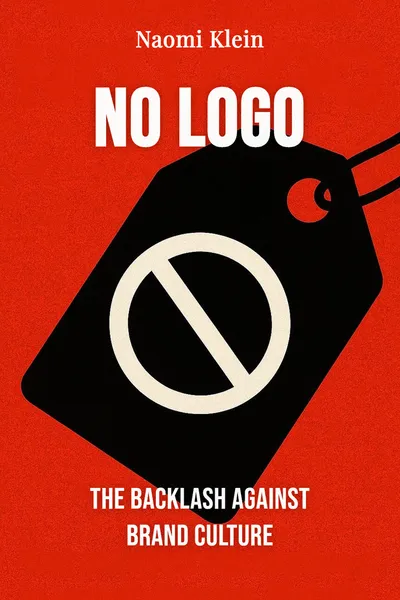
No Logo
The backlash against brand culture
Description
Sometime in the mid-1990s, a phrase started circulating in the executive suites of American consumer companies: the smartest thing a corporation could do was stop making things. Nike didn't need to own the factories that stitched its shoes. Tommy Hilfiger barely touched a sewing machine. What these companies owned, and poured their budgets into, was something less tangible — a logo, an attitude, a feeling attached to a swoosh or a set of initials. Naomi Klein, a Canadian journalist reporting from that decade, watched this quietly become the organizing logic of the whole economy, and in 1999 she published the book that named it: "No Logo."
The timing was uncanny. "No Logo" landed within weeks of the Seattle protests against the World Trade Organization in late 1999, and it read like the manifesto that a leaderless movement had been waiting for. It sold across dozens of countries, was translated into more than twenty languages, and turned a working reporter into a reference point for a generation of activists. But the book was not a slogan stretched to four hundred pages. It was reporting — factory floors in the Philippines, teenagers in shopping malls, campus sponsorship deals — assembled into a single argument about what happens when a company decides its product is beside the point.
Klein's wager was that the brand and the product had come apart, and that pulling them apart again — asking who actually made the shoe, and under what conditions — was where the resistance would come from. It's an argument that predates the smartphone, the influencer and the algorithmic feed, and reading it now is a strange experience, because so much of what she described has hardened into the water we swim in.
The question we’re asking : What did companies actually buy when they decided to invest in brands instead of factories, and who ended up paying for it?What we’ll see : How a decade of brand-building met the people it was built on, and the pushback that turned into a movement.
Table of contents
01 Chapter 1 — The company that decided factories were baggage
Klein starts with a shift in corporate thinking that most of us lived through without noticing. For much of the twentieth century, a company was defined by what it manufactured. Its value sat in plants, machines and inventory. Then, roughly through the 1980s and into the 1990s, a new idea took over the boardrooms: the manufacturing was the least valuable part of the operation. What generated loyalty, margin and market share was the brand — the meaning wrapped around the object.
The turning point Klein returns to is a marketing consensus that crystallized in the late 1980s, when companies discovered they could charge far more for identity than for utility. A shoe cost a few dollars to assemble. A shoe that meant something — rebellion, athletic transcendence, belonging — could sell for a hundred and fifty. The logical next step, once you accepted that framing, was to treat the factory itself as dead weight. Why own the messy, capital-heavy, low-margin business of making things when you could contract it out and keep the profitable business of meaning?

02 Chapter 2 — The colonized spaces
If the brand was going to replace the product as the real asset, it needed somewhere to live. Klein's first section, which she titles "No Space," tracks the brand's expansion into every corner of public and private life. A logo that once sat on a package now wanted the whole environment — the school, the street, the movie, the conversation. Marketing budgets swelled through the 1990s not because the products improved but because the branding had to reach further to keep working.
The clearest battleground was the school. Klein documents how cash-strapped American schools in the 1990s signed exclusive deals with soft-drink companies, accepted branded teaching materials, and let corporate sponsors into the one space that had been, in theory, off-limits to selling. Channel One piped advertising into classrooms in exchange for equipment. Universities took sportswear sponsorships that gave a company naming rights over the athletic program. The captive audience of students became, in the brand's logic, an audience like any other.
03 Chapter 3 — Jobs that used to be jobs
The second cost of the brands-not-products model, in Klein's account, was borne by workers on both ends of the supply chain. Her section "No Jobs" follows the labor that the brand economy either sent overseas or hollowed out at home. If a company's value lives in its logo, then the people who make the goods and the people who sell them become interchangeable, disposable, and cheap by design.
At the manufacturing end, Klein reports from export processing zones — industrial enclaves in the Philippines, Indonesia and elsewhere where factories produced goods for Western brands under conditions the brands could disavow. She describes long hours, low pay, suppressed unions and the constant threat that production would simply move if workers organized or a government raised the minimum wage. The zone existed precisely to be deniable: the brand-name company had a contract, not a workforce, and a contract can be canceled.
04 Chapter 4 — The counter-brand
The last movement of the book — "No Logo" itself, the section that gives it its title — is where Klein steps back and asks what all this produced. Her answer is that the brand's greatest strength turned out to be its vulnerability. A company that had staked everything on its image had also made its image the one thing it could not afford to have tarnished. The very deniability that let a brand distance itself from its factories also gave critics a target that couldn't be relocated.
So activists inverted the logic. If a corporation lived by its logo, it could be hurt through its logo. Klein describes the tactics that flowed from this insight: culture jamming that turned ads against themselves, anti-sweatshop campaigns that traced a specific shoe back to a specific factory floor, student movements that shamed universities over their sponsorship deals. Nike, having built the most valuable brand in its category, became the most exposed — every reported abuse in a contractor's plant now attached itself directly to the swoosh. The brand's reach became the channel through which accountability traveled back.
05 Conclusion
The book closes where the decade did, with a movement that believed it had found the soft tissue of global capitalism and knew how to press on it. Klein's factories in the Philippines, her sponsored classrooms, her cool hunters and her McJobs all led to the same conclusion: a company that sells meaning has handed its critics a lever, and by 1999 they had gripped it hard enough to force apparel giants to publish supplier lists and answer for their contractors.
Related books