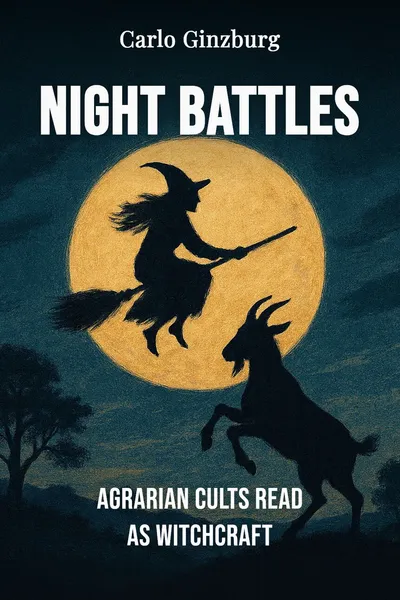
Night Battles
Agrarian cults read as witchcraft
Description
In 1575, in the Friuli region of northeastern Italy, a priest questioning a miller named Paolo Gasparutto heard something that did not fit any category he knew. Gasparutto explained, without much fear, that on certain nights of the year his spirit left his body and went out to fight. He and others like him — the benandanti, the "good walkers" — battled witches in the fields, armed with stalks of fennel while the witches carried sorghum. If the good walkers won, the harvest was saved. If they lost, famine came. He said all this as though describing a duty, not a crime.
The priest sent the case up to the Inquisition, and there it stalled. The inquisitors had a script for what they were hearing: a night flight, a gathering, a battle, spirits leaving bodies. To them, this was the witches' sabbath, and the man in front of them was confessing to devil worship whether he understood it or not. But Gasparutto insisted he was the enemy of witches, sent by God or an angel to defend the crops. He had the story exactly backwards, from the Church's point of view — and he would not let go of it.
Carlo Ginzburg found these trial records in the archive of the Archdiocese of Udine and traced them across more than a century. What he reconstructed was not a story about persecution alone, but about a collision between two ways of understanding the world, one of them slowly bending the other into its own shape until the good walkers came to believe they had been witches all along.
The question we’re asking : What did the benandanti actually believe they were doing, and how did the inquisitors' questions turn a fertility rite into a confession of witchcraft?What we’ll see : A peasant belief surviving in the trial records, and the long, quiet process by which it was overwritten from the outside.
Table of contents
01Chapter 1 — The men who fought for the harvest
The benandanti had one thing in common that set them apart from birth: they had been born with the caul, the amniotic membrane still covering the head. In Friulian peasant culture, this was a sign. A child born with the caul was destined to become a good walker, to be called out on four nights a year — the ember days, tied to the changing of the seasons — to fight for the fertility of the fields. Many kept the dried caul on their bodies as a kind of talisman. The mark was not chosen; it was received.
On those nights, according to what dozens of them told the Inquisition over the decades, their spirits left their sleeping bodies. Sometimes they traveled as animals, sometimes on animals, sometimes simply as absent souls whose bodies lay still and could not be woken. They gathered in the countryside and met the malandanti, the witches, in ritual combat. The weapons were vegetal and specific: the good walkers carried fennel, the witches sorghum stalks. The outcome decided the year. A victory for the fennel meant abundance; a defeat meant the crops would wither and hunger would follow.

02Chapter 2 — The inquisitors who could not hear them
From the first interrogations, the inquisitors and the accused were speaking past each other. The clergy carried in their heads a fully formed theory of the witches' sabbath — the demonological literature of the sixteenth century described exactly this kind of scene: night flights, gatherings, spirits abroad in the dark. When Gasparutto described leaving his body to travel to a field, the inquisitor did not hear a defender of crops. He heard the confession of a man attending the devil's assembly. The details the benandante offered as proof of his goodness were, to the inquisitor, proof of his guilt.
So the questions bent in one direction. The clergy pressed on the points that fit their template and dismissed the ones that did not. If the accused said he fought witches, the inquisitor asked who else was at the gathering, as though a gathering of witch-fighters and a coven were the same event seen from different angles. The benandanti resisted, sometimes stubbornly. Gasparutto at first denied everything, then confirmed the nocturnal battles, then — worn down, frightened, sensing that his version was somehow the wrong one — began to falter.
03Chapter 3 — Fifty years of slow correction
The most striking thing in the archive is not a single trial but the arc across them. Ginzburg followed the cases from the 1570s into the middle of the seventeenth century, and over that span the testimony itself changes. In the early records, the benandanti describe fighting witches, defending harvests, standing on the side of God. In the later records, the same tradition speaks a different language — one closer to the sabbath the inquisitors had been describing all along. The gap between what the peasants said and what the Church expected slowly closed. And it closed from the peasant side.
This is the quiet drama of the book. No mass burnings, no dramatic reversal — the Friulian Inquisition was in fact comparatively mild, and few benandanti suffered severely. What happened instead was slower and stranger. Generation by generation, the good walkers began to describe themselves in the terms their persecutors had supplied. Some later accused of being benandanti confessed, or half-confessed, to attending the devil's sabbath. The self-understanding of the cult migrated toward the accusation. The witch-fighters were becoming witches in their own accounts.
04Chapter 4 — What a translation error reveals
Step back from the fennel and the ember nights, and the benandanti case becomes something larger: a study in how belief survives not by staying the same but by being reclassified. The good walkers were not argued out of their cosmology. They were slowly renamed. And the renaming did most of the work that force alone could not — because once you accept your accuser's word for what you are, the original meaning has nowhere left to live.
This is why Ginzburg treated the trial records with such suspicion and such care at once. The documents are the only window onto the benandanti, and yet the window was built by the very people bending their story. Every question in the archive is leading; every confession is shaped by the categories of the questioner. The historian who wants the peasant voice has to read against the grain — to look for the moments where the accused resist the frame, where the answers do not fit the questions, where a stubborn detail about fennel refuses to become a detail about the devil. Those friction points are where the older belief shows through.
05Conclusion
Paolo Gasparutto began by explaining, almost patiently, that he went out at night to defend the harvest against witches. He believed he served God. Within a few decades, men and women of the same tradition were describing themselves as the very witches he had claimed to fight. Nothing in the fields had changed. What changed was the language available to describe what happened there, and that language came from the people holding the records.
Related books