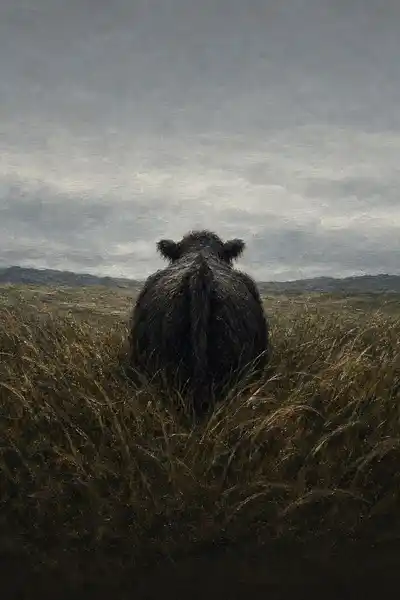
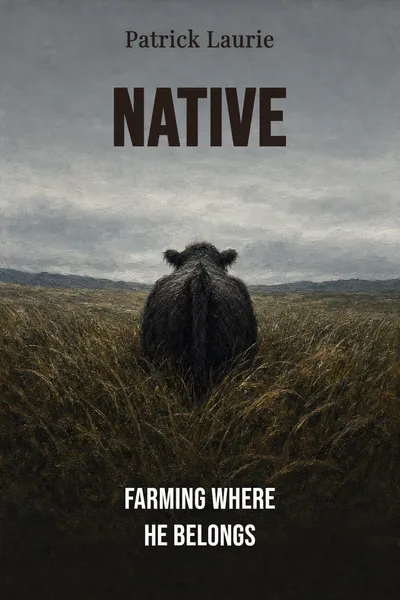
Native
Farming where he belongs
Description
Patrick Laurie grew up in Galloway, the hilly southwest corner of Scotland that most people drive through on the way to somewhere else. It is a place of granite, rushes, and low cloud, farmed hard for centuries and now half-forgotten by the rest of the country. Laurie's family had worked this ground for generations, and by the time he reached his thirties he found himself circling back to it — not out of nostalgia, but with the stubborn conviction that he was meant to be here, doing what people here had always done. He decided to keep cattle. Native breeds, on native land. It sounds simple. It was not.
Native, published in 2020, is the account of that return. It is a farming book, but not the kind that tells you how to make money from livestock — because Laurie's Galloway cattle barely make him any. It is a nature book, but it refuses the comfort of pretty landscapes, because the landscape Laurie loves is emptying out. And it is a book about heritage, written by a man who slowly realises that the traditions he wants to inherit are not sitting in a museum waiting for him. They are dying in real time, in the fields around his house, and the people who could teach him are nearly gone.
Running through all of it is a bird. The curlew — long-billed, mournful-voiced, once so common across these hills that nobody thought to count it. Laurie becomes obsessed with the curlew because he understands, in a way that took him years to articulate, that the bird and the farm and the man are the same story. Lose one, and you have already begun to lose the others.
The question we’re asking : What does it actually take to belong to a place — and can that belonging survive when the way of life that made it is falling apart?What we’ll see : How one man's return to old cattle, a vanishing bird, and a threadbare rural tradition becomes a meditation on the fragile knot between people and land.
Table of contents
01 Chapter 1 — The ground his family walked
Galloway does not sell itself. It has no famous glens, no shortbread-tin mountains, no coachloads of visitors. It is a working country of small hill farms, wet fields, and weather that comes in sideways off the Irish Sea. Laurie is honest about this from the start: he loves a place that most people find bleak, and he loves it partly because it is his. His forebears farmed here, are buried here, left their names on the maps and their walls across the hills. That inheritance is the thing he keeps returning to, testing it like a loose tooth.
But an inheritance of ground is not the same as knowing what to do with it. Laurie describes the awkward gap between feeling that he belongs and having any real skill to justify the feeling. He can point to the family graves. He cannot, at first, calve a cow in the dark or read a field the way the old farmers read it. The land had been continuous in his blood and discontinuous in his hands, and closing that gap becomes the quiet engine of the whole book.

02 Chapter 2 — Cattle as a language
The cattle Laurie chooses are not an accident. Galloway is the birthplace of a hardy, shaggy native breed built for exactly this kind of country — animals that can live outdoors on poor grazing, thrive on rough herbage, and shape the land as they eat. Modern farming had largely pushed such cattle aside in favour of faster, heavier, more profitable breeds fed on richer ground. Laurie goes the other way, on purpose, because for him the old cattle are not just livestock. They are a link back to the way his part of the world used to work.
He writes about them with the attention of someone learning a language he was born too late to speak fluently. There is the daily grammar of feeding and watching, the vocabulary of ailments and moods, the slow accumulation of judgement that lets an experienced stockman know, at a glance, that something is wrong. Laurie is a beginner among the last of the fluent speakers, and he knows it. He seeks out older farmers, listens hard, and tries to absorb knowledge that was never written down because it was always simply passed on, person to person, in the field.
03 Chapter 3 — The bird that measures the land
Then there is the curlew. It is the largest of Europe's wading birds, with a long down-curved bill and a bubbling call that carries across open ground like nothing else. For Laurie, the curlew becomes the measure of everything — the creature whose presence or absence tells him whether the land is still doing what it used to do. In the Galloway of his grandfather's time, curlews were everywhere in spring, nesting in the rough grazing, filling the hills with that liquid, unmistakable sound. Within living memory, they have collapsed.
The reasons are tangled, and Laurie resists easy villains. Some of it is the drainage and improvement of rough ground into tidy, productive fields where the birds cannot nest. Some of it is the spread of commercial forestry, blanketing open hill country with dense conifer plantations that curlews avoid and that shelter the predators which raid their nests. Some of it is simply the wider disappearance of the mixed, marginal, old-fashioned farming that once left room for wild things at its edges. The bird is caught, like the farmer, between an old way that is vanishing and a new way that has no place for it.
04 Chapter 4 — When belonging is work, not birthright
Step back from the cattle and the curlews, and Native is really an argument about what belonging means. Laurie begins with the assumption most of us carry: that belonging to a place is a matter of origin. You are from somewhere, your family is from somewhere, and that fact settles the question. By the end of the book he has quietly dismantled that idea. Being born to Galloway gave him a claim, but the claim was empty until he did the work — until he learned the cattle, walked the ground in every season, failed and tried again, and let the place shape his days and his body. Belonging, in his telling, is not a certificate. It is a practice.
This reframing has bite, because it means belonging can be lost even by people who never left. A landscape can be inherited and yet become foreign, if nobody keeps up the labour and the knowledge that made it legible. Laurie watches this happening across his region: fields that his grandfather would have known intimately, now managed by machines and formulas, farmed by people who no longer speak the old language of the ground. The physical place remains. The belonging drains out of it. That, more than any single extinction, is what he seems to fear.
05 Conclusion
Laurie ends more or less where he began: on wet Galloway ground, with his native cattle around him and the sky waiting for curlews that may or may not come back. Nothing has been solved. The bird is still in trouble, the economics still do not add up, the old farmers are still dying out with their knowledge half-untaught. What has changed is the man. He set out believing he belonged here because his family had, and he arrives at a harder, truer understanding: that belonging is something you keep alive by working at it, and that it can die of neglect as surely as any species.
Related books