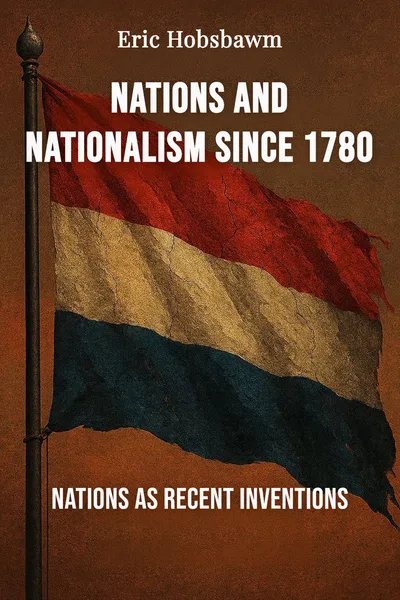
Nations and Nationalism since 1780
Nations as recent inventions
Description
In 1882, the French thinker Ernest Renan stood before an audience at the Sorbonne and made a claim that still unsettles people. Getting your history wrong, he said, is an essential part of being a nation. A century later, a British historian named Eric Hobsbawm took that provocation and turned it into a full argument. His slim book, Nations and Nationalism since 1780, published in 1990, set out to explain something most of us never think to question: where nations actually come from, and how recent they really are.
The intuition we carry around is roughly the opposite of what Hobsbawm found. We tend to assume that France was always French, that a people existed first — bound by language, blood, a shared past — and then, at some point, woke up and demanded a state of its own. The nation feels ancient, natural, almost geological. Hobsbawm spent the book dismantling that feeling, patiently and without much sentiment, tracing how the thing we treat as timeless was in fact assembled, mostly in the nineteenth century, often on purpose.
He was, it should be said, not a neutral observer. A lifelong Marxist writing as the Soviet bloc was collapsing and new nationalisms were flaring across Eastern Europe, he had reasons to be suspicious of the idea that nations were eternal. That timing gives the book its edge. It reads less like a detached survey and more like an argument made by someone watching the phenomenon roar back to life and wanting to explain, calmly, what he thought was really going on underneath it.
The question we’re asking : If nations are so recent, what actually came first — the people or the idea that made them a people?What we’ll see : How a historian reversed the usual story of belonging, and where that leaves an idea that refuses to fade.
Table of contents
01Chapter 1 — The order everyone gets backwards
The whole book turns on a single sentence that Hobsbawm borrows and sharpens. Nationalism, he argues, comes before nations. Not the other way around. Nations do not make states and nationalisms; it is states and nationalisms that make nations. The feeling of belonging to a French or an Italian or a German people is not the raw material from which a movement is built — it is, more often, the product that the movement manufactures once it is already underway.
This sounds like wordplay until you sit with it. The commonsense version runs like this: a nation exists, quietly, for centuries; then it becomes conscious of itself and claims its rights. Hobsbawm flips the sequence. First comes a political project — usually run by intellectuals, officials, or a rising middle class — that decides a nation ought to exist. Then that project goes looking for the language, the folklore, the ancestors, and the borders that will make the claim feel obvious in hindsight.

02Chapter 2 — The state needed citizens, and invented them
If nations follow nationalism, the obvious question is: who was doing the making, and why? A large part of Hobsbawm's answer is the modern state itself. As governments in the nineteenth century grew more ambitious — collecting taxes, conscripting armies, running schools, laying railways — they needed populations that were legible, loyal, and able to talk to one another. A patchwork of local dialects and local loyalties was, from the state's point of view, an administrative problem to be solved.
So the state set about solving it. Take language. In 1861, at Italian unification, only a small fraction of people on the peninsula actually spoke Italian in daily life — estimates put it at a few percent. The rest spoke regional tongues often unintelligible to one another. The famous line attributed to the era's politicians — we have made Italy, now we must make Italians — captures the whole logic. The state existed before the nation, and then had to produce the nation to justify the state.
03Chapter 3 — When ordinary people started to care
A weakness in any top-down story is that it can make nations sound like a trick played on a passive population. Hobsbawm is too good a historian for that. He devotes real attention to the question that keeps his argument honest: when did ordinary people actually start to feel national, and why did the feeling take hold so hard? A project run by elites explains the supply of nationalism. It does not, on its own, explain the demand.
He sketches a rough sequence, borrowing a scheme from the historian Miroslav Hroch. First a small circle of scholars and enthusiasts take a cultural interest in a people — its songs, its grammar, its past. Then a wider group of activists turns that interest into a political campaign. Only in a third phase does the idea reach the mass of the population and become something people will vote for, march for, and fight for. Most of the nineteenth century, in his telling, is spent in the first two phases; the mass phase comes late, often only around 1900 and after.
04Chapter 4 — A concept nobody can quite finish with
Step back from the nineteenth-century detail and a stranger fact comes into view. If the nation is this recent, this assembled, this dependent on schools and censuses and invented anthems, why does it feel so completely natural to almost everyone who lives inside one? Hobsbawm's answer is that the feeling of antiquity is not a bug in nationalism. It is the mechanism. A nation only works if its members forget it was made — if the manufactured past is experienced as simply the past, and the border as simply where the world was always divided.
This is why he returns, near the end, to Renan's uncomfortable line about getting your history wrong. Forgetting is load-bearing. A nation has to misremember its own origins, smoothing over the conquests, the coercions, and the sheer contingency that produced it, because remembering too clearly would expose the joins. The sense of a people stretching back into the mists is precisely the illusion the whole apparatus exists to sustain, and it sustains it remarkably well.
05Conclusion
Hobsbawm set out to reverse a story we tell ourselves without noticing. Nations do not precede nationalism and then awaken to claim their rights; the movement, the state, and the historical uncertainties of the modern world come first, and the nation is what they produce. Language academies, schoolrooms, conscription, censuses, and freshly minted traditions did the assembling, mostly within the last two centuries. That an identity so young should feel so old is not a failure of memory but the very condition on which the whole thing rests.
Related books