

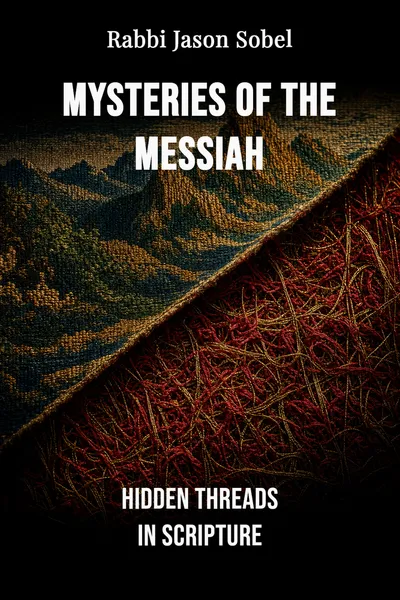
Mysteries of the Messiah
Hidden threads in Scripture
Description
Rabbi Jason Sobel grew up Jewish, spent years searching through Eastern practice and skepticism, and eventually arrived at a conviction that reorganized how he read the book he had known since childhood. In Mysteries of the Messiah, published in 2021, he returns to the Hebrew Scriptures not as a set of moral tales strung along a timeline, but as a single tapestry stitched with recurring threads — names that echo, numbers that rhyme, images that reappear across centuries. His claim is bold and specific: the figure Christians call Jesus and he calls Yeshua is not a late addition bolted onto the Hebrew Bible, but a presence he sees foreshadowed from its opening verses.
The method matters as much as the conclusion. Sobel writes from a Messianic Jewish perspective, which means he reads with two libraries open at once — the rabbinic tradition of Hebrew wordplay, gematria, and midrash, and the Christian conviction that the Messiah has already come. Where a reader of English sees a plain narrative, he sees a language built for layering, where a single word can carry a second story and a genealogy can hide a pattern. The book is an invitation to slow down over passages most of us skim.
What emerges is less an argument than a way of seeing — a habit of noticing connections the surface text keeps quiet. Whether or not we share Sobel's faith commitments, the exercise reframes the question of what a text this old is actually for, and who it was built to reward. We come to it expecting familiar ground and find the floor patterned in ways we hadn't looked at closely.
The question we’re asking : What does Sobel claim is hidden in the Hebrew Scriptures, and what kind of reading is required to see it?What we’ll see : How a Messianic Jewish reading treats the Bible as a woven whole, and what that way of reading offers anyone who opens it.
Table of contents
01Chapter 1 — The friend who reads Hebrew
Sobel's starting move is to insist that the Bible loses something in translation, and not in the vague way people usually mean. Hebrew, he argues, is a language where letters double as numbers, where roots branch into related meanings, and where the sound and shape of a word carry weight the English rendering flattens. Read this way, a verse is not just a statement but a small machine with moving parts. His book is, in large part, an attempt to hand the reader a few of those parts and show how they turn.
Take his treatment of names. In the Hebraic imagination a name is not a label but a destiny, a compressed description of who someone is meant to be. Sobel walks through figures whose names shift at pivotal moments — Abram becomes Abraham, Jacob becomes Israel — and reads the added letters as theology, a signal that the person has been enlarged by an encounter with God. Where a casual reader sees a spelling change, he sees a plot point.

02Chapter 2 — Names, numbers, and the shape of a story
With the tools laid out, Sobel starts pointing at patterns. One of his favorites is the recurrence of certain numbers — seven, twelve, forty — not as decoration but as structural markers that link distant episodes. When a period of forty days in one story rhymes with forty years in another, he reads the echo as intentional, a way the text signals that two moments belong to the same larger movement. The flood, the wilderness, the fasting of later figures all get pulled into one conversation.
He does the same with objects and images. The tree in Eden, the wood of the ark, the staff that becomes a serpent, the bronze serpent lifted in the desert — Sobel treats these recurring physical things as a vocabulary the narrative uses to talk to itself across the gaps. A reader moving chapter by chapter might never connect them. A reader holding the whole book in mind at once, which is how Sobel reads, sees a motif returning under new circumstances, gathering meaning each time.
03Chapter 3 — Genesis was already talking about him
The heart of the book is the claim that the Messiah is not a New Testament arrival but a figure the Hebrew Scriptures have been describing all along. Sobel finds him in the very first verses, reading the opening word of Genesis and the imagery of light, spirit, and creation as already sketching the shape of the redeemer he believes came later. This is where his method becomes most provocative, because it asks the reader to see a specific person prefigured in passages written, by conventional dating, long before that person lived.
He builds the case cumulatively rather than in a single stroke. The near-sacrifice of Isaac on a mountain, the Passover lamb whose blood spares the household, the suffering servant of Isaiah who is wounded for others — Sobel reads these as a series of foreshadowings, each partial, together pointing in one direction. No single episode proves his thesis; the argument lives in the pattern, in the way the images stack and resolve toward a figure who fulfills them all at once.
04Chapter 4 — Reading forward and backward at once
Step back from the specific claims and Sobel's book is really an argument about how a sacred text wants to be read. The dominant modern habit is linear: start at the beginning, move forward, treat each passage as a link in a chain. Sobel reads the other way too, moving backward from later meaning to reinterpret earlier text, and holding the entire book in view so that any verse can illuminate any other. He treats the Bible less as a timeline and more as a room where everything is simultaneously present.
This is not an eccentricity he invented. It is close to how the rabbinic tradition has long read, and how the New Testament authors themselves read the Hebrew Scriptures, finding in older passages a significance the original context did not obviously announce. Sobel's contribution is to make that mode explicit and to hand it to ordinary readers, showing that the patterns become visible only when you stop reading like a report and start reading like a poem — attentive to rhyme, repetition, and return.
05Conclusion
Sobel began as a searcher who left the tradition he was born into and circled back to read it with new eyes, and Mysteries of the Messiah is the record of what those eyes now see. The threads he traces — names that change, numbers that rhyme, images that recur, genealogies that hide sentences — all converge, in his reading, on a single figure the Hebrew Scriptures were describing before he arrived. Whether one accepts that conclusion depends on commitments no book can supply. What the book can do is show the patterns and let the reader stand in front of them.