Mother of God
Into the Amazon's beating heart
Description
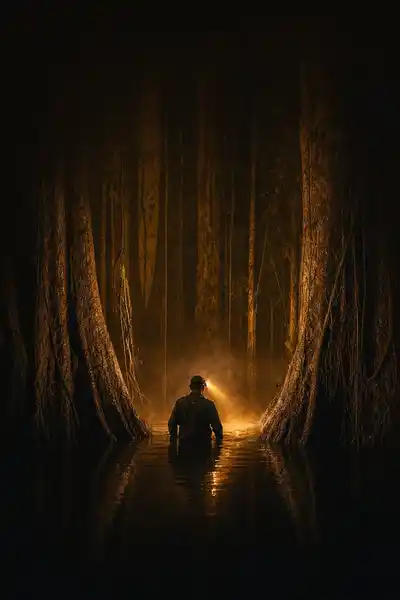
Somewhere in the western Amazon, a young man is standing waist-deep in black water at night, alone, listening. He is not supposed to be there — no guide, no radio, a headlamp and a dwindling sense of where the boat is. Around him the flooded forest breathes: insects, frogs, the occasional heavy splash of something large. This is roughly how Paul Rosolie describes the moments that made him. He first went to the Peruvian Amazon at eighteen, and kept going back until the rainforest stopped being a destination and became the organizing fact of his life. "Mother of God" is the book he wrote about it.
It is a strange hybrid of a book — part coming-of-age memoir, part naturalist's field notebook, part warning. Rosolie is not a detached scientist reporting from a research station. He is a self-taught adventurer who learned the forest by living in it, apprenticing himself to the people and animals that knew it far better than he did. The result reads less like a nature documentary and more like the account of a love affair, complete with the recklessness that love tends to license.
What lifts the book above its own adrenaline is that Rosolie keeps circling back to a harder subject. He arrived to find one of the last genuinely wild places on Earth already under pressure — from loggers, gold miners, roads, the slow arithmetic of a frontier closing in. His encounters with jaguars and anacondas and river dolphins are also, quietly, a running argument about what such a place is worth, and what happens to a person who decides they cannot look away.
The question we’re asking : What does it actually mean to love a wild place — and to try to protect one while it is disappearing?What we’ll see : How a restless teenager turned a river into a vocation, and what the Amazon taught him about wilderness, loss, and the cost of caring.
Table of contents
01 Chapter 1 — A teenager who bought a one-way ticket
Rosolie describes himself as a bad fit for the ordinary track. Growing up in New Jersey, he was the kind of kid who did poorly in a classroom and came alive outdoors, catching snakes and turtles, restless in a way that school could not absorb. By his late teens the restlessness had a direction: the tropics, and specifically the Amazon, which he had read about with the intensity of someone looking for a place to belong rather than a subject to study.
So at eighteen he went. The book's early chapters have the giddy quality of a young person who has escaped, arriving in Peru with little money and less of a plan, drawn upriver into the Madre de Dios region — the name, in Spanish, means Mother of God. He fell in with the researchers and locals working out of a remote field station, and quickly discovered that the forest did not care about his enthusiasm. It was hot, relentless, full of things that bit and stung, and indifferent to whether he thrived or not.

02 Chapter 2 — The floating forest and its pink ghosts
Much of what makes the Amazon feel otherworldly, in Rosolie's telling, comes from water. Every year the rivers rise and spill into the forest, submerging the land for months in what is called the flooded forest, or igapó. Trees stand in meters of dark water; fish swim among their trunks and eat fruit dropped from the canopy. It is a seasonal inversion of everything solid, and it turns the forest into something you navigate by canoe, drifting between crowns that were, a season earlier, well overhead.
It is in this drowned landscape that the book's most haunting characters appear: the Amazon river dolphins, the botos, whose skin flushes a startling pink. They are not the sleek marine dolphins of the open sea. They are strange, almost prehistoric-looking animals, with long snouts and unfused neck vertebrae that let them turn their heads and thread between submerged branches. Rosolie writes about them with genuine awe — intelligent, curious, surfacing near his boat and then vanishing, ghosts of a river that keeps most of its life hidden.
03 Chapter 3 — Las Piedras, and the frontier closing in
As Rosolie's years in the region accumulate, the book's focus tightens onto a particular river: Las Piedras, a tributary running through some of the least-disturbed forest left in the western Amazon. It becomes his heartland — the place he returns to across seasons, the place whose animals and channels he comes to know by name and mood. It is also, he realizes, exactly the kind of place that does not survive being discovered.
The threats he watches move upriver are not abstract. Loggers push in for mahogany and other hardwoods, and where the loggers cut trails, others follow. Gold miners strip riverbanks and leave behind poisoned water and moonscapes of tailings. Roads, once built, do not stay empty; they carry hunters, settlers, and the slow conversion of forest into pasture. Rosolie describes standing on the edge of intact wilderness and watching its boundary retreat, year over year, with the dumb inevitability of a tide.
04 Chapter 4 — What a wild place asks of the people who love it
Step back from the anacondas and the flooded canopy and the book is really about a particular kind of attachment. Rosolie's conservation is not the distant, managerial kind — protected areas administered from a capital city, species tracked as data points. It is the conservation of someone who fell in love with a specific river and could not, afterward, treat its fate as somebody else's file. The whole argument of "Mother of God" is that this is not a weaker basis for protection than science. It may be the necessary one.
That reframing matters because the standard case for saving the Amazon is usually made in planetary abstractions — carbon, biodiversity, the lungs of the Earth. Those are true, and Rosolie uses them. But abstractions rarely move anyone to spend a decade knee-deep in a swamp. What moves people is relationship: knowing an animal, a channel, a season, well enough that its loss registers as grief rather than statistic. Rosolie's wager is that wilderness will be defended by people who know it intimately, or it will not be defended at all.
05 Conclusion
The book ends where it began, on the water, with a young man who never quite managed to leave. Rosolie went to the Amazon at eighteen expecting an adventure and instead acquired an obligation. The pink dolphins surfacing beside his boat, the flooded forest, the river he learned to read like a second language — these stopped being scenery and became the things he organized a life around defending. "Mother of God" is his attempt to hand that attachment to readers who will likely never stand in that black water themselves.
Related books