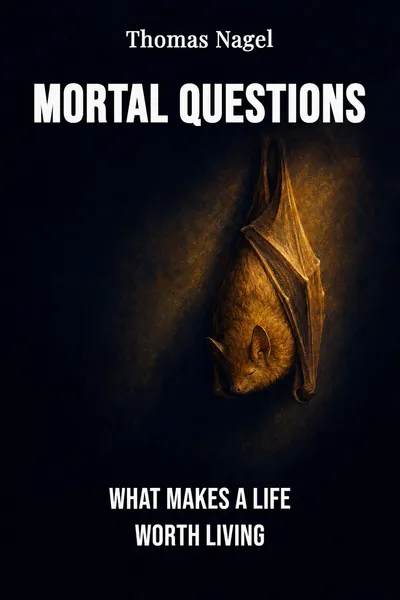
Mortal Questions
What makes a life worth living
Description
In 1979, a philosopher at Princeton named Thomas Nagel gathered fourteen essays into a slim book and gave it a title that sounded more like a confession than an academic work: Mortal Questions. The essays had appeared in journals over the previous decade and, on paper, had almost nothing in common. One asked whether it is bad to die. Another asked what it is like to be a bat. There were pieces on sexual desire, the ethics of war, whether luck should bear on blame, the authority a government holds over its citizens. A reader could be forgiven for thinking the collection had no spine at all.
But the essays hung together in a way Nagel himself only half-planned. Each one begins somewhere ordinary and human — a funeral, a war crime, the feeling of desire, the fear of no longer existing — and each one, followed patiently, opens onto a much stranger question underneath. Why we mind death leads to what a person even is. Why we blame people leads to how much of a self we actually control. The book's method is to refuse the easy exit, to sit with the problem after the comfortable answer has been shown to be too small.
What holds it all together is a single tension Nagel never lets go of: the collision between how the world looks from inside one particular life and how it looks from nowhere in particular. We are each the center of our own existence and, at the same time, one organism among billions on a minor planet. Most philosophy picks a side. Nagel's wager is that the honest thing is to keep both in view at once, even when they will not fit.
The question we’re asking : Why do the everyday things we care about most — dying, desiring, being judged — turn out to rest on questions we can't actually answer?What we’ll see : How a handful of ordinary human worries, followed far enough, run straight into the deepest puzzles about the self, and why Nagel thinks we shouldn't tidy them away.
Table of contents
01 Chapter 1 — Death is a loss even when no one is left to mind it
Nagel opens with the oldest reassurance in philosophy, the one Epicurus offered two thousand years ago: death is nothing to us, because when it comes we are no longer around to suffer it. Where there is death, there is no me; where there is me, there is no death. It is a tidy argument, and Nagel takes it seriously precisely so he can show why it fails to console anyone. If death is bad, it is not bad the way a toothache is bad — as an experience we live through. So the question becomes whether something can harm us without our ever feeling it.
Nagel thinks it plainly can. Consider a man betrayed by friends who keep the secret; he is worse off for the betrayal even if he dies never knowing. Consider a brilliant adult reduced by brain injury to the contentment of an infant — we say something terrible has happened, though the person himself is perfectly happy. Harm is not always a matter of what gets registered in experience. It can consist in the gap between the life a person had and the life they might have had. Death is the deprivation of all the goods a continued life would have contained.

02 Chapter 2 — The subjective character of experience
The book's most famous essay asks a question that sounds almost like a joke: what is it like to be a bat? Nagel is entirely serious. A bat navigates the world by echolocation, building a picture of its surroundings from reflected sound. There is, presumably, something it is like to be that creature, some way the world seems from inside its experience. And here is the trouble: no amount of information about the bat's brain, its neurons, its wiring, tells us what that inner life is like. We could know every physical fact about the animal and still have no idea what it is like to be one.
Nagel uses the bat because it is alien enough to make the point unavoidable, but the point is about us. Consciousness has a subjective character — there is a particular way things feel and appear from the standpoint of the one having the experience. This first-person quality is real, and yet it slips through the net of objective description that science provides. The physical account is a view from outside that anyone could in principle occupy. Experience is a view from a single place. You cannot get to the second by piling up more of the first.
03 Chapter 3 — Moral luck, or the accidents we get judged for
We like to believe that people can only be blamed for what is within their control. A person is not responsible for the weather, the family they were born into, or what a stranger does. Nagel takes this principle — as reasonable a moral idea as exists — and shows that we do not actually live by it, and probably cannot. He calls the problem moral luck: the way our moral judgments depend, constantly and inescapably, on factors nobody chose.
His examples are ordinary and damning. Two drivers are equally careless; one happens to have a child step into the road, the other does not. The first is a killer, tormented, perhaps prosecuted; the second drives home and forgets it. The only difference is luck, yet we judge them differently and cannot fully talk ourselves out of it. A soldier's virtue or cowardice may never be tested if the war never reaches his town. The Nazi functionary might, in another decade, have been a mild bureaucrat who never harmed anyone. What a person becomes morally depends heavily on circumstances they did not arrange.
04 Chapter 4 — The parts of a person that don't add up
Step back from the individual essays and the same fault line runs through all of them. Death matters because of the future a person loses — but who is that persisting person, and why do their possibilities weigh on us now? Consciousness resists science because it is tied to a single point of view. Responsibility frays because the free agent, seen from outside, dissolves into causes. In each case Nagel arrives at the same wall: the collision between the world as it appears to a subject and the world as described from no place at all. This is what the whole book is finally about, and why he later called the objective standpoint the view from nowhere.
What is unusual is his refusal to pick a winner. The dominant instinct in philosophy, and in the science it admires, is to treat the objective view as the real one and the subjective as a local distortion to be explained away. Nagel resists that move. The objective view is not more true; it is a different truth, one that systematically omits the very things — the feel of experience, the standpoint of the agent, the significance of a particular life — that the questions were about in the first place. To flatten everything into the impersonal is to lose the data the philosophy was meant to account for.
05 Conclusion
The book that looked like fourteen unrelated essays turns out to be one long argument made from many angles. Start anywhere Nagel starts — at a graveside, in a bat's cave, at the wheel of an unlucky car — and follow the thread honestly, and you end at the same seam in the world, where the life lived from inside and the world described from outside meet and fail to close. Death, mind, freedom, value: all cases of the same larger difficulty wearing different clothes.
Related books