Morality
Why morality matters most
Description
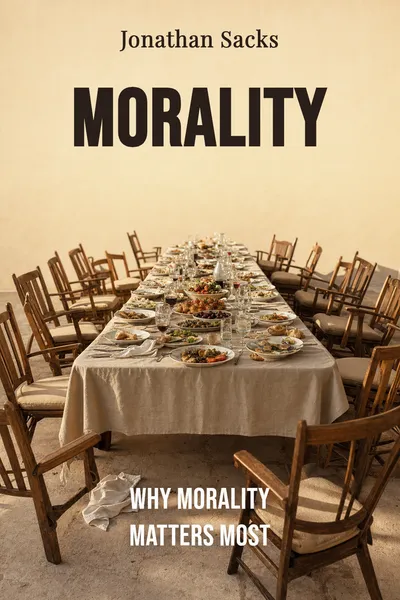
In 2020, a British rabbi who had spent decades as one of the country's most listened-to public voices published a book with a title so plain it almost dared you to look away: Morality. Jonathan Sacks had been Chief Rabbi of the United Hebrew Congregations of the Commonwealth for twenty-two years, a member of the House of Lords, a broadcaster whose Thought for the Day segments reached millions who shared none of his beliefs. He was a man used to speaking across dividing lines. And what he saw, looking out at Western societies in the late 2010s, was a set of lines that had stopped being crossable at all.
The symptoms were everywhere, and Sacks read them as connected rather than separate. Liberal democracies looked fragile. Public argument had curdled into something closer to war. Rates of depression, loneliness, and drug abuse were climbing, especially among the young. Families were fracturing. Trust in institutions was draining away. The usual response was to treat each of these as its own problem, with its own policy fix. Sacks proposed something less comfortable: that they were branches of a single root — the quiet abandonment of a shared moral code, a common sense of what we owe one another beyond what the law requires.
His diagnosis cut against the grain of an age that prizes personal freedom above almost everything. We had come to treat morality as a matter of private taste, something each of us decides alone. Sacks thought this sounded like liberation and worked like isolation. A society that can no longer say "we" — only "I" — has, he argued, lost the very thing that lets freedom survive.
The question we’re asking : If we've made morality a private choice, why does its loss feel like a shared crisis — and can anything be rebuilt in common?What we’ll see : How a respected faith leader traces our fractured public life back to a single abandonment, and why he thinks the repair belongs to all of us rather than to any expert.
Table of contents
01Chapter 1 — The word we quietly stopped using
Sacks begins with a distinction that most of us blur. There is morality, and there is the market, and there is the state, and for most of Western history all three coexisted in an uneasy balance. Morality was the domain of the "we" — the shared habits, obligations, and expectations that told people how to treat their neighbors, raise their children, keep their promises. It lived in families, congregations, communities, associations. It was learned less through argument than through belonging. Over the past half-century, he argues, it has thinned almost to nothing.
The thinning was not a decision anyone made. It happened as a by-product of things many people welcomed. The postwar decades brought an extraordinary expansion of individual freedom — freedom from deference, from stifling convention, from being told by others how to live. Sacks does not want to reverse this; he calls himself a friend of liberty. But he notices what came in freedom's wake. As the shared "we" retreated, morality did not disappear. It privatized. Right and wrong became matters each person settled for themselves, with no expectation that anyone else would agree.

02Chapter 2 — How we outsourced the good to the market and the state
If morality retreated, something had to fill the space. Sacks's answer is that two great systems rushed in: the market and the state. Both are formidable, both have delivered real goods, and neither can do the job that morality once did. The market is superb at generating wealth and coordinating the wants of strangers. The state is superb at maintaining order and providing what markets neglect. But between them they cover only two of the three questions a society must answer, and they leave the third one homeless.
The market answers "what do I want?" It runs on choice and self-interest, and it is astonishingly good at satisfying preferences. The state answers "what does the law require?" It runs on power and rules, and it is good at setting limits. Neither answers the question Sacks thinks matters most: "what should we do, together, because it is right?" That question belongs to morality, and it cannot be reduced to a transaction or a regulation. You cannot buy a good marriage or legislate a generous neighbor.
03Chapter 3 — From we to I, and what it cost us
To show that this drift is neither inevitable nor natural, Sacks takes the long view. He walks from ancient Athens to the biblical world to the Enlightenment, tracing a slow migration in the center of moral gravity — from the community to the individual. The Greeks and the Hebrew prophets, for all their differences, assumed that a person was formed within a people and answerable to it. Virtue was something you practiced in company. The self was embedded, not sovereign.
The modern turn, which he locates gathering force from the seventeenth century onward, made the individual the starting point. Rights came before duties. Autonomy became the highest value. This was a genuine achievement — it underwrites much of what we rightly cherish, from human dignity to freedom of conscience. But Sacks argues that a culture built entirely on the "I" eventually forgets how to sustain the "we" that made the "I" possible. Rights need a moral community willing to honor them. Autonomy needs people raised to use it well. Neither generates itself.
04Chapter 4 — A morality nobody owns because everybody does
Step back from the individual symptoms and Sacks's larger claim comes into focus. Morality is not a private possession, a personal creed you keep in a drawer and consult when convenient. Nor is it a system that can be delegated to experts, encoded in law, or engineered through incentives. It is closer to a language — something that exists only because a community keeps speaking it, and that dies when people stop. This is why the crisis feels shared even though we each experience it alone. A language nobody uses together is a language that decays for everyone.
That framing changes where responsibility lies. If morality were a technical problem, we could wait for governments or philosophers to solve it. But if it is a shared practice sustained by ordinary conduct, no expert can restore it and no policy can substitute for it. It is rebuilt, if at all, in the way people actually treat one another — in families that honor commitments, in communities that show up for their vulnerable, in the small daily acts of trust that teach the next generation what "we" means. Sacks locates hope precisely here, in the reach of the ordinary rather than the elite.
05Conclusion
Sacks ends where he began, surveying a fractured landscape — but not despairing at it. Having traced the crisis from ancient Greece through the Enlightenment to a present of toxic argument, fragile democracies, and rising despair, he insists the story is not a decline that must simply run its course. What was built together can be rebuilt together. The market and the state will keep doing what they do well; the missing third element — the shared sense of how we ought to live — has to be recovered by the people who live it. That recovery is slow, unglamorous, and impossible to outsource, which is exactly why he thinks it is within reach.
Related books