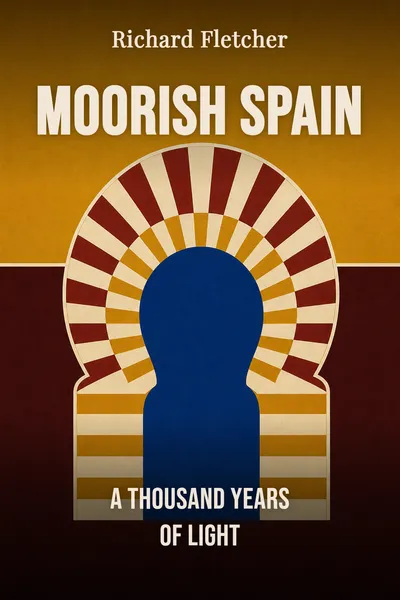
Moorish Spain
A thousand years of light
Description
In the spring of 711, a Berber commander named Tariq ibn Ziyad crossed the narrow strait that separates Africa from Europe and landed near a great rock that would come to carry his name — Jabal Tariq, Gibraltar. He had perhaps seven thousand men. Within a few years, almost the entire Iberian peninsula had passed into Muslim hands, the Visigothic kingdom that had ruled it simply folding under the pressure. There was no grand plan behind it, no long-nursed dream of conquest. It was, as Richard Fletcher tells it, closer to a raid that got wildly out of hand.
What followed was not a single empire that rose and fell on schedule but something far stranger and longer-lived. For close to eight centuries, some corner of Spain answered to Muslim rulers, and the territory they governed — al-Andalus — went through every possible condition a society can go through. It was, at moments, the most cultivated place in Western Europe, a country of libraries and running water and translated Greek philosophy while much of the continent had forgotten how to read those books. At other moments it was a scatter of squabbling petty kings paying protection money to Christian neighbours. Fletcher refuses to flatten any of it.
His "Moorish Spain" is a short book with a long reach, written by a medievalist who distrusts the sentimental versions of this story as much as the hostile ones. He wants the reader to see al-Andalus as it actually was — brilliant and violent, tolerant and cruel, a real place rather than a parable. And he wants us to ask why later centuries have found it so hard to leave the real place alone.
The question we’re asking : How did a Muslim civilization take root in Europe, flower, fracture and vanish — and why do we keep rewriting what it was?What we’ll see : We follow al-Andalus from an accidental invasion to its cultural peak, through its slow political disintegration, and into the contested memory it left behind.
Table of contents
01Chapter 1 — 711 and the accidental conquest
The Spain that Tariq walked into was already coming apart. The Visigoths who had ruled since the collapse of Roman authority were a small warrior elite governing a much larger population, and their crown was a prize fought over by rival factions. When Tariq's army defeated King Roderic — probably somewhere in the south, though even the battle site is uncertain — there was no cohesive state left to organize resistance. Cities surrendered on terms. Local lords cut deals. Fletcher is careful here: this was less a war of religion than an opportunistic collapse, the sort of thing that happens when a brittle regime meets a mobile army at exactly the wrong moment.
The conquerors themselves were a mixed lot, and Fletcher never lets us forget it. The commanders were Arabs from the recently expanded Umayyad world; the rank and file were largely Berbers from North Africa, newly and sometimes loosely Muslim, with their own grievances. Tensions between Arab and Berber, between different Arab clans, between the men who arrived first and those who came later, would shape al-Andalus for centuries. The invasion was not the arrival of a monolith. It was the arrival of a coalition that spent much of its energy arguing with itself.

02Chapter 2 — Córdoba at its height
Under Abd al-Rahman and his successors, Córdoba became the heart of the new state, and over two centuries it grew into something Europe had not seen since antiquity. Estimates of its population vary wildly and Fletcher treats the largest with suspicion, but by the tenth century it was among the great cities of the world — paved and lit streets, public baths, a water supply, markets thick with goods from across the Mediterranean and beyond. The Great Mosque, its forest of striped arches still standing today, announced a civilization confident enough to build for the ages.
In 929 the ruler Abd al-Rahman III took a step his predecessors had avoided: he declared himself caliph, claiming the highest title in Islam and asserting that al-Andalus answered to no one. The caliphate of Córdoba, at its zenith, was a machine of remarkable sophistication — a salaried bureaucracy, a professional army stiffened with slave soldiers and mercenaries, a diplomacy that received envoys from Byzantium and the German emperor alike. The court cultivated poetry, music, astronomy, medicine. The caliph's library was said to run to hundreds of thousands of volumes, a figure Fletcher again handles gently but which points to something real.
03Chapter 3 — The kingdoms that could not hold
The caliphate that looked so solid did not survive its own success. After the death of the great chamberlain al-Mansur, who had dominated the state and terrorized the Christian north with almost annual campaigns around the year 1000, the central authority disintegrated with startling speed. Civil war tore Córdoba apart, and by the 1030s the caliphate had formally dissolved. In its place rose the taifa kingdoms — dozens of small principalities, each ruled from a city like Seville, Granada, Toledo or Zaragoza, each jealous of its neighbours.
The taifa period is one Fletcher clearly relishes, because it complicates every neat story. These little courts were often exquisitely cultivated, patronizing poets and philosophers with a lavishness that outshone the caliphate. But they were also militarily weak and endlessly divided, and their divisions were an opening the Christian kingdoms of the north were learning to exploit. Alliances crossed the religious line constantly: a Muslim king would hire Christian troops against a Muslim rival, a Christian lord would take a taifa's money to leave it alone. The most famous mercenary of the age, the Castilian warlord known as El Cid, fought for and against both sides as opportunity dictated.
04Chapter 4 — The long afterlife of a myth
That last state was the Emirate of Granada, and it endured, improbably, for another two and a half centuries as a tributary of Castile, its rulers building the Alhambra as a final flowering of Andalusi art. It fell on the second of January, 1492, when the last emir, Muhammad XII, handed the keys to Ferdinand and Isabella. The same year the monarchs expelled the Jews; a decade later the Muslims of Granada, promised toleration, faced forced conversion, and their descendants were expelled outright in the early seventeenth century. The thousand years ended not in a battle but in a series of edicts.
What Fletcher spends his final pages on is not the ruins but the memory — because al-Andalus has proven irresistible to people who want it to mean something. For one modern tradition it is a lost paradise of convivencia, three faiths living in creative harmony, a rebuke to every later intolerance. For another it is proof that coexistence was always a fiction masking domination and decline. Fletcher, a working historian, distrusts both. He shows the daily reality as neither idyll nor nightmare but something harder to slogan: a hierarchical society where minorities were tolerated within limits that could and did tighten violently.
05Conclusion
From Tariq's landing at Gibraltar to Muhammad XII surrendering the keys of Granada, the story spans very nearly eight centuries — long enough that no single word can carry it. Fletcher's achievement is to keep the whole arc in view without smoothing its texture: the accidental invasion, the refugee prince who built a kingdom, the caliphate that dazzled and then dissolved, the little courts, the Moroccan rescues that became annexations, the slow Christian advance, and the edicts that closed the door.
Related books