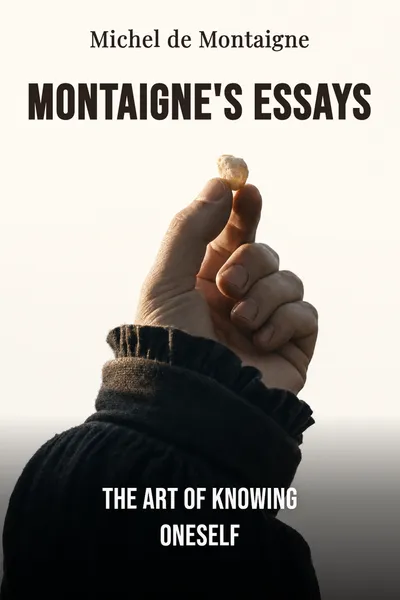
Montaigne's Essays
The art of knowing oneself
Description
Sometime around 1571, at the age of thirty-eight, a nobleman from the Bordeaux region withdrew from public life, climbed to a tower on his family estate, and decided to write about the only subject he felt he knew even slightly: himself. Michel de Montaigne had served as a magistrate, buried a beloved friend, and grown tired of the noise of the law courts. In the round library at the top of his tower, surrounded by roughly a thousand books and beams carved with Latin maxims, he began jotting down whatever crossed his mind. He called these pieces essais — attempts, trials, tries. The word had never been used that way before.
What came out over the next twenty years was strange and unclassifiable. Montaigne wandered from the education of children to the taste of melons, from ancient battles to his own kidney stones, from cannibals in the New World to the way he preferred to ride a horse. He quoted Seneca and Plutarch constantly, then contradicted them just as readily. He revised the text endlessly, adding layers rather than tidying, so that a single page might hold three versions of himself arguing across thirty years. The result, published first in 1580 and expanded until his death in 1592, was a book with no real precedent — and it invented a form we still use every day.
The wager underneath all this was quietly radical. Montaigne assumed that one ordinary, honest mind, watched closely enough, could tell us something true about being human. Not a saint's mind, not a philosopher's system — just a man noticing how he changes his opinions between morning and evening. Four and a half centuries later, in an age that rewards confident opinions and finished selves, that assumption still feels almost countercultural.
The question we’re asking : How does a man make a whole book out of watching himself, and why has it outlasted almost everything written to instruct us?What we’ll see : How Montaigne turned self-observation into a literary form, what he found when he looked, and why the search itself mattered more than any answer.
Table of contents
01 Chapter 1 — A man who put himself on the page
Montaigne warned readers upfront, in a short note titled "To the Reader," that he was the matter of his own book. He meant it more literally than anyone had before. Autobiographies existed — confessions, memoirs of great deeds — but they told a life as a story with a shape. Montaigne did something odder: he recorded a mind in motion, thought by thought, contradiction by contradiction, without pretending the pieces added up.
The trigger, in part, was grief. In his late twenties he had formed an intense friendship with Étienne de La Boétie, a fellow magistrate and writer, and when La Boétie died of the plague in 1563 Montaigne lost the one person he felt had truly known him. His famous line about that friendship — that if pressed to explain it, he could only say "because it was he, because it was I" — carries the whole loss in it. Writing became, in a sense, a way of continuing a conversation that death had cut short.

02 Chapter 2 — The subject that never sits still
The trouble Montaigne kept running into was that the self he was trying to describe would not hold still long enough to be painted. "I cannot keep my subject still," he admitted. "I do not portray being; I portray passing." He noticed that he held opposite views at different hours, that yesterday's certainty embarrassed today's, that he was brave and cowardly, generous and mean, depending on the moment. Most writers would have hidden this. Montaigne made it the discovery.
This is where his skepticism does its real work. His motto, stamped on a medal he had made, was a question: "Que sais-je?" — What do I know? He was fascinated by how little any of us can be sure of, and by how confidently we all behave anyway. In his longest and most searching essay, the defense of the theologian Raymond Sebond, he dismantles human pretensions to knowledge with an almost dizzying patience, arguing that reason is a slippery tool and that we mistake habit for truth constantly.
03 Chapter 3 — Reading, dying, and other ways to live
For all his wandering, Montaigne kept circling back to a handful of durable questions, and the most persistent was death. Following the Stoics, he opened by arguing that to philosophize is to learn how to die — that we should keep death always in view, rehearse it, strip it of its terror through familiarity. He carried Seneca and Cicero around in his head like a portable defense.
Then, characteristically, he changed his mind on the page. A riding accident, in which he was thrown from his horse and briefly believed himself dying, taught him something the books hadn't: dying, up close, felt oddly peaceful, not the horror he'd braced for. His body seemed to know how to let go on its own. So in the later essays he softens the Stoic drill. Better, he decides, not to obsess over death at all — better to live so fully in the present that death, when it comes, finds us busy planting our cabbages. Peasants, he noted, die more gracefully than scholars.
04 Chapter 4 — A book that refuses to teach
Read enough of the Essays and something unusual sinks in: Montaigne never tells us what to do. This is rarer than it sounds. Most writing about how to live, from his century and ours, comes with instructions — a system, a program, seven habits, a doctrine to adopt. Montaigne offers none. He offers company. He shows you one honest person thinking, and trusts you to do your own thinking alongside him.
That refusal is the quiet radical center of the book, and it's what has let it survive when so much confident wisdom has aged into embarrassment. Systems date. A man admitting he doesn't know, and looking anyway, doesn't. When Montaigne writes that he changes his mind, that he's full of contradictions, that he's ashamed of some things and puzzled by others, we recognize ourselves — not because human nature is fixed, but because the experience of being uncertain and various is exactly what he set out to record.
05 Conclusion
Montaigne kept adding to the Essays until he died in 1592, never smoothing away the older layers, so that the finished book is less a monument than a living record of a man revising himself for two decades in his tower. He never claimed to have arrived anywhere. "What do I know?" remained a question, not a pose. The last essays are the loosest and most at ease, a man who has stopped trying to master death or knowledge and settled for tasting his own life carefully, cabbages and all.
Related books