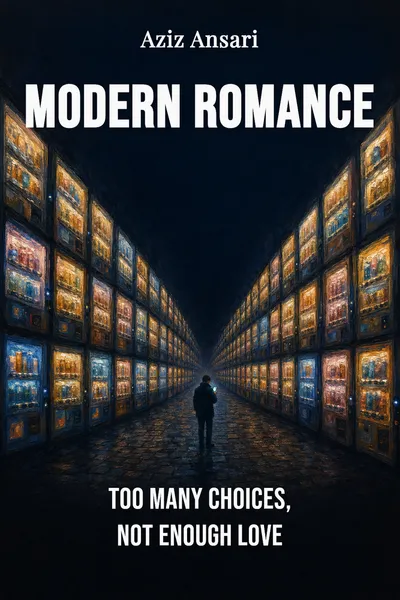
Modern Romance
Too many choices, not enough love
Description
In 2013, the comedian Aziz Ansari found himself staring at his phone, watching a message he'd sent to a woman named Tanya sit unanswered for hours. He'd met her, they'd had a good time, he'd texted something breezy about grabbing a drink. Then nothing. He refreshed. He waited. He drafted and deleted. The small agony of that silence — familiar to almost anyone with a smartphone — struck him as strange enough to investigate. So he did something few comedians do: he teamed up with the sociologist Eric Klinenberg and turned his own romantic confusion into a research project.
The result was Modern Romance, published in 2015. Ansari and Klinenberg ran focus groups from New York to Tokyo, interviewed older couples in retirement homes, mined data from dating sites, and consulted researchers on everything from decision-making to text-message etiquette. What they found was that the way we look for love has changed more in one generation than in all the ones before it combined. The people we now call soulmates, our grandparents would have called neighbors.
And here's the puzzle the book keeps circling. We have more romantic options than any humans who ever lived, and tools of astonishing power to find and filter them. By every logic of the market, we should be happier. Instead a lot of us feel exhausted, anxious, permanently unsure whether the person in front of us is good enough — or whether someone better is one more swipe away.
The question we’re asking : Why does having more romantic choice than ever seem to leave so many people frustrated rather than fulfilled?What we’ll see : How courtship went from a practical arrangement to an open-ended search, and what all that searching quietly does to the people doing it.
Table of contents
01 Chapter 1 — The soulmate our grandparents never looked for
To understand how strange our situation is, Ansari and Klinenberg started with the people who did it differently. When they interviewed residents of a Manhattan retirement community, they kept hearing the same kind of story. People had married someone who lived in their building, or on their block, or a few doors down. One woman had married a man from the same apartment complex. The distances involved were, by our standards, almost comic: a partner found within a radius you could walk in five minutes.
The book leans on older studies of American marriage to sketch what courtship used to be. For much of the twentieth century, marriage was less about finding your one true match than about finding someone suitable, nearby, and ready — and doing it fairly young. The goal was what researchers called a good-enough partner: reliable, from a compatible background, capable of building a household. Romance existed, but it grew inside a practical arrangement rather than preceding it. Marriage was something you did on your way into adult life, not the prize you claimed at the end of a long personal quest.

02 Chapter 2 — When the phone becomes the whole relationship
The most immediate change Ansari examines isn't dating apps but the humble text message. When he polled his live audiences and ran focus groups, the same complaints surfaced everywhere. People agonized over how long to wait before replying. They analyzed punctuation. They screenshotted messages and forwarded them to friends for group interpretation, the way analysts pore over intercepted signals. A single ambiguous text could occupy an afternoon.
The book gives this behavior a name it borrows from psychology: we've turned courtship into a game of managing uncertainty, and the phone is the field it's played on. Ansari describes the particular misery of the 'waiting' — sending something and then watching the silence, unsure if the other person is busy, uninterested, or simply playing the same waiting game back. He and Klinenberg found people deliberately delaying replies not out of disinterest but out of strategy, each side afraid to seem too eager, each convinced that showing enthusiasm first was a kind of surrender.
03 Chapter 3 — The paradox of the endless menu
If texting changed how we talk, online dating changed the size of the pool. Ansari and Klinenberg trace the arc from early sites like Match to the swipe interface of Tinder, and the numbers are staggering. A single person can now scroll past more potential partners in an afternoon than a nineteenth-century villager met in a lifetime. On paper, this is pure gain. In practice, the book argues, abundance carries a hidden tax.
The tax has a name in the research Ansari cites: the tyranny of choice, drawn from work by the psychologist Barry Schwartz and a famous experiment involving jam. Shoppers offered twenty-four varieties of jam were far less likely to buy any than shoppers offered six. Too many options don't liberate us; they paralyze us and, worse, leave us less satisfied with whatever we finally pick, because we can't stop imagining the twenty-three we passed up. Ansari's point is that dating apps are the jam experiment run on human beings — except the jars are people, and the shelf refills itself faster than you can browse.
04 Chapter 4 — What the search itself does to us
Step back from the texts and the apps and a larger pattern in Ansari's reporting comes into view. The problem isn't really the technology. It's what abundance does to desire. When we can sort, filter, and compare romantic partners the way we compare flights or headphones, we quietly import the logic of consumer shopping into a domain that was never built to run on it. And the search stops being a means to an end. It becomes a condition we live in.
Ansari keeps returning to a distinction from decision research: the difference between 'maximizers,' who need to find the absolute best option, and 'satisficers,' who choose something good enough and move on. Modern romance turns nearly all of us into maximizers, because the tools make maximizing feel possible. But love, unlike a purchase, doesn't reward the maximizer. The couples the book most admires — including the older ones in that Manhattan building — didn't find perfect partners. They found decent ones and then built something real over years, which is precisely the thing a maximizer can't do while still browsing.
05 Conclusion
That unanswered text from Tanya, the small torment that launched the whole project, turns out to be the perfect emblem of the book. It's a tiny drama that would have been unimaginable a generation ago, produced entirely by tools that were supposed to make connection easier. Ansari and Klinenberg don't end on despair, though. Their reporting keeps finding people who put the phone down, meet in person, and let a good-enough beginning grow into something the swiping could never deliver.
Related books