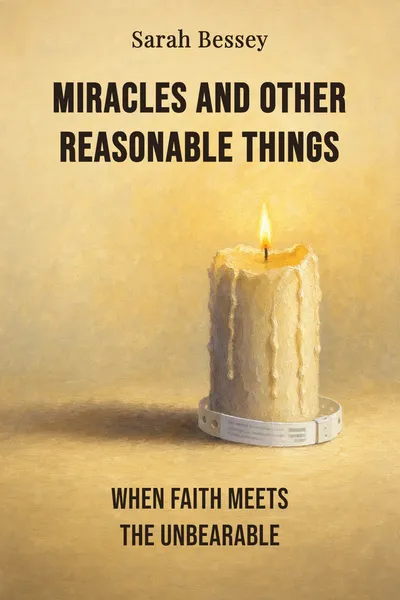
Miracles and Other Reasonable Things
When faith meets the unbearable
Description
In late 2016, on an ordinary highway in Canada, a truck ran a red light and hit the car Sarah Bessey was driving. She was a bestselling author, an in-demand speaker and preacher, a mother of four, married to a man she still calls the love of her life. Her body took the full force of the crash. She survived, and for a while the story looked like it might resolve the way her whole life had seemed to resolve so far: the good woman gets hurt, God shows up, and everything is put back the way it was. That is not what happened. The pain stayed. It became a resident, not a visitor.
Bessey had grown up inside the Word of Faith and prosperity movements, where the arithmetic of belief was simple and load-bearing. Obey God, and blessings follow. Have enough faith, and the healing comes. For most of her adult life the math had checked out — the marriage, the children, the career all seemed to confirm that the preachers of her childhood had been telling the truth. The accident broke the equation and left her holding the pieces. If faith was supposed to protect her, and it hadn't, then either the faith was wrong or God was, and neither answer was one she could live inside.
Out of that collision — the literal one and the theological one — came her most personal book, a memoir written in the trademark voice she'd built a following on: warm, unguarded, allergic to easy answers. It follows her down a long road that runs, improbably, through Rome and a room with the Pope, and lands somewhere she never expected to find God at all.
The question we’re asking : What happens to a faith built on the promise of blessing when the blessing stops coming and the pain stays?What we’ll see : How a car crash dismantled one woman's inherited theology, and what she found in the rubble instead.
Table of contents
01 Chapter 1 — The theology that worked until it didn't
The world Bessey came up in had a name for the arrangement between a believer and God, and the name was more or less transactional. The Word of Faith movement, with its cousin the prosperity gospel, taught that God's favor was legible in your circumstances. Health, money, a thriving family — these weren't lucky breaks, they were dividends. You spoke your faith out loud, you claimed your healing, you sowed and you reaped. Sickness that lingered wasn't just bad news; it was evidence, a quiet accusation that somewhere your belief had come up short. The theology was generous when things went well and brutal when they didn't.
For a long stretch, things went well for her. She married the man she loved, raised four kids, wrote books that people carried around and underlined, stood on stages and preached to rooms that leaned in. She had, by her own account, landed squarely in her sweet spot. And the sweet spot did a quiet thing to her theology: it confirmed it. When your life keeps handing you evidence, you stop noticing that the frame you're using to read the evidence might be the problem. The preachers of her childhood seemed vindicated by the simple fact of her flourishing.

02 Chapter 2 — The accident and the body that stayed broken
The crash itself takes only a sentence to describe and years to absorb. A vehicle came through an intersection and struck her, and the impact did lasting damage to her body — the kind that doesn't announce a finish line. In the weeks and months after, Bessey learned the vocabulary of the chronically injured: the pain that has good days and bad days but no last day, the appointments that stack up, the calendar that reorganizes itself around what the body can and can't do. She was still a mother of four, still a wife, still someone with a career, except now every ordinary act came with a tax she hadn't budgeted for.
The harder injury was to the story she'd been telling herself. She prayed for healing the way she'd been taught to — with expectancy, with the words spoken aloud — and the healing she'd been promised didn't arrive on schedule, or in the shape she'd ordered. This is where the old theology turns cruel, because it hands the sufferer a second wound on top of the first. If faith produces healing, and you aren't healed, the fault must be yours. Bessey names that logic clearly and refuses it, but refusing a thing you were raised on is slow work, and she doesn't pretend it was clean.
03 Chapter 3 — Rome, the Pope, and the Holy Spirit in the wrong room
The road out of that middle place runs, of all directions, toward Rome — and the detour matters, because a good Protestant girl raised in charismatic churches is not supposed to find anything there. Bessey traveled to Italy as part of a small gathering and ended up, through a chain of events she describes as complicated, in the presence of Pope Francis. She's clear-eyed about the whole thing: she's not Catholic, she carries her own history with institutional religion, and she's wary of turning a brush with a famous man into a spiritual souvenir. The encounter isn't offered as proof of anything. It's offered as a hinge.
What happened next is the part she seems least able to have predicted and least willing to tidy up. In a setting foreign to everything she'd been formed in — the incense, the liturgy, the tradition she'd been taught to keep at arm's length — she experienced something she can only describe as the Holy Spirit meeting her. The God she'd been arguing with showed up in the last room she'd have thought to look, not to explain the accident, not to reverse it, but simply to be present in it. The healing on offer wasn't the kind she'd been demanding. It was quieter and stranger, and it reached the parts of her the crash had wrecked that no surgeon could.
04 Chapter 4 — When healing stops meaning fixed
Step back from the memoir and the deepest move Bessey makes is a redefinition — she takes the word miracle away from the people who sell it and hands it back changed. In the theology she inherited, a miracle was a spectacular override: the tumor gone, the diagnosis reversed, the body restored to factory settings, ideally in front of witnesses. It was healing as vindication, proof that the arrangement still held. By the end of her story she's living with chronic pain that never fully lifted, and she's calling her life miraculous anyway, which is either a contradiction or a whole new definition. She means it as the second.
The miracles she ends up believing in are ordinary and unglamorous: the capacity to hope with the evidence stacked against you, the holiness that shows up in a friend's casserole or a good doctor or an unexpected room in Rome, the strange wholeness a person can have while their body stays broken. This isn't a lowering of the bar or a consolation prize dressed up as theology. It's a claim that the prosperity gospel had the whole thing backward — that God is most reliably found not in the rescue but in the staying, not above the suffering but inside it, doing quieter work than the billboards advertise.
05 Conclusion
The story that began with a truck running a red light doesn't end with Bessey walking away healed. It ends with her walking, unevenly, carrying pain she now expects to keep and a faith she no longer expects to protect her from anything. The equation she grew up with — obedience in, blessing out — never balanced again, and she stopped trying to make it. What she found instead was a God who didn't show up to fix the accident but refused to leave the room where it kept hurting, including a room in Rome she'd have crossed the street to avoid a few years earlier.
Related books