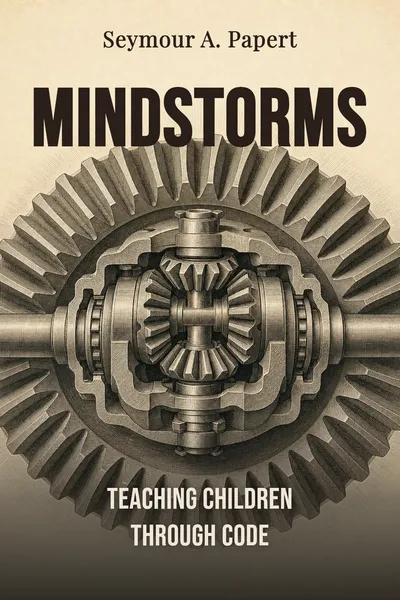
Mindstorms
Teaching children through code
Description
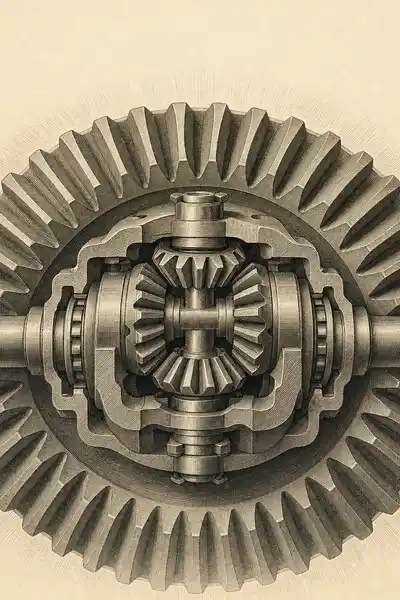
Before he became one of the founding figures of educational computing, Seymour Papert was a small boy in South Africa obsessed with automobile gears. He would sit turning the differential over in his mind, working out how one wheel could drive another, how the ratios meshed. Years later, as a mathematician who had worked alongside Jean Piaget in Geneva, he realized what those gears had really given him. They were an object he could think with — a piece of the world he could hold in his head, play with, and use to make abstract mathematics feel bodily and obvious. The multiplication tables that baffled other children slid into place for him because he could map them onto something he already loved. The problem, he came to believe, was that most children never get their gears.
In 1980, Papert published Mindstorms: Children, Computers, and Powerful Ideas, and the gears returned as the book's opening image. His wager was that the computer could be, for every child, what the differential had been for him — a universal object-to-think-with, endlessly reshapeable, capable of turning the driest school subject into something a child could build and inhabit. To make the case, he and his collaborators had already built the tool: LOGO, a programming language simple enough for an eight-year-old, and its most famous creature, a small robotic turtle that drew on the floor as the child told it where to go.
The book landed as personal computers were arriving in classrooms, and it refused the question everyone else was asking — how do we use computers to teach children better? Papert flipped it. What happens, he asked, when the child is the one giving the orders to the machine, and not the other way around?
The question we’re asking : What does it change when a child programs the computer rather than being programmed by it?What we’ll see : How one man's childhood fascination with gears became a whole theory of learning, built out of a turtle that draws on the floor.
Table of contents
01Chapter 1 — A gear that turned in a child's head
The gears are the key to the whole book, so Papert spends its opening pages on them rather than on any machine. What mattered about the differential gear was not that it taught him mechanics. It was that he fell in love with it first, and the mathematics arrived later as a gift, riding in on something he already cared about. When he met multiplication tables in school, he did not experience them as arbitrary rules to be memorized. He experienced them as gear ratios he already understood in his fingers. The abstract had a home in the concrete because the concrete had come first, and it had come with pleasure attached.
This is the intuition Papert builds everything on. Children learn an enormous amount before they ever reach a classroom, and they learn it without being taught — walking, talking, navigating a household full of adults and objects. They learn it because the world is full of materials rich enough to think with. The trouble starts, in his view, when children hit subjects for which the surrounding culture supplies no such materials. Mathematics is the clearest casualty. Most children grow up in a world almost entirely empty of things that make math feel natural, and so they meet it cold, as a foreign language with no speakers around.

02Chapter 2 — LOGO and the turtle that could be a child
LOGO was the programming language Papert and his colleagues designed at MIT precisely so that a child could use it to think. Its most beloved feature was the turtle: at first a small robot that rolled across the floor, later a triangle on a screen, that moved and drew according to the child's instructions. Type FORWARD 50 and it advances fifty steps, leaving a line behind it. Type RIGHT 90 and it pivots a quarter turn. From these few commands a child can draw a square, and from a square, a house, and from a house, a whole village — building complexity out of pieces she wrote herself.
The genius of the turtle is that a child can identify with it. When she wants to make it draw a circle, Papert's advice is to have her walk in a circle herself and pay attention to what her body does. She discovers that a circle is made by going forward a little and turning a little, over and over. She has just done differential geometry, in a sense, but she got there by pretending to be a turtle. This is what Papert calls body-syntonic learning: mathematics rooted in the child's own sense of being and moving through space, rather than floating free as symbols on a page.
03Chapter 3 — Learning to think about thinking
In most classrooms, a wrong answer is a small catastrophe — a mark against you, a thing to feel bad about and hurry past. Programming rearranges that entirely. A program almost never runs correctly the first time, and nobody expects it to. When the turtle draws a lopsided square instead of a house, the child does not conclude she is bad at this. She looks at the program to find out what went wrong, and she fixes it. Papert borrows the programmer's word for this: debugging. The bug is not a sin; it is the ordinary, expected middle of getting something to work.
This is, for Papert, one of the most powerful ideas a child can absorb, and it reaches far past the computer. A child who has spent hours debugging turtle programs is learning that being wrong is not shameful but diagnostic — that you look at what you did, form a theory about the flaw, and try again. He wants that stance to leak into everything: into writing, into arithmetic, into how a child understands her own struggles. The point is not just to solve problems but to develop a language for talking about how one thinks, so that thinking itself becomes something a child can inspect and improve.
04Chapter 4 — When the computer belongs to the child
The deepest argument in Mindstorms is about who is in charge. In the dominant vision of educational technology, then and now, the computer is a teaching machine: it presents material, drills the child, tests her, and adjusts the next question based on her answers. The computer, in that model, programs the child. Papert found this not merely limited but backwards. His entire proposal rests on the reversal — the child programs the computer. One arrangement trains; the other empowers. And he was clear-eyed that most schools, offered a powerful new tool, would instinctively bend it to the training model, because that is the model schools are built on.
This matters because a tool is never neutral. A computer used to deliver drills quietly teaches the child that knowledge comes from an authority and that her job is to receive it correctly. A computer the child commands teaches the opposite: that she can build knowledge, test it, and own it. Papert saw the machine as a kind of mirror in which a society's assumptions about children become visible. Decide the child is a passive vessel, and the technology will confirm it. Decide the child is a capable builder of theories, and the same technology will confirm that instead.
05Conclusion
The gears come back at the end, as they must. What Papert wanted was for every child to have access to something like his differential — an object rich enough to fall in love with, and rich enough to carry powerful ideas in along with the affection. He believed, against most of the educational thinking of his day, that the computer could be that object for the whole range of children, not just the ones already marked as clever. The condition was that the child had to be the one holding the controls, telling the turtle where to go, deciding what counted as done.
Related books