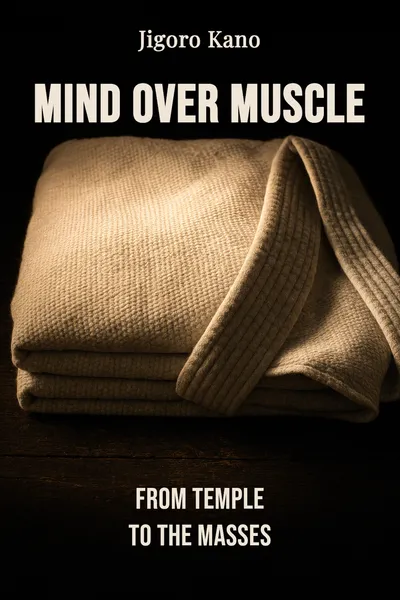
Mind Over Muscle
From temple to the masses
Description
In February 1882, a slight, bookish man in his early twenties rented a few rooms and a stretch of borrowed floor at Eishoji, a small Buddhist temple in the Shitaya district of Tokyo. Jigoro Kano was twenty-one, a graduate of the Imperial University, and already marked for a career in education. He was not a large man, and he had spent years being thrown around by opponents far stronger than himself. What he laid down at Eishoji had nine students and no reputation. He called it the Kodokan, the place for teaching the way, and he called what he taught judo.
The word mattered. Kano had trained in jujutsu, the close-combat techniques of the old samurai schools, at a moment when those schools were dying. The warrior class that had kept them alive was gone, dissolved by the Meiji reforms; the masters were aging, scattered, some of them reduced to giving public demonstrations to survive. Kano collected what he could from teachers who remembered the classical forms, then did something the classical world would never have permitted. He took the art apart, kept what he judged sound, discarded what he judged dangerous or merely traditional, and rebuilt it around a single idea a schoolboy could grasp.
That rebuilding is the story Kano tells in his own writing, gathered under the title Mind Over Muscle. It is less a fighting manual than the account of a man who believed a martial art could be a method of education — for the body, but also for the mind and for the way a person moves through the world. The art he had inherited belonged to a closed elite. What he did with it belonged, eventually, to everyone.
The question we’re asking : How did a fragile inheritance of samurai combat become a discipline open to schoolchildren, clerks and the whole of a modernizing society?What we’ll see : A young educator remakes a dying warrior craft into something that could be taught, measured and shared far beyond the room where he began.
Table of contents
01 Chapter 1 — A student who could not win with strength
Kano came to jujutsu out of frustration rather than family tradition. Born in 1860 in Mikage, near Kobe, he moved to Tokyo as a boy and grew into a clever, undersized student who found himself bullied by larger classmates. He had read that jujutsu let a smaller man overcome a bigger one, and he wanted that badly enough to go looking for a teacher — which, by the late 1870s, was not easy. The arts of the samurai had lost their patrons, and the men who still knew them were hard to find and reluctant to take pupils.
He eventually trained under Fukuda Hachinosuke and later Iso Masatomo in the Tenjin Shin'yo school, and then under Iikubo Tsunetoshi in the Kito school. Each tradition gave him something different: one emphasized striking and grappling on the ground, another the throws and the sweeping use of an opponent's own momentum. Kano absorbed both, but he kept running into the same wall. Against a genuinely strong opponent, technique alone often failed, and he was forever the smaller man in the room.

02 Chapter 2 — The temple with nine students
The Kodokan of 1882 was almost comically modest. Kano was boarding at Eishoji, and the temple gave him room to lay mats and gather pupils; the first year counted nine of them. He was teaching part-time around his duties as a young instructor, and money was tight enough that repairs to the worn floor were a genuine problem. There was nothing about the setting to suggest that the thing being founded there would outlast its founder by a century.
What made it different was not the scale but the intention. Kano did not present judo as a family secret or a warrior's privilege. From the start he treated it as a subject to be taught openly, with graded practice, clear explanations and a structure a beginner could follow. He organized techniques into categories, developed forms — kata — for studying principle, and set aside free practice, randori, for testing it against a resisting partner. The old schools had these elements too, but Kano arranged them into something closer to a curriculum than an initiation.
03 Chapter 3 — The principle that made it teachable
At the center of everything Kano built sat a phrase he returned to again and again: seiryoku zen'yo, maximum efficient use of energy. The point was not to be stronger than an opponent but to use one's power, and the opponent's, to the fullest and least wasteful effect. A throw worked not because you overpowered a man but because you found the instant his balance was already compromised and added the smallest necessary push. This is the meaning behind the idea of mind over muscle — that judgment, timing and understanding could accomplish what raw force could not.
This principle did more than explain the techniques; it made them teachable. Because there was a reason behind each movement, Kano could show a beginner why a throw succeeded rather than simply drilling it until the body remembered. Randori, the free sparring, became a laboratory: students tested the principle constantly, safely, at full resistance, learning through their own falls instead of an instructor's blows. Kano had also studied ways to fall without injury, which meant practice could be intense without being ruinous — a quiet innovation that made mass instruction possible.
04 Chapter 4 — When a fighting art became a way for everyone
For most of Japanese history, the martial arts had belonged to the few. They were the craft of the warrior class, transmitted within schools that guarded their methods and chose their students, closed to the farmer, the merchant and the clerk. What Kano did, more than invent techniques, was change who the art was for. By turning combat into curriculum — with reasons instead of secrets, grades instead of initiation, safe practice instead of injury — he made it something a society could hand to almost anyone.
The mechanics of that opening were as important as the philosophy. Kano's ranking system, the progression through colored belts to the black belt and beyond, gave students a visible path and a shared standard; his written explanations meant the art no longer depended on a single master's presence to survive. These were the tools of a modern institution rather than a private lineage, and they let judo scale in a way the old schools never could. A discipline that had lived in the memory of a few teachers could now be reproduced in schools across a country.
05 Conclusion
Jigoro Kano died in 1938, aboard a ship returning from an Olympic meeting, having spent fifty-six years turning the borrowed floor at Eishoji into a discipline practiced on every continent. He never stopped calling himself a student of the old jujutsu, and he never stopped insisting that judo was more than a sport — that the throw and the fall were, in the end, ways of teaching a person how to think and how to live alongside others.
Related books