
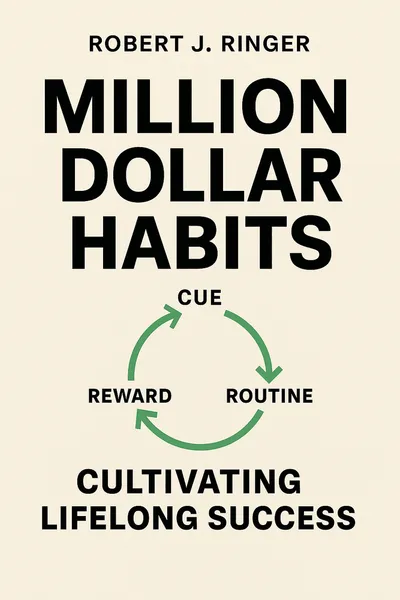
Million dollar habits
Cultivating lifelong success
Description
Success doesn't hinge on innate intelligence, unique abilities, education, hard work, or luck. The gap between success and failure is surprisingly narrow, devoid of any secret formulas. Success boils down to consistently practicing straightforward, effective habits accessible to all.
These habits, once cultivated, can steer anyone towards success. Actions yield results, and the secret lies in directing daily efforts through these success habits. A successful life is essentially an accumulation of successful days, achieved through the persistent application of these habits
Table of contents
01Grasping reality
Embracing reality over dreams, desires, and wishes is a crucial step towards achieving success. This approach requires a love for truth that surpasses the urge to see one's dreams realized, leading to a trade-off where fantasies are exchanged for tangible, high-level success. The essence of success lies in understanding and accepting reality as it is, not as we wish it to be.
Reality, grounded in immutable principles like the law of actions having consequences, forms the bedrock of success. To cultivate the habit of success, one must transcend delusions and view the world with realism. The world of advertising, which thrives on creating alluring delusions, exemplifies the temptation to live in a world of fantasies rather than facing the stark realities of life. Success is directly proportional to one's dedication to shunning delusions and making decisions based on reality.

02Mindset matters
While many believe that life's course is entirely random, pointing to the world's injustices as evidence, this perspective overlooks the power of personal agency.
Life, though fraught with inevitable challenges, offers us the freedom to choose our responses and attitudes, significantly influencing our success. Embracing a positive mental attitude isn't about mysticism but about a firm belief in action. This attitude strengthens with knowledge and wisdom, enabling us to navigate life's realities more effectively.
Understanding that problems are a constant part of life is crucial. Instead of dwelling on their existence, focusing on how to derive benefits from them is more productive. Life operates on a balance; every positive aspect has its negative counterpart and vice versa. This balance requires sacrifices for gains, and ignoring this reality is perilous. The law of averages also plays a critical role, suggesting that success rates increase with the number of attempts. This principle underscores the importance of persistence.
03Viewing angles
Developing a habit of perspective involves questioning "problems relative to what" when faced with challenges. Many people struggle to see daily issues in a relative context, which can significantly impact their success. It's essential to understand that problems are a constant part of life, filled with difficulties, rejections, and frustrations. However, these are not fatal but integral to the human experience.
By maintaining perspective, misfortunes and setbacks can be seen as mere illusions, with hidden benefits emerging from all experiences. Successful individuals manage to keep their problems in perspective, always looking for the silver lining in any negative situation. This approach turns adversity into a learning opportunity and a disguised chance for growth.
04Embracing the now
Embracing the notion that today could be the last day of our lives shifts our perspective from a future-focused existence to finding meaning in the present. It's a common misconception that achieving our goals is the ultimate purpose of life. However, the essence of living lies not in the destination but in the journey itself.
The pursuit of happiness as a primary goal is a flawed approach; happiness is a byproduct of engaging in activities that fulfill us on a deeper level. Life demands more than just survival; it requires us to find passion, belief, and purpose in our daily endeavors.
To avoid the trap of living for a future that may never come, we must ask ourselves critical questions about our desires, strengths, and the essence of our happiness. Discovering what truly brings us joy, recognizing our talents, and understanding our life's overarching objectives are crucial steps. These reflections help us identify a path that is both rewarding and aligned with our inner values. Acknowledging the sacrifices required to follow this path and deciding whether we are willing to make them is essential.
05Ethical living
Living each day as if it were your last doesn't mean disregarding the future, but rather infusing the present with meaning and purpose. Happiness isn't a goal to be chased; it's a byproduct of a life lived in alignment with our deepest passions. The essence of existence isn't in reaching goals but in the pursuit itself, in the striving that gives life its flavor and zest.
To avoid the trap of living solely for a future that may never come, it's crucial to ask oneself what brings joy, what one excels at, and what overarching objective gives life direction. Discovering what you truly enjoy, independent of financial gain, can lead to work that is fulfilling in itself. When you engage in what you're good at, the joy that follows can eclipse the pursuit of wealth, which often comes naturally as a result.
06Interpersonal dynamics
Integrity is the cornerstone of moral behavior, embodying the practice of adhering to one's ethical principles. It is a personal journey, where the individual is the sole judge of their adherence to these values. True integrity is tested not in moments of convenience but in times of challenge, where maintaining moral standards requires genuine effort. Living as though under the constant gaze of the world can foster a discipline of unwavering moral conduct, essential for mastering ethical habits.
Civilization distinguishes itself through a commonly accepted moral framework, mirrored in its laws, advocating for the freedom of action so long as it does not infringe upon others' rights. Yet, the definition of such infringement is often contested. Success, therefore, hinges on the clear articulation of one's moral compass, guiding daily actions and decisions. This ethical foundation not only directs one's conduct in business but also in crafting a coherent life strategy. Without pre-established moral convictions, decisions may become reactionary, driven by fleeting desires or emotions, leading to inconsistent moral standards and ultimately, failure.
07Navigating social ties
Embrace simplicity to unlock freedom and efficiency in your pursuit of success. Often, we gravitate towards complexity, but simplicity is the key to achieving results without unnecessary complications. A cluttered mind, bogged down by trivial details, can't focus on transformative ideas.
It's essential to value your time and energy, saying no to minor demands and projects that don't align with your strengths. Successful people aren't necessarily workaholics; they're adept at accomplishing more in less time, focusing on the few critical tasks that truly matter.
Meetings often mark the end of simplicity; they should be concise and focused if they're to happen at all. Your time is better spent on creative endeavors that have the potential for significant outcomes. Play to your strengths and delegate the rest. Effective delegation involves clear objectives, allowing for creativity, regular check-ins, and course correction if needed. This approach frees you to work on creative projects that yield big results, focusing on the essence rather than getting bogged down in the process.
08Avoiding energy vampires
Allowing "drain people" into your life can significantly impact your mental and emotional well-being. These individuals consume your time, energy, and resources, leaving you feeling depleted and unable to focus on the positive aspects of your life. They can affect your peace of mind, relaxation, comfort, and even your financial stability.
It's crucial to recognize that you cannot change these people, as they are unlikely to alter their behavior or outlook. Engaging with the wrong people can hinder your success, as the company you keep often reflects your position in life. It's wise to be cautious and, when in doubt, distance yourself from those who may bring negativity into your life. This includes a variety of personalities, such as those who lack humor and resent positivity, individuals who insist on changing others, and those who are always looking for a better deal.
09Mastering self control
Self-discipline is the cornerstone of achieving positive outcomes in life, as it allows individuals to prioritize intellectual decisions over emotional impulses. This habit is essential for focusing on long-term benefits rather than seeking immediate gratification. The internal battle between intellect and emotion is a common human experience. By acting on well-reasoned conclusions and resisting the lure of instant rewards, one exhibits self-control and gains freedom from emotional enslavement, which can be considered the most restrictive form of bondage.
Recognizing that our emotions are naturally inclined towards quick pleasures is a critical step in cultivating the habit of self-discipline. It's important to understand that the things that give us the most immediate joy are often those that can hinder our success in the long run. Distinguishing between daily job satisfaction and prematurely enjoying unearned benefits is crucial.
10Taking initiative
The essence of success lies not in the possession of great ideas or extensive planning, but in the ability to take decisive action. Theories and knowledge gain their true value only when they are put into practice. Without action, even the most profound wisdom is rendered useless. Ideas are merely the starting point; it is the execution of these ideas through planning, preparation, and action that brings their potential to fruition.
Developing the habit of action requires overcoming mental barriers such as resistance to change. Embracing change can be invigorating, propelling you towards your goals. Waiting for circumstances to improve on their own is futile; it is crucial to take initiative and shape your own destiny. Feeling overwhelmed by numerous projects can be paralyzing, but it's important to recognize that time is finite and not everything can be accomplished. Prioritizing and taking intelligent action is key.