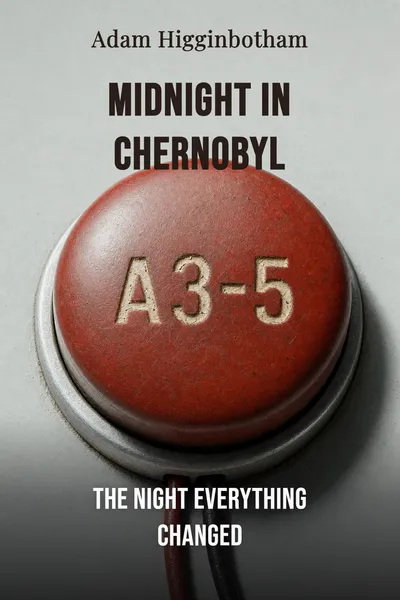
Midnight in Chernobyl
The night everything changed
Description
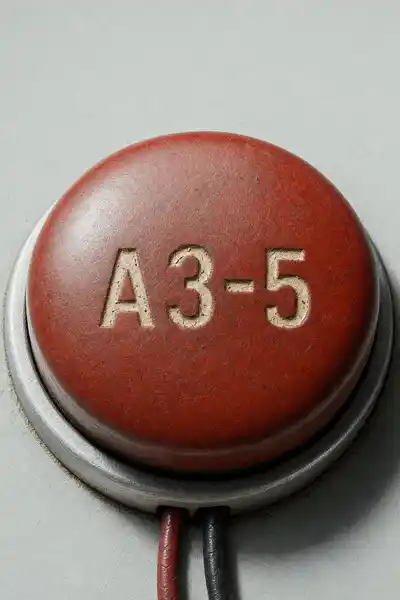
At 1:23 a.m. on April 26, 1986, in the control room of Reactor No. 4 at the Chernobyl Nuclear Power Plant in Soviet Ukraine, a night-shift operator named Leonid Toptunov pushed the button that was supposed to shut the reactor down. It was labeled AZ-5, the emergency scram. For a few seconds nothing seemed wrong. Then the building shook, the fuel channels ruptured, and roughly seven seconds later the top of the reactor — a concrete-and-steel lid weighing around two thousand tonnes — was thrown into the air. What came down was the first exposed nuclear reactor core in history, burning in the open in the middle of Europe.
Adam Higginbotham's Midnight in Chernobyl reconstructs that night almost minute by minute, and then follows what came after — the firefighters who arrived without knowing what they were breathing, the engineers who insisted for hours that the core was intact, the town of Pripyat where fifty thousand people slept while radiation drifted over their apartment blocks. It is a book built from interviews, declassified files, and the testimony of people who were in the room. And it refuses the cartoon version, in which a few reckless men flipped the wrong switches.
The reactor did explode because of what the operators did that night. But the operators did what they did inside a machine they had been lied to about, built by a state that could not admit its own mistakes even to itself. Higginbotham's account holds those two truths together, and that is what makes it more than a horror story. It is the anatomy of how a whole system arrived at 1:23 a.m.
The question we’re asking : How does a modern reactor come to explode — and who, or what, is actually responsible when it does?What we’ll see : How the machine, the men and the state each carried part of the fault, and what the wreckage revealed about the country that built it.
Table of contents
01 Chapter 1 — A reactor built to a compromise
The RBMK reactor that powered Chernobyl was a Soviet original, and Higginbotham is careful to explain why it existed in the form it did. It was big, it was cheap, it could be assembled from parts made across the union without a single giant pressure vessel that only a few factories could forge, and — the detail that mattered most — it could produce plutonium for weapons alongside electricity. It was a dual-purpose machine, and that lineage shaped every compromise built into it.
The compromises were real, and some of the men who designed it knew. The RBMK used graphite to slow neutrons and water to cool the fuel, a combination that gave it a nasty trait engineers call a positive void coefficient: as the cooling water boiled into steam at low power, the reaction sped up instead of settling down. In most of the world, a reactor that becomes more reactive as it loses coolant would not have been licensed. In the Soviet system, it was not so much approved as simply built, and the flaw was classified rather than fixed.

02 Chapter 2 — The test that went wrong
The immediate cause was almost mundane: a safety test. The plant needed to prove that if the reactor lost off-site power, the spinning turbines would keep the coolant pumps running long enough for backup diesels to start. It was an electrical experiment, run by a team from the turbine side, and it had been botched on earlier attempts. This time the men in charge were determined to finish it, and the schedule had already slipped by most of a day.
That delay was itself part of the trap. The test was meant to run in the afternoon, but the grid controller in Kiev needed Chernobyl's power into the evening, so the reactor was held at half strength for hours — a state in which a fuel poison called xenon builds up and smothers the reaction. By the time the night shift took over and was cleared to proceed, the reactor was choking on its own byproducts. To bring the power back up, the operators pulled out control rod after control rod, far past the safe margin, until the core was held in a fragile balance almost no rods could correct.
03 Chapter 3 — The lie was the second disaster
What Higginbotham does most powerfully is show that the explosion was only the first catastrophe. The second was the refusal to believe it had happened. Standing in the ruined plant, senior staff kept insisting the reactor was intact and that the graphite scattered across the grounds could not possibly be from the core. To admit otherwise was almost physically impossible — an RBMK core did not explode, so it had not. Men were sent to look for cooling water to pump into a reactor that no longer existed, and some absorbed fatal doses walking to check tanks that stood beside an open, burning core.
The firefighters came first, in cotton uniforms, told there had been a fire on the roof. They put it out with astonishing courage and no idea that the black rubble underfoot was fuel and graphite delivering lethal radiation by the minute. Many were dead within weeks. In Pripyat, the model town built for the plant's workers, life continued through the morning — children went to school, a wedding was planned, people sunbathed while a plume drifted overhead. The evacuation did not begin until thirty-six hours later, and even then residents were told it was temporary. They never went home.
04 Chapter 4 — The men who went in anyway
Step back from the control room and Chernobyl reads, in Higginbotham's hands, as a story about the widening gap between the world as the Soviet state described it and the world as it physically was. For decades the two had been allowed to drift apart — flaws reclassified as non-existent, failures reported as successes, dangers filed rather than fixed. On the night of April 26, physics collected the difference all at once, and no amount of official language could argue with an exposed core.
And yet the same system that produced the lie also produced people who closed the gap with their own bodies. The response is the part of the book that lingers. Divers went into flooded basements beneath the burning reactor to open valves and drain water that might have caused a second, larger steam explosion. Miners dug a tunnel under the foundation in stifling heat to install a cooling slab. Hundreds of thousands of workers — the liquidators — were sent in shifts to bury villages, scrub roofs, and shovel graphite off the ruin in bursts measured in seconds because a minute would kill them.
05 Conclusion
The sarcophagus went up over the ruined reactor by the end of 1986 — a hasty concrete shell built by exhausted men to seal in what could not be cleaned up. Toptunov and Akimov, who had reached for the emergency button, died within weeks. Dyatlov was tried and imprisoned, one of a handful of operators blamed in a courtroom while the design flaws stayed classified for years. Only later, quietly, were the RBMK reactors modified so that a scram could never again do what it did that night.
Related books