
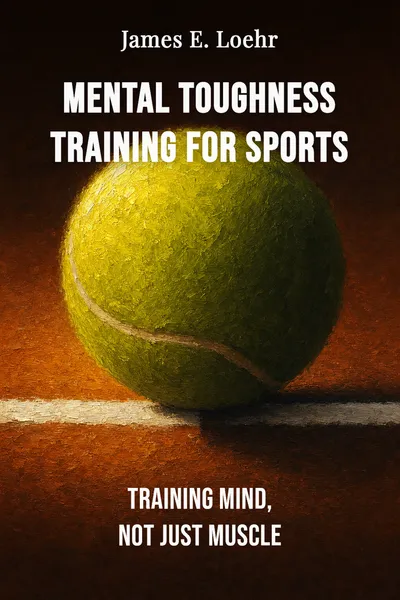
Mental Toughness Training for Sports
Training mind, not just muscle
Description
Every athlete has lived the moment. The training was done, the skill was there, the body was ready — and then, at the exact second it mattered, something in the head gave way. The serve that had landed a thousand times in practice sailed long. The putt that should have been routine rimmed out. The point-guard who could hit free throws in his sleep bricked two with the game on the line. What failed wasn't the muscle. It was the mind, and everyone who has competed knows the difference between the two.
In the early 1980s, a sports psychologist named James Loehr started asking a question that most coaching had quietly avoided. If athletes will spend six hours a day drilling their bodies, why do they spend almost none training the one thing that decides close matches? Loehr had spent years courtside with tennis players, studying the ones who came apart under pressure and the ones who somehow got stronger, and he arrived at a conclusion that sounds obvious now and did not then: mental toughness is not a gift you are born with. It is a set of skills, and skills can be built.
His book, Mental Toughness Training for Sports, published in 1982, took that conviction and turned it into a program — something concrete enough to practice, measure, and repeat. It was not a pep talk. It was closer to a training manual for the part of an athlete that no weight room reaches, written for anyone who trains hard and still finds their concentration, not their talent, failing them at the worst possible time.
The question we’re asking : Why does the mind fail at the exact moment the body is most ready — and can it be trained like everything else?What we’ll see : How Loehr reframed toughness as a learnable skill, the internal state that great performances share, and the drills meant to make it repeatable.
Table of contents
01 Chapter 1 — The game happens between the ears
Loehr's starting point was a distinction that competitive athletes feel instinctively but rarely name. There is the physical game — the strokes, the speed, the conditioning — and there is the inner game, the flow of thoughts, emotions and arousal that runs underneath every point. Two players can arrive at a match with nearly identical physical tools, and one falls apart while the other holds. The gap, Loehr argued, sits almost entirely on the mental side, and it widens precisely as the stakes rise.
What convinced him was watching the pattern up close on the professional tennis tour. He noticed that when a player started to lose, the collapse showed on the body first: the shoulders dropped, the walk changed, the eyes went flat between points. The negative feeling and the negative posture fed each other in a loop. By the time the player consciously registered that things were going wrong, the physiology had already tipped, and the strokes that had been automatic all week suddenly required thought — which is the surest way to break them.

02 Chapter 2 — The Ideal Performance State
The center of Loehr's system is an idea he called the Ideal Performance State. He had interviewed and observed athletes across many sports about how they felt during their best performances — not their best results, but the moments when everything clicked — and he found the descriptions were strikingly consistent regardless of the discipline. Whether it was a tennis player, a golfer, or a boxer, the language of peak performance kept circling the same internal territory.
The state they described was not intense effort or gritted-teeth determination. It was closer to the opposite: relaxed, calm, energized, and free of the sense of trying too hard. Athletes reported feeling loose and physically alert at once, confident without arrogance, fully absorbed in the moment with no room left for worry about the score or the outcome. Time seemed to slow. The body did what it knew how to do while the conscious mind got out of the way. Effort felt effortless.
03 Chapter 3 — Toughness is a skill, not a trait
The word toughness usually implies something fixed — you either have it or you don't, the way one athlete is naturally fearless and another is naturally fragile. Loehr rejected this outright. Mental toughness, in his definition, is the ability to consistently access the Ideal Performance State regardless of circumstances: behind in the score, tired, rattled, in front of a hostile crowd. And an ability, by definition, is something you develop. That single reframe is what turned an intangible into a training program.
The training rests on the link between physiology and emotion working in both directions. If a slumping posture drags the mind down, then deliberately correcting the posture, the breathing and the between-point ritual can pull it back up. Loehr paid close attention to what athletes do in the empty seconds between points and plays — the walk back, the eyes, the pace, the small physical routine — because those seconds are when the emotional state is set for what comes next. Control the ritual and you begin to control the state.
04 Chapter 4 — When the mind becomes the sport
Step back from tennis and Loehr's real contribution comes into focus. What he did was strip the mystique off performance under pressure and treat it as an engineering problem. The clutch performer had always been described in the language of character — nerve, heart, ice in the veins — as if it were a fact about who you are. Loehr's insight was that it is a fact about what you can do, and that shift moves the whole question from destiny to method. You are not stuck with the mind you brought to the arena.
This is why the ideas travelled so far beyond the baseline. Loehr went on to work with performers of every kind, and eventually with executives, on the same premise: that the ability to stay composed and fully present when the outcome is on the line is a trainable capacity, not a personality type. The surgeon, the litigator, the musician walking onstage all face the same basic problem the tennis player faces on a break point — how to keep the body's stress response from sabotaging a skill that is otherwise ready. The mechanics of choking do not care what the task is.
05 Conclusion
Return to that failed moment — the serve long, the putt short, the free throw off the rim. Loehr's whole project was to insist that this moment is not a verdict on the athlete's talent or their nerve. It is a description of an internal state that was never trained, and states can be trained. The player who comes apart and the player who comes alive are running the same machinery; the difference is that one of them has practiced getting into the right setting and staying there when the pressure arrives.
Related books