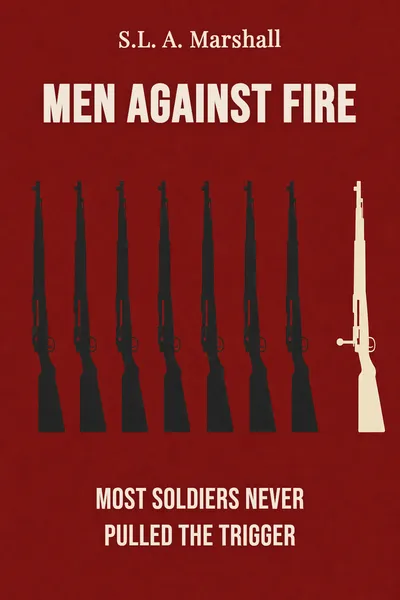
Men Against Fire
Most soldiers never pulled the trigger
Description
In November 1943, on the small Pacific island of Makin, an American combat historian named Samuel Lyman Atwood Marshall did something that no one in his line of work had quite done before. Instead of collecting after-action reports weeks later, back at headquarters, he sat the men down together the moment they came off the line — whole platoons at once, still filthy, still shaking — and walked them minute by minute through the fight they had just survived. He did it again in Europe, from Normandy through the Rhineland. And out of those hundreds of sessions came a claim that landed on the postwar military like a slap: in the average infantry company under fire, no more than one soldier in four actually used his weapon.
Marshall published the number in 1947, in a short, hard-edged book called Men Against Fire. He was not an outsider taking shots at the Army. He had fought in the first war, reported on the second, and would advise commanders through Korea and after. That was precisely what made the figure so uncomfortable. Here was a man the generals trusted, telling them that three-quarters of the riflemen they had trained, shipped overseas, and sent into contact had, at the decisive moment, simply not fired — not out of cowardice, not because they broke and ran, but for a reason the training had never even considered.
The book was less an exposé than a diagnosis. Marshall was trying to explain why the thing armies are built to do — deliver fire on the enemy — kept failing to happen even when the men stood their ground. His answer reached past tactics and toward something in the men themselves, something the drill sheets and marksmanship ranges had quietly ignored for as long as there had been rifles.
The question we’re asking : Why did most infantrymen, standing their ground and in no danger of running, still fail to fire on the enemy in front of them?What we’ll see : How one historian's method uncovered a number that forced armies to rethink what a soldier actually is.
Table of contents
01Chapter 1 — The historian who followed the companies out of the line
Marshall's authority came less from a theory than from a method, and the method was almost embarrassingly simple. Combat history in the 1940s was written from paper: unit journals, casualty lists, the recollections of officers who had watched the fight from a command post several hundred yards back. Marshall distrusted all of it. He had seen enough of battle to know that the men who did the fighting rarely knew what the men fifty feet away had done, and that memory curdled fast once a soldier was alone with it.
So he went to the source while it was still warm. Within a day or two of an action, sometimes within hours, he would gather the survivors of a company — riflemen, sergeants, the surviving officers, everyone, sitting as equals on the ground — and reconstruct the engagement out loud, together. One man's account corrected another's. A private could contradict a lieutenant, and often did. The group memory that emerged was rougher and truer than any single report, and Marshall came away convinced it was the only honest picture of a fight that existed.

02Chapter 2 — The company interview, and the number that came out of it
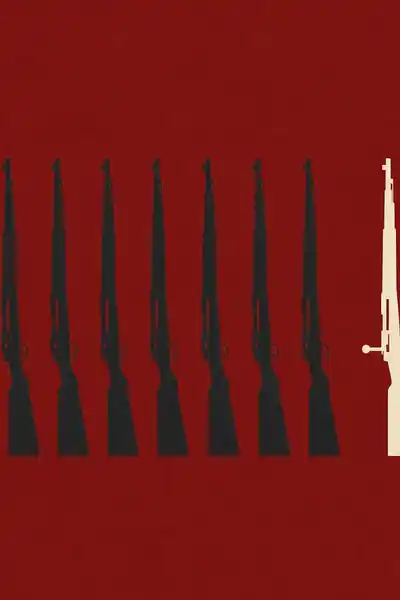
The figure Marshall settled on was blunt: in a typical engagement, only fifteen to twenty-five percent of the riflemen who could have fired actually did. Even in the best companies, under the best leaders, with a target plainly in view, the number of active weapons rarely climbed past a third. He was careful about what the claim did and did not mean. These were not men who ran. They stayed. They took casualties. They held ground that mattered. They just did not shoot.
The reason, as he pieced it together, had nothing to do with courage and everything to do with what these men had been before they were soldiers. They came, overwhelmingly, from a civilian world that had spent their entire lives teaching them that killing another person was the deepest wrong there was — a prohibition absorbed in church, at school, at the family table, so early and so completely that it operated below thought. The uniform and the training had not touched it. Handed a rifle and a live enemy, a large part of a man simply refused, and the refusal was so quiet that even he often did not notice it happening.
03Chapter 3 — The Army that had trained the trigger and forgotten the man
From that finding Marshall built his real indictment, which was aimed not at the soldiers but at the institution that had prepared them. The whole apparatus of infantry training, he argued, had been designed around the weapon and around a fictional user — a man who, once taught to hit a bullseye at two hundred yards, would naturally point that same rifle at a living enemy and squeeze. Marksmanship was drilled endlessly. The far harder problem, the human unwillingness to kill, was not addressed at all, because the Army had never admitted it existed.
The result was an army that measured the wrong thing. Rifle ranges rewarded accuracy against paper. They said nothing about whether the man would fire at all, which was the variable that actually decided engagements. Marshall pointed out the strange arithmetic this produced: a squad's real combat power was not its number of rifles but its number of firers, and by that count a full company might be fighting at a quarter of its paper strength without anyone in the chain of command realizing it. Firepower was an illusion built on the assumption that every weapon was a weapon in use.
04Chapter 4 — The soldier the manuals had left out
Step back from the number, and what Marshall had really done was expose a hidden assumption that armies had carried for centuries. Every rifle, every volley formation, every calculation of firepower rested on the belief that a trained man with a weapon and a target is a man who will use it. Marshall's interviews suggested that belief was false for most men most of the time — that the limiting factor in ground combat was never the equipment or even the fear, but the ordinary human being's deep reluctance to kill another human being at close range.
This reframed the entire problem of making soldiers. An army was not, in Marshall's account, a machine for delivering firepower; it was a machine for overriding a moral instinct, and it had been trying to do so without ever naming the instinct. The men who fired were not braver than the men who did not. They were the ones the situation had socialized into it — bound into a crew, watched by a leader, made to feel that their neighbors were counting on them. Take those bonds away, and the inhibition reasserted itself, because it had never left.
05Conclusion
The claim that came out of those circles of exhausted men on Makin and in the hedgerows of Normandy did not stay in a book. Marshall's argument that fire was a social act, that men shot when they were watched and needed and led, reshaped how the American Army trained afterward — toward realistic targets that looked and fell like men, toward conditioning the act of firing until it happened before the conscience could intervene. Later fire ratios, by the Army's own account, rose sharply. Whether Marshall's original quarter was measured with precision or estimated from an honest but informal method has been argued over ever since, and the exact figure may never be pinned down.
Related books