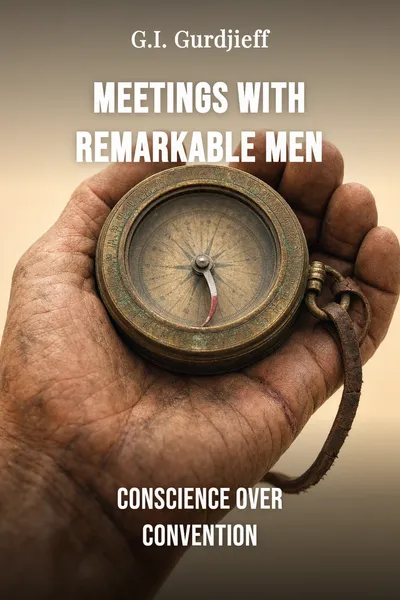
Meetings with Remarkable Men
Conscience over convention
Description
Somewhere around the turn of the twentieth century, a young man from the Caucasus set out on a route most people would call insane. He crossed deserts, forged permits, joined a loose brotherhood of friends who pooled their money to fund expeditions toward Central Asia, Egypt, the mountains of the Hindu Kush. He was not chasing trade or empire. He was looking for people — specific people, rumored to hold fragments of a knowledge that ordinary life had misplaced. George Ivanovich Gurdjieff spent decades on that search, and late in life, after a car crash nearly killed him, he decided to write it down.
The result, published after his death in 1949, is a strange kind of memoir. Meetings with Remarkable Men isn't a travelogue and isn't quite an autobiography. It's a gallery of portraits — a father, a tutor, a handful of companions and strangers Gurdjieff met on the road — each drawn because the person embodied something he thought worth preserving. The men are remarkable not for fame or fortune. Several are poor, one is a drunk, one dies obscurely. What links them is an inner quality Gurdjieff kept circling back to, and could never quite fit into the words "good" or "bad."
That quality is where the book plants its flag. Gurdjieff's father tells him early that the measure of a person isn't what the neighbors approve of but whether the person acts as conscience demands. It sounds like a platitude until you watch the whole book try to prove it, one human being at a time. The portraits become an argument about what makes a life worth admiring — and the answer turns out to have almost nothing to do with the verdicts our surroundings hand us.
The question we’re asking : What makes a person genuinely remarkable, if it isn't success, virtue, or the approval of those around them?What we’ll see : How a search for extraordinary people became a quiet case for living by an inner compass rather than the world's rules.
Table of contents
01 Chapter 1 — A father who buried his money and kept his word
Gurdjieff opens not with a sage in a mountain monastery but with his own father, a cattle-dealer and carpenter in Alexandropol who was also, in the old sense, a bard — an ashokh who could recite epics through the night. The man had once been prosperous. Then a cattle plague wiped out his herds, and a series of misfortunes reduced the family to near poverty. What stayed with the son was not the loss but the way his father carried it. He never complained, never blamed, never let the collapse touch his composure. He treated ruin as a fact to be met, not a wound to be nursed.
One story becomes the anchor. The father had a debt of honor — a promise made to a man now dead — and though nobody living would have known or cared, he sold nearly everything he had left to keep it. Convention would have excused him easily; his conscience would not. Gurdjieff watched this and understood, long before he could name it, that his father operated on a criterion the world around him didn't share. The neighbors measured a man by his herds. His father measured himself by something they couldn't see.

02 Chapter 2 — The tutor who sent a boy looking for questions
The second decisive figure is Dean Borsh, a priest and the boy's tutor, a man of severe intelligence who took the young Gurdjieff's education far more seriously than any school would have. Where the father shaped character, Borsh aimed at the mind — and specifically at the kind of mind that refuses to be satisfied with received answers. He treated the boy not as a vessel to be filled but as someone who had to be provoked into genuine inquiry, and he was demanding to the point of harshness about it.
What Borsh planted was a question rather than a doctrine. He and the boy became preoccupied with phenomena the science of the day dismissed or couldn't explain — instances of what looked like foreknowledge, healing, powers that didn't fit the tidy materialist picture their era was so proud of. Instead of telling the boy what to conclude, Borsh insisted that these things pointed to some knowledge that had once been whole and was now scattered, surviving only in fragments held by people who had preserved it away from the modern world. The task was to go and find them.
03 Chapter 3 — The men worth crossing continents to find
The middle of the book unfolds as a series of companions met on the road, each a variation on the same theme. There is Abram Yelov, an Assyrian bookseller with an astonishing memory and a knack for languages, who lived by his wits and thought about words the way a jeweler thinks about stones. There is Ekim Bey, a Turkish friend who abandoned a conventional career to investigate the same hidden phenomena. There is Piotr Karpenko, and above all Pogossian, a friend so committed to work as a discipline that he kept his hands busy at all hours simply to refuse idleness.
Pogossian's principle is one of the book's sharpest ideas. He worked deliberately, even at pointless tasks, because he had decided that a person is made by effort and unmade by drift. Physical labor was not a means to money but a way of forging will against the natural pull toward comfort. These were not holy men in robes. They were tradesmen, engineers, adventurers — people who happened to have organized themselves around an inner aim while the world around them organized itself around ease and appearances.
04 Chapter 4 — What conscience does that convention cannot
Step back from the portraits and the argument comes into focus. Every remarkable man in the book is remarkable by an inner measure — will, honesty, a conscience that overrides comfort — and almost none of them scores well on the external measures a society uses: wealth, rank, reputation, respectability. Gurdjieff is doing something deliberate here. He is separating two ways of judging a person that most of us keep fused, and insisting they can point in opposite directions. The neighbors called his father a broken man; Gurdjieff calls him the first of the remarkable.
The father's early instruction states the principle bluntly: learn not what the people around you consider good or bad, but to act as your conscience bids. What the book adds to that sentence is the demonstration that conscience isn't a feeling you're born with and can trust automatically. In these lives it is something built — through ordeal, through work, through the refusal to drift — the way Pogossian built will with his hands or Vitvitskaia built understanding out of ruin. Convention is inherited; conscience has to be earned.
05 Conclusion
The book ends where a life like Gurdjieff's had to end — with the search itself, the sense that the fragments were real and that finding them cost everything the searcher had. He never delivers a tidy doctrine at the close, and that restraint is faithful to the whole. The remarkable men are left as portraits, not as lessons to be underlined, because their point was never a maxim you could quote. It was a way of standing in the world, carried by people who mostly went unnoticed while they stood there.
Related books