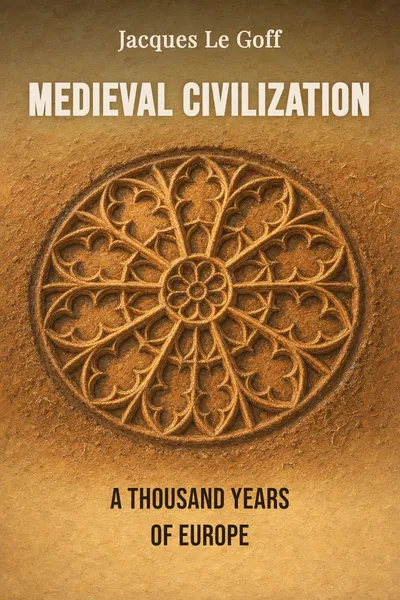
Medieval Civilization
A thousand years of Europe
Description
When we picture the Middle Ages, we tend to picture a gap: a thousand years of mud and superstition sitting between the glory of Rome and the light of the Renaissance, best skipped on the way to the good parts. Jacques Le Goff spent his career arguing that this picture is not just unfair but backwards. In his 1964 book Medieval Civilization, the French historian took the whole span — from the barbarian settlement of a Roman Europe in the fifth century to the war-torn Christian Europe of the fourteenth and fifteenth — and treated it as a single, coherent civilization worth understanding on its own terms.
The book became something rare: a work respected by scholars and read by everyone else, a classic that generations of students would carry through their studies. Its first half tells the story straight through, as a narrative of one continent slowly becoming itself. Its second half does something stranger and more lasting — it reconstructs how medieval people actually experienced time, space, the sacred, and their own place in a fragile world. Le Goff wanted us to stop grading the period against later ones and start listening to it.
What emerges is not a dark age but a formative one. The Europe we live in — its towns, its universities, its calendar of holidays, its intuitions about work and money and the beyond — took shape during these centuries, often for reasons its inhabitants would have found unrecognizable. To understand the medieval world, Le Goff insists, is to understand where a good deal of the modern one quietly comes from.
The question we’re asking : How did a thousand disorderly years between Rome and the Renaissance become a civilization in their own right?What we’ll see : How Le Goff rebuilds the medieval millennium from the ground up — its slow making, its inner world, and the long shadow it still casts.
Table of contents
01 Chapter 1 — The barbarians moved in, and Rome dissolved slowly
The Roman Empire did not fall in a single catastrophe, and Le Goff is careful to dismantle the image of a sudden collapse in 476. What happened across the fifth, sixth and seventh centuries was closer to a long settlement. Germanic peoples — Goths, Franks, Lombards, Vandals — moved into imperial territory as much by drift and negotiation as by conquest, often as federated troops before they became rulers. Many admired Rome and tried to preserve its forms. The result was not a clean break but a blurring, in which Roman institutions decayed while new peoples borrowed their prestige.
Le Goff reads these centuries as a slow-motion fusion rather than a destruction. The barbarian kingdoms kept Roman law where they could, Latin remained the language of writing, and the new elites intermarried with the old. What genuinely receded was the connective tissue of empire: the roads maintained, the taxes collected, the long-distance trade, the cities kept full. Economic life contracted toward the local and the rural. The Mediterranean, once a Roman lake binding the whole world together, gradually became a frontier rather than a highway.

02 Chapter 2 — How the year 1000 turned a frontier into a continent
If the early medieval centuries were about survival, the central ones — roughly the eleventh through the thirteenth — were about growth, and Le Goff describes this stretch with something close to affection. Around and after the year 1000, almost everything expanded at once. The population rose. Forests were cleared and marshes drained. New villages appeared, heavy ploughs turned heavier northern soils, and food surpluses fed people who no longer had to farm. Le Goff treats this quiet agricultural revolution as the engine beneath everything else that followed.
On that surplus, towns revived. Markets and fairs stitched regions back together, merchants moved goods across distances that had been unthinkable in the seventh century, and money, long scarce, began circulating again in volume. A new figure emerged that the old order had no slot for: the townsman, the merchant, the person whose wealth came from trade rather than land. Le Goff is fascinated by this urban world because it introduced tensions the Church struggled to absorb — above all around money, lending and the moral status of profit, questions the age argued over intensely.
03 Chapter 3 — A civilization that thought in images, not maps
The book's second half turns from what happened to how it was experienced, and this is where Le Goff's originality shows most clearly. Medieval people, he argues, did not perceive time, space or nature the way we do. Their world was saturated with meaning, read everywhere as a system of signs pointing beyond itself. A lion was not merely an animal but a symbol; a number carried spiritual weight; the visible world was a coded message from the invisible one. To understand the period is to enter this symbolic imagination rather than to correct it.
Time itself was structured religiously. The day was marked by the bells of prayer, the year by a dense calendar of feasts and saints, the whole of history framed between Creation and the Last Judgment. The future was not an open horizon of progress but a countdown toward an ending that could arrive at any moment. Le Goff shows how this stretched, sacred sense of time governed ordinary life — until, late in the period, the merchant's clock and the merchant's need to measure hours for wages and interest began, slowly, to compete with the Church's time.
04 Chapter 4 — The Middle Ages we never actually left
The deeper argument of Medieval Civilization is that this millennium was not a detour but a foundation, and Le Goff pursues the point without ever pretending the period was gentle. His medieval Europe is unequal, violent, superstitious and frequently hungry. What he refuses is the verdict that follows too easily from those facts — that it was therefore a blank stretch, a darkness to be hurried past. The centuries between Rome and the Renaissance were where Europe's lasting mental and institutional furniture was actually built.
Consider how much of it we still use. The university, the town charter, the parliament and estates, the very idea of Europe as a cultural unit distinct from its neighbors — all are medieval in origin. So are quieter things: the seven-day rhythm of work and rest, the map of feast days that still shapes the calendar, the intuition that there is a middle place between salvation and damnation. Purgatory, which Le Goff studied at length elsewhere, is his sharpest example of how a medieval invention reorganized the imagination of an entire civilization and outlived its own age.
05 Conclusion
Le Goff set out to rescue a thousand years from the condescension of a single word, and Medieval Civilization does it not by insisting the period was better than we think, but by insisting it was ours to begin with. He tells the story twice: first as a slow becoming, from barbarian settlement through the great expansion around the year 1000 to the crises of the late medieval centuries; then as an inner world, a way of living time, space and the sacred that we can reconstruct but no longer inhabit. The two halves together make the case that this was a civilization with its own logic, not a waiting room for later ones.
Related books