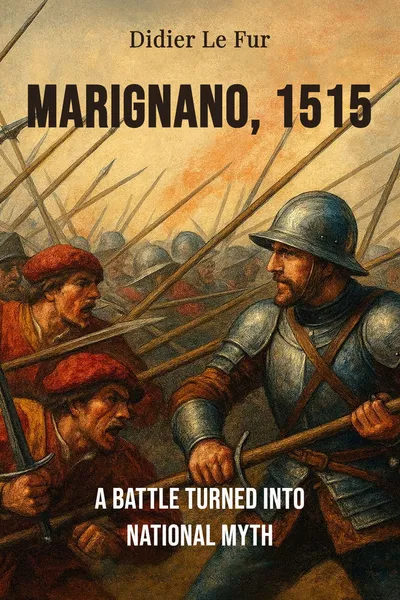
Marignano, 1515
A battle turned into national myth
Description
Every French schoolchild of a certain generation could give you one date without hesitation: 1515, Marignano. It sat in the memory like a nursery rhyme, detached from any real understanding of what happened, who fought, or why it mattered. The number itself became the fact. Ask what the battle actually decided and the answer usually dissolves into a vague sense of glory, a young king on a horse, France at its most radiant. That vagueness is not an accident. It is the whole point.
In September 1515, a French army led by the newly crowned François I clashed with Swiss mercenaries in the marshy plain south of Milan, near a village then called Melegnano. Two days of brutal fighting left thousands dead. François held the field, entered Milan, and for a moment looked like the most brilliant prince in Europe. Within a few years the conquest had unravelled, Milan was lost again, and the king who won at Marignano would end up a prisoner after the catastrophe of Pavia in 1525. On the ledger of French power, the victory bought very little that lasted.
And yet the date endured while far more decisive battles faded. The historian Didier Le Fur set out to understand that survival — to peel the event apart from the centuries of ceremony, painting and schoolroom recitation that grew over it. What he found is a story less about warfare than about memory, and about how a nation chooses which fragments of its past to keep polishing.
The question we’re asking : Why did a battle that changed almost nothing become one of the most memorized dates in French history?What we’ll see : How a two-day fight in a Lombard marsh was slowly reworked, century after century, into a founding image of the nation.
Table of contents
01Chapter 1 — Two days in the marshes
The setting was not glamorous. South of Milan stretched a flat, waterlogged plain cut by irrigation ditches and canals, terrible ground for the heavy cavalry that made up the pride of the French army. François I, barely twenty-one and crowned only months earlier, had crossed the Alps at the head of a large force to make good on the French claim to the duchy of Milan, a claim inherited from his predecessors and never truly secured. The march itself had been an achievement — moving artillery over mountain passes was slow, punishing work — but it was the kind of achievement no one would later remember.
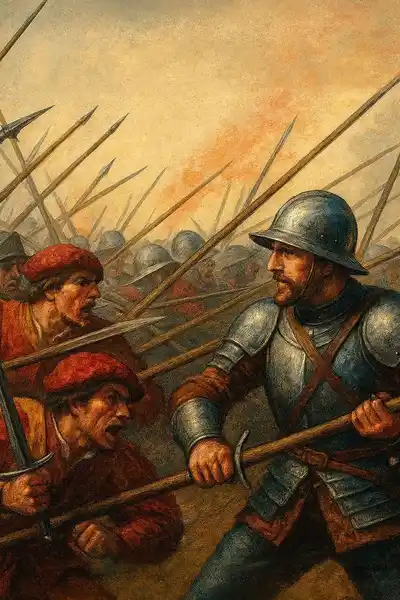
The obstacle was the Swiss. In the early sixteenth century, Swiss pikemen were considered the finest infantry in Europe, hired by whoever could pay them and feared for their discipline in dense square formations that could shatter a cavalry charge. Several thousand of them held Milan on behalf of the duke, and on the afternoon of September 13, 1515, they marched out to attack the French camp near Marignano rather than wait to be besieged. The fighting began late in the day and ran into the dark, the two sides grinding against each other by moonlight until sheer exhaustion pulled them apart.

02Chapter 2 — The King who needed a victory
The meaning of Marignano was manufactured almost immediately, and François I was the first to see its value. A king who took the throne without the aura of a warrior needed something to establish his standing among the crowned heads of Europe. A dramatic victory over the celebrated Swiss, won in person in his first year, was exactly the raw material required. The court set to work turning the event into an image, and it did so while the ground was still fresh.
Letters were sent, accounts were commissioned, the news was spread with care to allies and rivals alike. The story that circulated emphasized the personal courage of the king, the length and violence of the fight, the prestige of the enemy defeated. There is a famous line, often attributed to the old marshal Trivulzio, calling Marignano a battle of giants — a phrase that did precisely what royal propaganda needed it to do, elevating a hard-won engagement into something legendary, something that placed the young sovereign in the company of the ancients.
03Chapter 3 — How a battle becomes a story
A date does not stay famous on its own. It has to be maintained, and Marignano was maintained across centuries by people who found in it whatever they happened to need. This is the heart of Le Fur's inquiry: not the two days of fighting, but the long afterlife, the way each era rewrote the battle to suit its own preoccupations while keeping the number intact. The event stayed fixed; its meaning kept changing hands.
Under the monarchy, Marignano remained an emblem of royal valour and the chivalric grandeur of the Renaissance court. François I himself was gradually recast as the model prince, patron of arts and letters, the sovereign who brought the Italian Renaissance home to France, and his early victory served as the martial complement to that portrait. The battle fit neatly into a story the crown wished to tell about itself, and later reigns had no reason to let it fade.
04Chapter 4 — When a date does the work of a nation
Step back from Marignano itself and a broader pattern comes into view: nations do not remember their pasts, they curate them. A date survives not in proportion to what it decided, but in proportion to how useful it proves to those who inherit it. Marignano is a near-perfect specimen because the gap between its slender historical importance and its enormous commemorative weight is so wide that the mechanism becomes visible, almost embarrassingly so.
What Le Fur exposes is the labour hidden inside a familiar number. Somebody chose to keep 1515 and let other, more consequential battles slip away. Kings, courtiers, republican educators — each generation added a coat of varnish, and the accumulated layers are what we mistake for the event. The battle became a surface onto which very different Frances projected their idea of themselves: chivalric, then royal, then republican. The same two days in the mud served three incompatible portraits, and served them well.
05Conclusion
The battle of Marignano lasted two days and settled almost nothing. The duchy it delivered was lost within a decade, and the king it glorified would soon know the humiliation of capture. Measured by its consequences, it deserves a modest line in the history of the Italian Wars. Measured by its fame, it stands among the handful of dates a whole nation once carried in its head. That distance between what happened and what was remembered is the real subject Le Fur pursues.
Related books