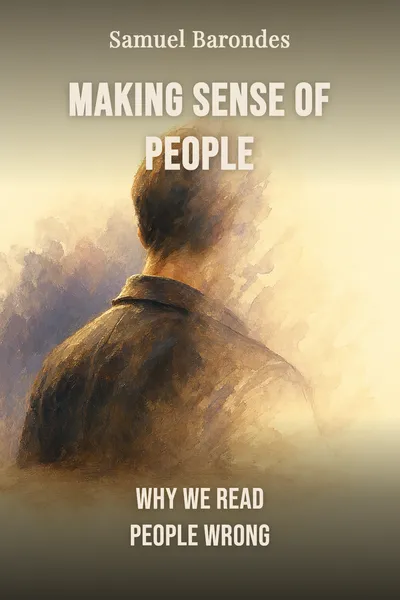
Making Sense of People
Why we read people wrong
Description
We do it before the coffee lands on the table. A new colleague sits down, says three sentences, and something in us has already filed a verdict: warm, guarded, a little full of himself. Samuel Barondes, a psychiatrist and neuroscientist at the University of California, San Francisco, spent a career watching people do exactly this — and getting it wrong. His 2012 book Making Sense of People starts from a plain admission most of us skip over. We are all amateur personality assessors, constantly, and we mostly run on gut. The gut is fast, occasionally brilliant, and unreliable in ways we rarely notice.
What bothers us about a boss, or about a daughter's new boyfriend, or the reason we can't stop thinking about the person we're dating — these are not vague feelings for Barondes. They are readings, and readings can be sharpened. His wager is that a hundred years of psychological research has quietly assembled a usable toolkit for judging character, one that sits between the airport-bookstore quiz and the clinical manual. Most people have never been handed it. He wanted to hand it over in plain language.
The catch is that the tools don't flatter our confidence. They tell us which parts of a person are stable enough to bet on, which parts we tend to invent, and where our own history bends the picture without asking permission. Barondes is not selling the idea that we can finally see people clearly. He is offering something more modest and more usable: a way to be wrong less often, and to know when we are guessing.
The question we’re asking : Can we actually get better at reading people, or is judging character just a gift some have and others don't?What we’ll see : How research turned a lifelong habit into a set of tools — and why the honest version of it never delivers a final verdict.
Table of contents
01Chapter 1 — The five dials psychologists settle on
The first thing Barondes does is calm the noise. Personality tests are a crowded market, and most of them sort people into types — you are this animal, that color, one of sixteen four-letter codes. He is politely unimpressed. Types feel satisfying because they draw hard borders, but people don't come in boxes; they come in gradations. The research consensus, built painstakingly over decades, landed somewhere less catchy and more honest.
That consensus is the Big Five. After years of researchers running the actual words people use to describe each other through statistics, five broad dimensions kept surfacing, no matter the language or the sample. Extraversion, how much someone draws energy from others. Agreeableness, how warm or prickly they run. Conscientiousness, how organized and dependable. Neuroticism, how easily rattled and prone to worry. And openness, how curious and drawn to novelty. Each is a dial, not a switch.

02Chapter 2 — Character is not the same as temperament
The Big Five, for all its reliability, has a blind spot Barondes refuses to ignore. It measures temperament — the raw dispositions we're largely born with — but it stays quiet on the question most of us actually care about when we're sizing someone up. Is this person good? Can they be trusted when it costs them something? Two people can score identically on the dials and behave in opposite ways when the stakes rise, because character is built on top of temperament, not read off it.
To get at this, Barondes turns to the harder end of the spectrum, the patterns clinicians spend their careers naming. He draws on the vocabulary of personality disorders — not to diagnose the people around us, which he warns against repeatedly, but because the extreme cases illuminate the ordinary ones. The narcissist who needs constant admiration, the person who charms without conscience, the one whose moods swing so wide that everyone nearby learns to walk carefully. These are exaggerated versions of tendencies that exist, in milder doses, in almost everyone.
03Chapter 3 — Where the patterns crack
If the tools worked cleanly, the book could end at chapter two. They don't, and Barondes spends much of his energy on why. The first problem is us. We come to every reading loaded with our own history, and that history distorts what we see without announcing itself. The person we can't stop thinking about may simply resemble, in some untraceable way, someone from our past. Attraction, he suggests, is often recognition mistaken for discovery.
This is where he leans on the idea, borrowed from psychoanalytic thinking, that we transfer old templates onto new people. The boss who infuriates us out of proportion may be standing, without knowing it, in a role someone else once occupied. The feeling is real; the target is partly invented. Barondes doesn't ask us to distrust our reactions, which would be paralyzing. He asks us to interrogate them — to notice when the intensity of a feeling outruns anything the person has actually done.
04Chapter 4 — The report we never stop writing
Step back from the individual chapters and a larger claim comes into focus about what Barondes thinks assessment actually is. It is not a verdict we deliver once and file away. It is a report we keep rewriting, because people reveal themselves over time and because our own reading equipment keeps needing recalibration. The book's real argument is that judging character is a practice, closer to a skill than a talent, and skills improve with attention.
This reframing matters because our culture treats reading people as an innate gift — some have the eye, some don't. Barondes rejects the fatalism gently but firmly. He structures the whole enterprise as steps anyone can follow: describe the traits, weigh the character beneath them, dig into the personal history that shaped the person, and stay honest about how your own history is coloring the view. None of it requires a clinical degree. It requires patience and the willingness to be corrected.
05Conclusion
The verdict we reached at the coffee table, before the colleague finished his third sentence, was never the problem. We are built to make those calls fast, and Barondes never asks us to stop. What he offers instead is a way to catch the first draft before we mistake it for the finished report — a vocabulary for the dials that hold steady, a warning about the character that sits above them, and a mirror for the ways our own past keeps editing the copy.
Related books