Making of Europe
How Europe colonized itself
Description
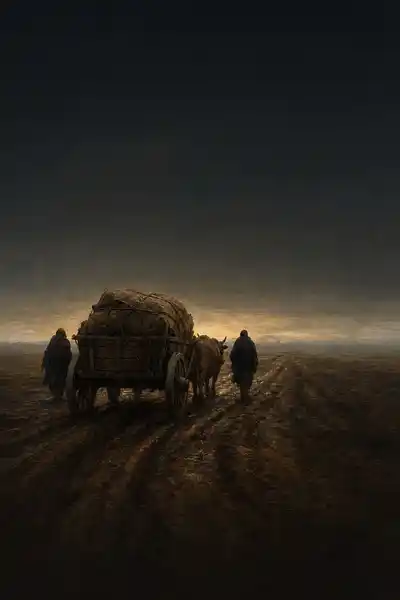
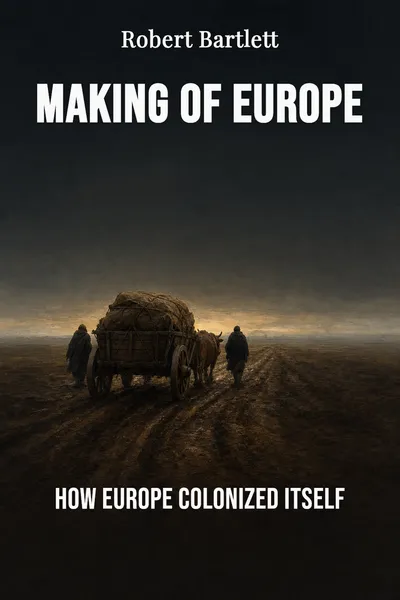
Somewhere around the year 1200, a peasant family might have loaded a cart in a crowded village near the Rhine and set out east, toward land they had never seen, lured by a recruiter who promised a plot, a few years without rent, and the right to be judged under a familiar law rather than a local lord's whim. Multiply that scene by hundreds of thousands, across three centuries and half a continent, and you get the movement Robert Bartlett tracks in The Making of Europe, first published in 1993. It is not a story of kings or crusades in the usual sense. It is a story of ordinary people, charters and plows.
Bartlett's claim is unsettling in its symmetry. Between roughly 950 and 1350, the core of Latin Christendom — a compact zone of Frankish knights, Benedictine monks and Roman clergy — pushed outward in every direction: east into Slavic and Baltic lands, south into Iberia, west into Ireland and Wales, and around the Mediterranean. It did so with settlers, towns, castles and legal privileges, and it left behind a continent that looked strikingly uniform where it had once been a patchwork of separate worlds. Europe, in this telling, was colonized before it colonized anyone else.
The word colonization sits heavily on the medieval period, and Bartlett uses it deliberately. He wants us to see the machinery — the recruitment, the frontier grants, the transplanted institutions — that a later age would ship overseas. The people doing the expanding did not think of themselves as a single civilization on the march. Yet by the end, they had produced one.
The question we’re asking : How did a small core of Latin Christendom expand across a continent, and what did that internal conquest actually build?What we’ll see : A vivid reconstruction of medieval settlement, its human machinery, the people it displaced, and what Europe learned to do with it afterward.
Table of contents
01Chapter 1 — The Frankish frame that spread outward
Bartlett starts by drawing a map most of us never learned. Around the year 1000, the aristocratic, military, ecclesiastical culture we tend to picture as "medieval Europe" occupied a fairly small heartland — roughly the old Carolingian lands, northern France, the Rhineland, parts of Italy. Beyond its edges lay societies that were Christian in different ways, or not Christian at all, organized around kin and locality rather than around castles and cathedral chapters. The interesting historical fact is not that this core existed, but that over the next three hundred years it expanded until its distinctive forms reached from Ireland to the eastern Baltic.
The expansion was not a single conquest directed from one place. There was no medieval master plan, no capital issuing orders. What spread was a recognizable package: the heavy-armored knight, the stone castle, the chartered town, the reformed monastery, a clergy answering to Rome and using Latin. Bartlett's point is that these forms travelled together and reinforced each other. A conquering lord wanted knights; knights wanted land; land needed settlers and revenue; settlers wanted towns and law; the church followed to consecrate the whole arrangement.

02Chapter 2 — Knights, monks and the tools of expansion
What made this outward push possible was less a matter of ideology than of tools, and Bartlett is unusually concrete about them. The first was military. The mounted, armored knight, backed by the castle, gave a small group of newcomers a lopsided advantage over lightly armed local populations. A castle was a machine for holding conquered ground with few men: it turned a raid into a permanent occupation. Across the frontiers of the High Middle Ages, the castle is the physical signature of the Frankish advance.
The second tool was economic and demographic. The core of Europe was growing — more people, more land under the plow, better yields from the heavy plow and three-field rotation. That surplus population had to go somewhere, and lords on the frontier were happy to receive it. Recruiters, sometimes called locators, went into crowded districts and signed up settlers with concrete promises: a measured holding, an initial rent holiday, and a favorable legal status. Whole villages in the east were founded on this model, laid out on a grid, populated by people who had moved hundreds of miles.
03Chapter 3 — The colonists who moved and the ones already there
It is easy to describe expansion as a set of institutions and forget that it was made of people leaving home. Bartlett keeps the human movement in view. Flemings drained coastal marshes and then took their expertise east. Germans crossed the Elbe and Oder into Slavic country. Normans and English pushed into Wales and Ireland. Christian settlers moved south into reconquered Iberia, repopulating towns that changed hands by war. These were not armies alone; they were farmers, brewers, weavers, priests and their families, remaking landscapes in a familiar image.
For the newcomers, the frontier could be a place of opportunity — better terms than they had known at home, land of their own, a freer legal status. Bartlett resists a simple story of victors and losers, but he does not soften the fact that this was conquest. Somebody was already living on the land. Slav, Balt, Irish, Welsh, Muslim and Jewish populations found themselves absorbed, displaced, subordinated, or in some cases assimilated into the incoming order on unequal terms.
04Chapter 4 — A template Europe carried past its own borders
Step back from the villages and charters and a larger claim comes into focus, one that gives Bartlett's book its provocative edge. The mechanisms Europeans refined during their internal expansion did not simply end when the frontiers filled up around 1350. They became a repertoire — a set of practices for taking, holding and settling land that could be carried elsewhere. When European ships reached the Atlantic islands, the Americas and beyond, they were not improvising. They were reaching for tools they had already built at home.
The continuities are specific. The chartered settlement laid out on new ground; the grant of land and legal privilege to lure colonists; the frontier lord holding territory from a fortified point; the church arriving to convert and consolidate; the legal machinery that sorted the conquerors from the conquered by descent. Each of these has a medieval European ancestry. Bartlett notes that the very words and habits of the later colonizers — plantation, conquest, the treatment of natives as a legally distinct category — echo practices worked out on the Elbe, in Ireland, in Andalusia centuries earlier.
05Conclusion
Return to that peasant family loading its cart near the Rhine. Bartlett's achievement is to make us see that their small, hopeful journey east was one thread in something enormous: the assembly of Europe itself. Not a continent that always existed, waiting to act on the world, but a thing built between roughly 950 and 1350 out of settlement, charters, castles and conquest, radiating outward from a modest Frankish core until it reached the sea in every direction.
Related books