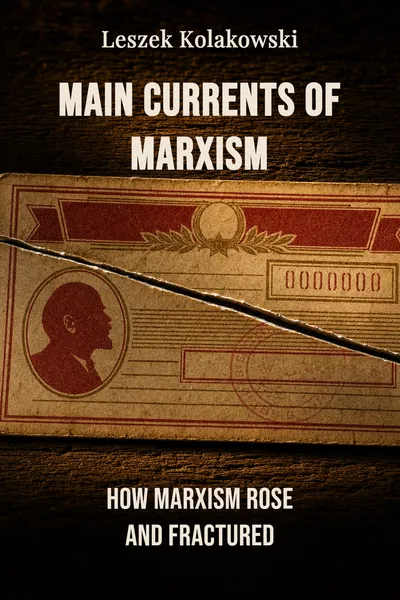
Main Currents of Marxism
How Marxism rose and fractured
Description
In 1978, a Polish philosopher named Leszek Kolakowski published a three-volume history of Marxism that ran to well over a thousand pages. He had been a committed Marxist in his youth, a rising star of the intellectual establishment in postwar Poland, before the regime expelled him from the party in 1966 and eventually pushed him into exile at Oxford. So when he sat down to write the definitive account of the tradition, he was not writing about a set of ideas he had read in a seminar. He was writing about a faith he had held, argued for, and then watched himself lose.
The book he produced, "Main Currents of Marxism," does something unusual. It takes Marxism completely seriously as philosophy — following its arguments back past Marx into German idealism, Christian eschatology, and the Enlightenment — while also delivering, quietly and cumulatively, one of the most devastating critiques the tradition has received. Kolakowski does not caricature. He explains why intelligent people believed, and then he shows where the belief broke. The two moves happen in the same sentences, which is what makes the book hard to argue with.
Marxism, in his telling, is not one thing. It is a river fed by many sources, splitting into currents that flow in opposite directions and sometimes turn against each other. To read its history is to watch an idea promise the reconciliation of everything, gather enormous force, and then fracture under the weight of its own promise. The interesting question is not whether Marx was right. It is how a philosophy of total liberation kept producing the opposite of what it announced.
The question we’re asking : How did a philosophy that promised total human liberation rise to dominate the mind of a century, and then break apart from within?What we’ll see : We follow Kolakowski's river from its distant sources through the moment the idea hardened into doctrine, into the brilliant quarrels of its heyday, and toward the fault line running through the whole enterprise.
Table of contents
01Chapter 1 — The dream older than Marx
Kolakowski opens not with Marx but with a longing that predates him by centuries. The first volume carries a telling subtitle, "The Founders," and its opening chapters wander through territory that seems, at first, to have nothing to do with economics or revolution. He goes back to Plotinus and the neo-Platonists, to medieval mystics, to the Christian idea that history is a story with a beginning, a fall, and a final redemption. His point is that Marxism inherited a very old dream: the dream that human beings are estranged from their true nature and that history is the process by which they will be made whole again.
This is the notion of alienation, and Kolakowski insists it is the secret engine of the whole tradition. Long before it acquired a vocabulary of surplus value and class struggle, the intuition was religious in shape — a world that has fallen away from itself and yearns to return. What the Enlightenment did was to move this drama out of heaven and into human hands. Progress replaced providence. Reason would finish the work that grace had been supposed to do.

02Chapter 2 — When the idea became a philosophy
Kolakowski's account of Marx himself is careful and, in places, admiring. The early Marx, wrestling with alienation in the manuscripts of 1844, is a humanist thinker of genuine power, describing how labor under capitalism turns human activity into something alien and hostile to the worker who performs it. The later Marx, author of "Capital," builds an immense analytical structure meant to expose the hidden laws of capitalist production. Between the two lies a tension Kolakowski will not let the reader forget: the passionate moralist and the would-be scientist do not always speak with one voice.
The core of the mature theory is historical materialism — the claim that the way a society produces its material life determines its politics, its law, its ideas, even its religion. Consciousness does not shape history; history shapes consciousness. Class struggle is the motor. Capitalism, by its own internal contradictions, generates the class that will overthrow it, and the proletarian revolution will end not just one form of exploitation but exploitation as such, ushering in a society without classes and eventually without the state.
03Chapter 3 — The golden age that never held together
The second volume Kolakowski calls "The Golden Age," covering roughly the decades on either side of 1900, when Marxism became the official creed of a mass movement and its finest minds went to work. This is the era of German Social Democracy, of the great theoretical journals, of figures like Karl Kautsky, who guarded the orthodoxy, and Eduard Bernstein, who challenged it. Bernstein looked at the actual capitalism around him and noticed it was not collapsing as predicted; wages were rising, the middle class was growing. He proposed that socialists abandon the prophecy of catastrophe and pursue reform instead. The revisionist controversy that followed was, in Kolakowski's reading, the moment the tradition first split openly over whether it believed its own predictions.
Against Bernstein stood the revolutionaries, and here the book gives us Rosa Luxemburg, brilliant and uncompromising, and above all Lenin, who transformed Marxism into an instrument of political action. Kolakowski treats Lenin with cold clarity. Lenin's crucial innovation was the party — a disciplined vanguard of professional revolutionaries who would bring correct consciousness to a working class that, left to itself, would settle for mere reforms. In that idea Kolakowski sees the germ of everything that followed: if the party embodies the truth of history, then whatever the party decides is by definition the will of the proletariat, and dissent becomes not disagreement but error, even treason.
04Chapter 4 — The doctrine that ate its own contradictions
Step back from the individual thinkers and a single shape emerges across Kolakowski's thousand pages. Marxism, for all its scientific costume, is at bottom a soteriology — a doctrine of salvation. It promises that history will deliver total human reconciliation: the end of alienation, of class, of the division between what we are and what we could be. This is why it inspired devotion that no merely economic theory could command, and why, Kolakowski argues, it could never keep its promise. A doctrine that guarantees paradise on earth licenses any means to reach it, because against infinite redemption no finite cost can weigh.
The third volume, "The Breakdown," traces where the promise led once a state was built in its name. Kolakowski's treatment of Stalinism is unsparing, and he refuses the comforting move of calling it a betrayal of Marx. He does not claim the Gulag was written into "Capital." But he insists that the connection between the theory and the terror is not accidental either. If one class carries the meaning of history, if the party embodies that class, and if opposition is therefore objectively counter-revolutionary, then the machinery of total control follows with a certain logic. The philosophy of universal liberation contained, unexamined, the tools of universal coercion.
05Conclusion
Kolakowski ended his last volume with a sentence that has followed the book ever since: Marxism, he wrote, has been the greatest fantasy of our century. Not the smallest, not the most contemptible — the greatest. Coming from a man who had believed and then paid, in his career and his country, for ceasing to believe, the word carries its full weight. He meant that the tradition was serious, morally powerful, intellectually vast, and finally an illusion — a dream of total reconciliation dressed as the necessary law of history.
Related books