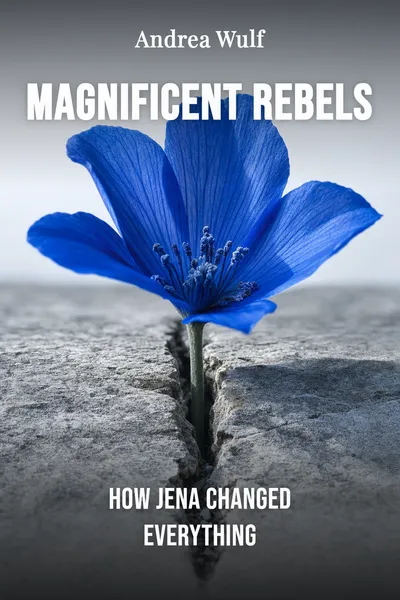
Magnificent Rebels
How Jena changed everything
Description
In the mid-1790s, a sleepy university town in central Germany, home to maybe four thousand people, briefly became the most intellectually charged square mile in Europe. Jena had a small university, cheap lodgings, a duke next door in Weimar who liked writers, and — crucially — lax censorship. Within a few years it drew a cluster of young philosophers and poets who would rewrite what it meant to be a person. Goethe rode over from Weimar. Schiller settled in. The Schlegel brothers arrived, then Novalis, then Schelling, then a philosopher named Fichte whose lectures were so electric that students packed the hall to hear him say, essentially, that the world begins with the self.
What happened there was not a movement anyone planned. It was closer to a shared household that occasionally exploded. These people married each other's spouses, reviewed each other's books, borrowed each other's money, and fell out spectacularly. But in the middle of the domestic chaos, they arrived at an idea that felt genuinely new: that the individual self was not a small thing tucked inside a God-given order, but the very place where meaning, nature, and freedom came into being. It sounds abstract. In their hands it was almost dangerous.
In her book Magnificent Rebels, Andrea Wulf follows this circle year by year, treating them less as marble busts than as a volatile group of friends in their twenties and thirties, working out ideas we now breathe without noticing. The story is worth following partly because these people were so alive, and partly because so much of how we think about ourselves started in their rented rooms.
The question we’re asking : How did a handful of young thinkers in one small German town rework the idea of the self — and why does it still shape the way we see our own lives?What we’ll see : A university town, a philosophy that put the self at the center, the human wreckage that surrounded it, and the long shadow it casts over how we talk about who we are.
Table of contents
01 Chapter 1 — A small town with the wrong kind of ambition
Jena in the 1790s had almost nothing going for it on paper. It was small, muddy, and provincial, overshadowed by Weimar down the road where the court and the money lived. What it had instead was a university that welcomed outsiders and a censorship regime loose enough that dangerous books could be printed and dangerous lectures given. For a generation of young people raised in the long shadow of the French Revolution — which had begun in 1789, when most of them were teenagers or barely older — that combination was irresistible.
The revolution mattered more than any single text. These were people who had watched a whole social order be torn up in the name of the individual and his rights, and who felt the tremor even in a German backwater with no revolution of its own. Political freedom had failed to arrive in the German lands; the states stayed small, absolutist, and cautious. So the energy went inward and upward, into philosophy, poetry, and science. If they could not remake the state, they would remake the mind.

02 Chapter 2 — The Ich, and the argument that lit the fuse
The spark that set everything alight was a philosopher named Johann Gottlieb Fichte, who arrived to teach in 1794 and immediately drew crowds. Fichte took the difficult work of Immanuel Kant and pushed it somewhere Kant had not gone. Kant had argued that we never encounter the world raw; the mind supplies the forms through which anything can appear. Fichte's move was bolder and stranger: he began from the Ich, the I, the self that posits itself and, in the same act, posits everything it is not. The self, in this telling, was not a passive spectator of reality but its active source.
To students this landed like a liberation. If the self was the ground of the whole world of experience, then freedom was not a political gift to be petitioned from a prince — it was the deepest structure of being a person. You could hear, in the packed lecture hall, a generation being told that their own inner life was the most important thing in the universe. Fichte was combative, absolute, and eventually too much even for Jena; a dispute over religion later cost him his post. But the seed was planted.
03 Chapter 3 — Brilliant, entangled, and mostly impossible to live with
The ideas were exhilarating. The lives were a mess. Wulf's great achievement is refusing to separate the two, and one figure holds the whole tangle together: Caroline Schlegel. Sharp, fearless, and better read than most of the men, she had already been jailed briefly on suspicion of revolutionary sympathies before she reached Jena. She married August Wilhelm Schlegel, ran what was effectively the circle's intellectual salon, and did an enormous amount of unsigned work on the translations and reviews that made the group's reputation.
Then she fell in love with Schelling, who was more than a decade younger, and eventually left one Schlegel brother to marry the philosopher. This was not a footnote. The circle prized love, passion, and self-realization as philosophical values, and then had to live with what happens when real people actually pursue them. Friendships curdled. The other Schlegel brother, Friedrich, was meanwhile living openly with Dorothea Veit, a married woman who left her husband for him — a scandal he half-turned into a novel, Lucinde, that shocked respectable Germany.
04 Chapter 4 — The self we inherited without noticing
Step back from the marriages and the quarrels and what the Jena circle left behind is a way of experiencing our own existence that now feels simply obvious. The assumption that each person carries a unique inner self, that this self ought to be expressed rather than suppressed, that finding and following it is a life's central task — none of that is a permanent feature of human beings. It is, to a striking degree, an inheritance from a few years in one German town. Wulf's argument is that we are all, in this sense, quietly living in the world the rebels of Jena built.
The inheritance runs everywhere once you notice it. The idea that a life should be authentic, that feelings are a form of knowledge, that nature is something to commune with rather than merely exploit, that the artist's inner vision is a kind of truth — these are Jena's fingerprints, passed down through poetry, through philosophy, and eventually through the everyday vocabulary of self-fulfillment. The Romantic bet that the individual is the true center of meaning became the water we swim in.
05 Conclusion
By 1806, the circle was scattered and the town's brief golden age was effectively over. That autumn, Napoleon's army crushed the Prussians just outside Jena, and the small university town that had hosted a revolution in ideas found itself trampled by the real thing marching through its streets. Goethe stayed on in Weimar; Schiller was already dead; the Schlegels, Schelling, and the rest had moved on to other cities and other lives. The household never reassembled.
Related books