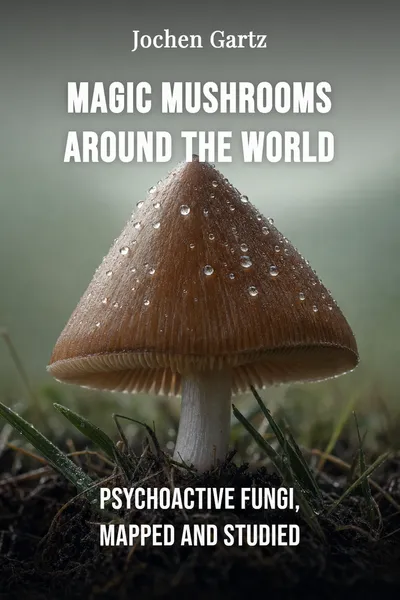
Magic Mushrooms Around the World
Psychoactive fungi, mapped and studied
Description
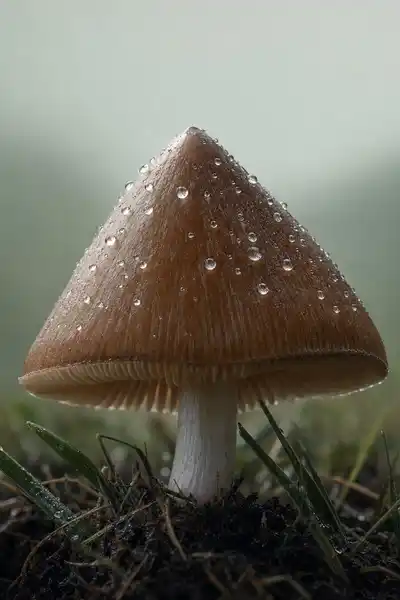
Somewhere on a cow pasture in the Pacific Northwest, on a wet Welsh hillside, along a roadside in central Mexico, the same small brown mushroom is pushing up through the grass. It is unremarkable to look at — a slim stem, a conical cap, the kind of thing a hiker steps over without a second glance. And yet this modest organism has generated criminal statutes, religious ceremonies, scientific papers, and decades of argument. Jochen Gartz, a German chemist who spent years working with these fungi in the laboratory, set out to do something the field had not seen in roughly a decade: gather what was actually known about them, species by species, region by region.
His book, Magic Mushrooms Around the World, is not a manifesto and not a trip report. It is closer to a naturalist's ledger — dozens of species described, distribution maps drawn, active compounds measured, and the wildly different ways human cultures have treated the same fungus laid side by side. Some of the mushrooms he covers are famous. Others are rare, poorly documented, known from a handful of collections in a single valley. What unites them is a family of molecules the human brain happens to respond to.
That coincidence — a chemistry that means nothing to the mushroom and a great deal to us — is where the book gets its quiet tension. Gartz writes as someone who measures things for a living, which makes his subject feel less mystical and, oddly, more strange. A fungus does not know it is illegal in one country and sacred in another. It simply grows.
The question we’re asking : How does one organism end up mapped, measured, worshipped, and outlawed all at once?What we’ll see : A chemist's global survey of psychoactive fungi, from where they grow to what they contain to what we have decided they mean.
Table of contents
01 Chapter 1 — The fungus that grows on every continent
One of the first things Gartz establishes is how widely distributed these mushrooms are. The popular image ties them to a few exotic locations — a Mexican mountain village, a corner of the Amazon — but the reality he maps is far broader. Species in the genus Psilocybe, which contains most of the relevant fungi, turn up across North and South America, throughout Europe, in South and East Asia, in Australia and New Zealand, and in parts of Africa. They are not tropical curiosities. Several of the most potent grow in cool, damp, temperate climates.
The best-known European species, Psilocybe semilanceata — the liberty cap — favors grazed grassland and appears reliably across Britain, Ireland, and much of continental Europe each autumn. Across the Atlantic, other species thrive in decomposing wood chips, on dung, in gardens and along landscaped verges. Gartz notes that human land use has quietly expanded their range: the mulched flowerbeds of a modern city can host fungi that never grew there before. The mushroom follows disturbance, and few animals disturb the ground like we do.

02 Chapter 2 — What the laboratory finds inside
Gartz's home ground is the bench, and the book is at its most distinctive when it turns to what these mushrooms actually contain. The two compounds that matter are psilocybin and its close relative psilocin. Psilocybin is the more stable of the pair; once inside the body it converts to psilocin, which is the active form. Both were first isolated and named in the late 1950s by the Swiss chemist Albert Hofmann, working from material sent out of Mexico — the same Hofmann who had earlier synthesized LSD.
What Gartz adds is granularity. He reports how concentrations vary not only between species but within them — from one collection site to another, between the cap and the stem, and depending on how the specimen was dried and stored. A liberty cap gathered on one hillside can differ markedly from one gathered on the next. This variability is not a footnote; it is central to understanding why the fungi resist neat generalization. There is no single dose that a species reliably delivers, because the fungus is a living thing responding to its conditions, not a manufactured tablet.
03 Chapter 3 — Two cultures, two answers
Set the biology beside the anthropology and the contrast is stark. Gartz devotes real attention to how different societies have received the same organism, and the range is remarkable. In parts of Mesoamerica, the use of psychoactive mushrooms reaches back centuries and was woven into ritual and healing. The Mazatec of Oaxaca, and the healer María Sabina in particular, became famous in the West after the American banker and amateur mycologist R. Gordon Wasson published an account of her ceremonies in the late 1950s — an encounter that transformed both a local practice and a global curiosity.
That publicity had consequences Gartz does not romanticize. Attention from outsiders disrupted the very tradition it celebrated, drawing seekers to a community unprepared for them and straining the discretion the practice had depended on. The mushroom that had meant one thing in a Mazatec ceremony came to mean something quite different once it entered Western imagination — a symbol, a commodity, a controversy.
04 Chapter 4 — A map that keeps redrawing itself
Step back from the individual species and a larger point in Gartz's approach comes into focus. His book is built around maps and measurements — the tools of someone trying to pin a subject down. But what the survey ultimately reveals is how much of the subject refuses to hold still. The distribution maps shift as land use changes and as new populations are recorded. The chemical values vary from one specimen to the next. The legal status flips at a border. The cultural meaning transforms the moment an outsider walks into the room. Only the organism itself stays roughly constant.
This is the quiet argument underneath the ledger. By insisting on precision — measured concentrations, careful identifications, sourced figures — Gartz throws into relief just how unstable everything surrounding the fungus is. The science firms up what it can, but the mushroom keeps generating new questions faster than the answers accumulate. A field guide from a decade earlier is already partly out of date; ranges have expanded, analytical methods have sharpened, laws have moved.
05 Conclusion
Return to that small brown mushroom in the grass. Over the course of the book it has been located on maps, weighed and analyzed in the laboratory, traced through a Mazatec ceremony and a modern statute, and found to be at once ordinary and endlessly contested. Gartz never lets us forget that all of this activity happens around the fungus, not within it. It grows, produces its compounds, releases its spores, and knows nothing of the arguments it has set off.
Related books