Lincoln at Gettysburg
Lincoln's words, reborn
Description
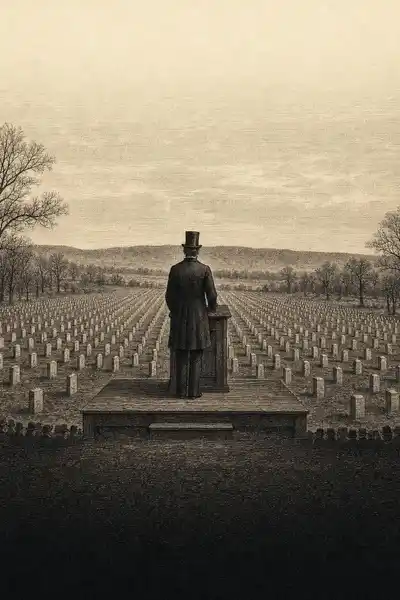
On November 19, 1863, a crowd gathered on a ridge in Pennsylvania to dedicate a cemetery for the men who had died there four and a half months earlier. The featured speaker was Edward Everett, the most celebrated orator in America, a former president of Harvard and secretary of state. He spoke for roughly two hours, from memory, in the grand classical style the occasion seemed to demand. Then the president of the United States stood up and read from a single sheet of paper for a little over two minutes. He said fewer than 275 words. By the time the applause had settled, most of the audience had barely registered that he was finished.
For decades a comfortable legend circulated: Lincoln had scribbled the speech on the back of an envelope during the train ride, an inspired afterthought from a busy man. The historian Garry Wills, in his 1992 book on the Address, dismantles that story and replaces it with something far more interesting. The speech was not an accident of the moment. It was the distilled product of years of reading, arguing, and thinking about what the nation was and what its founding documents actually meant. In two minutes, Lincoln did something that historians usually need a war to accomplish.
Wills's claim is bold and specific. He argues that Lincoln, standing over the graves at Gettysburg, quietly rewrote the terms on which Americans understood their own country — and that he did it not by contradicting anyone but by choosing his words with the precision of a surgeon. The Address is short, but almost nothing in it is casual. Every clause is doing work, and the work adds up to a transformation the crowd could not have seen coming.
The question we’re asking : How did a two-minute speech that most of its first listeners barely noticed end up remaking the way a nation understood its own founding?What we’ll see : How a president known for his cases and his stories turned brevity into an instrument of political change — and what that instrument reveals about the man holding it.
Table of contents
01 Chapter 1 — Two minutes after two hours
The setting Wills reconstructs is not the intimate hush of legend but a public event with a program, a schedule, and a hierarchy of importance. The main attraction was Edward Everett, and everyone understood this. Everett had prepared for weeks, walked the battlefield, studied the troop movements, and built an oration in the Greek funeral tradition — a form with rules, expectations, and a fixed emotional arc. Two hours was not indulgent by the standards of the day. It was the measure of respect the dead were owed.
Lincoln's role was almost ceremonial. He had been invited to offer a few "appropriate remarks" to formally dedicate the ground, a courtesy slot after the real speech. The organizers did not expect the president to compete with Everett, and Lincoln did not try to. What he brought instead was a different idea of what a funeral oration could be for. Where Everett narrated the battle in exhaustive detail, Lincoln never named the battle, never named a general, never named the enemy. He barely referred to the specific events at all.

02 Chapter 2 — The words that came from somewhere
The heart of Wills's argument is that the Address did not spring from nowhere. It was assembled, consciously, out of materials Lincoln had been working with for years. One of those materials was the tradition of the Greek funeral oration, especially the speech Pericles gave over the Athenian war dead as Thucydides recorded it. That form had a recognizable structure: praise the dead by pointing not to their individual deeds but to the ideals of the community they died for, and then turn to the living and ask them to be worthy. Lincoln's speech follows that arc almost exactly, which Wills treats as design rather than coincidence.
A second material was the culture of rural cemeteries and the movement to make burial grounds into civic, almost sacred, public spaces. Gettysburg was being consecrated as one of these new cemeteries, and the ceremony borrowed the language of dedication and consecration that the movement had made familiar. Lincoln plays on those very words — dedicate, consecrate, hallow — and then inverts them, insisting that the living cannot consecrate the ground because the dead already have. The rhetorical move only lands because the audience knew the vocabulary of consecration cold.
03 Chapter 3 — A quiet rewrite of the founding
Here Wills makes his most consequential claim, and it turns on a single date. Lincoln opens not with the Constitution of 1787 but with a phrase — "four score and seven years ago" — that counts back to 1776 and the Declaration of Independence. The choice matters enormously. The Constitution is a document of compromise that accommodated slavery in several places without ever naming it. The Declaration is a document of principle, and its principle is that all men are created equal. By anchoring the nation's birth in 1776 rather than 1787, Lincoln quietly proposed that the country's founding commitment was to equality.
This was not a neutral historical observation. It was, Wills argues, an argument about what the war was for and what kind of country would emerge from it. Many of Lincoln's contemporaries, including much of the legal establishment, understood the United States as a compact among states defined by the Constitution. Lincoln offered a different genealogy, in which the states were secondary and a single people, dedicated to a proposition, came first. He did not announce that he was doing this. He simply spoke as though it were already true, and the confidence of the assumption did much of the persuading.
04 Chapter 4 — The style that made it stick
Step back from the argument and the Address becomes a window onto Lincoln himself. Wills's larger portrait is of a man who used language the way a general uses terrain — with an eye for economy, position, and the decisive point. The plainness of the speech is not modesty. It is a form of control. Lincoln understood that a short, balanced sentence lodges in the memory while a long ornate one dissolves, and he chose the memorable form deliberately, knowing that what people can repeat is what survives.
This was the same intelligence that had built his legal career and his political rise. Lincoln had spent decades in courtrooms and on debate platforms learning that the person who defines the terms usually wins the case. At Gettysburg he defined the terms of national identity in words simple enough that no one could argue with the phrasing even as the meaning quietly shifted beneath them. The technique is almost invisible, which is why it worked. You cannot easily object to a sentence you find yourself agreeing with before you have finished hearing it.
05 Conclusion
Edward Everett went home to his reputation as America's finest orator, and within a generation almost no one could quote a line of what he said that day. Lincoln's few minutes became something schoolchildren memorized, monuments engraved, and historians spent careers unpacking. The reversal that began the moment Everett sat down has only deepened. The two-hour oration is a historical curiosity; the two-minute one is close to scripture.
Related books