Lies My Teacher Told Me
What textbooks refuse to teach
Description
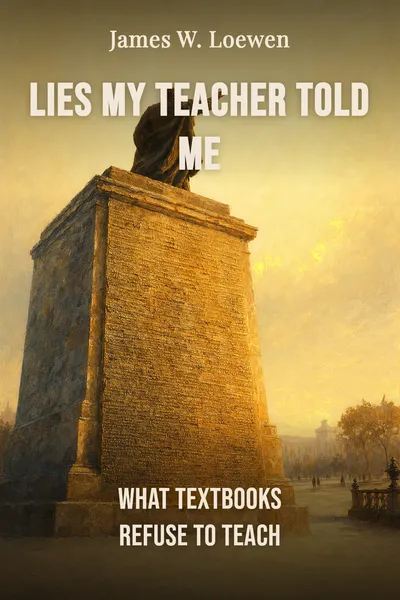
In the late 1980s, a sociologist named James Loewen sat down and did something few people bother to do with a high-school textbook: he read one cover to cover. Then he read another. In the end he worked through twelve of the leading American history textbooks in use across the country, the fat glossy ones weighing four or five pounds, the ones assigned to millions of teenagers every year. What he found was not a set of twelve accounts arguing with each other. It was one account, repeated twelve times, with the disagreements sanded off and the hard parts quietly removed.
The book that came out of it, published in 1995, was called Lies My Teacher Told Me. It won an American Book Award, sold more than half a million copies across its editions, and became one of those rare academic titles a lot of non-academics actually finished. Its charge was blunt. American history as taught in school is not just incomplete — it is actively shaped to reassure, to flatter, and to bore. The heroes are perfect, the villains are foreign, the conflicts resolve neatly, and the country is always, in the end, getting better.
That premise sounds like it should produce an angry book. What Loewen wrote instead is closer to a detective's report: patient, specific, more interested in showing the mechanism than in scoring points. He goes looking for the seams where the official story was stitched together, and he finds them everywhere — in the way Columbus is introduced, in what happens to Helen Keller's politics, in the twelve years after the Civil War that most textbooks would rather forget.
The question we’re asking : Why does American history taught in school feel so flat, so heroic, and so oddly untrustworthy — and who decided it should be that way?What we’ll see : What Loewen found inside twelve textbooks, and the machinery that keeps producing the version students learn to tune out.
Table of contents
01Chapter 1 — Twelve textbooks that agreed on everything
The first thing Loewen noticed was the sameness. Twelve textbooks from different publishers, different authors, different decades, and they read as if a single cautious committee had written them all. Same triumphant arc, same cast of unblemished founders, same reluctance to say anything a parent in any state might object to. He came to see this not as coincidence but as the natural output of how these books get made and sold — and the uniformity was the tell that something other than accuracy was steering the ship.
Take the sheer heft of them. A typical volume ran well over a thousand pages and covered five centuries, which sounds thorough until you realize the length works against understanding rather than for it. Everything is mentioned; almost nothing is explained. Causes disappear. A war simply happens, a movement simply arises, a president simply decides. Students come away with a blur of names and dates and no working sense of why anything occurred — which, Loewen argues, is exactly what makes the subject feel like memorization rather than thought.

02Chapter 2 — The heroes get sanded down
Nowhere is the tidying more visible than in how the textbooks handle famous people. Loewen's word for it is heroification — the process by which a real, complicated human being is turned into a flawless statue. The awkward parts are chipped away until nothing remains but virtue, and the result is a figure no student can relate to and no student quite believes.
Columbus is the opening example. The textbooks give him courage, curiosity, and a nice round date, and stop there. What they leave out is the man who, by his own logs and those of his companions, enslaved the people he encountered, demanded tribute in gold, and presided over the collapse of the Taíno population. Loewen's point is not simply to indict Columbus. It is that a student who later learns any of this feels tricked — and rightly so — because the book chose comfort over completeness.
03Chapter 3 — Reconstruction was the lie that stuck
If heroification is the small-scale distortion, Loewen argues that Reconstruction is where the textbook version of American history commits its most damaging large-scale one. The twelve years after the Civil War, when the federal government attempted to remake the South and extend full citizenship to formerly enslaved people, are among the most consequential in the nation's history. The textbooks he surveyed treated them as a confusing, corrupt interlude best hurried past.
The version that had settled into American schoolbooks came, Loewen shows, from an early-twentieth-century school of historians who framed Reconstruction as a tragic mistake — a period when vengeful Northerners and unqualified freedmen misgoverned a prostrate South until decent order was mercifully restored. That interpretation was not neutral. It was built to justify the system of segregation and disenfranchisement that followed, and it lingered in textbooks for decades after historians had thoroughly dismantled it.
04Chapter 4 — Boredom is the point
Step back from any single distortion and a harder question surfaces: why does this keep happening? Loewen's answer is that no villain is required. The textbook version of American history is the predictable product of a system, and the system rewards blandness at every step. Publishers do not write these books to be true so much as to be adoptable, and adoptable means offending no one who holds a vote over the purchase.
The mechanism runs through the adoption boards. A handful of large states buy textbooks centrally, and their committees can make or break a title's national sales. A book that takes a clear position on anything contested risks losing an adoption, so publishers hedge everything, drop what might provoke a complaint, and pile on the uncontroversial names and dates that pad a book without endangering it. The result is a volume engineered to survive a political process, not to teach.
05Conclusion
Loewen began by reading twelve textbooks the way almost no one ever does, and ended by describing a machine — adoption boards, cautious publishers, the national urge to be reassured — that reliably turns a dramatic past into an inert one. The Columbus who is only brave, the Helen Keller frozen at the water pump, the Reconstruction hurried past in a paragraph: none of these are accidents. They are what the machine produces when it is working exactly as designed.
Related books