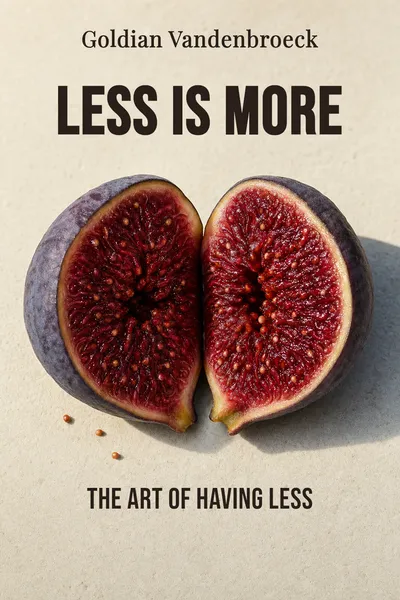
Less Is More
The art of having less
Description
In 1991, an editor named Goldian Vandenbroeck published a book with a title that had already become a slogan: Less Is More. The phrase was borrowed from the architect Mies van der Rohe, though he had lifted it in turn from a Robert Browning poem. But Vandenbroeck's book was not about buildings or design. It was an anthology — a gathering of voices, hundreds of them, stretched across continents and centuries, all circling the same stubborn question. How much does a person actually need? He assembled Lao Tzu and Thoreau, Seneca and the Shakers, Gandhi and medieval monks, and let them speak in fragments, side by side, without forcing them to agree.
What holds the collection together is not a thesis so much as an intuition, one most of us have felt at some point. The sense that we have more than we use, that acquiring rarely delivers what it promised, that beyond a certain point adding to a life starts to subtract from it. Vandenbroeck's wager is that this intuition is old — far older than the twentieth-century anxieties about consumption that made his book feel timely. He traces it back to an idea the Greeks called the golden mean, and to something even plainer: the natural economy of taking only what you can use.
An anthology is a strange kind of book. It makes no claims of its own, yet the selection is itself an argument — every voice chosen, every voice left out. Reading Vandenbroeck means reading a curator's mind through the company he keeps, and asking why so many unrelated people, separated by language and millennia, kept arriving at the same modest conclusion.
The question we’re asking : Why have thinkers across so many eras and cultures kept returning to the idea that having less can mean living more?What we’ll see : How an anthology gathers scattered voices around a single old intuition, and turns the case for simplicity into a discipline of attention rather than a rule.
Table of contents
01 Chapter 1 — An anthology, not an argument
The first thing to understand about Less Is More is its form. Vandenbroeck did not write a treatise defending simplicity; he built a mosaic of other people's words. The book is organized by theme rather than chronology, so a Taoist sage from the sixth century BCE might sit on the same page as a nineteenth-century American transcendentalist or a Roman senator. The effect is deliberate. By stripping away the historical context around each fragment, Vandenbroeck makes the reader feel that these voices are in conversation, answering each other across gulfs of time and geography they never knew existed.
This method carries a quiet risk, and Vandenbroeck seems aware of it. Pulled out of context, a maxim can flatten into a fortune-cookie line. A sentence Seneca wrote to console a grieving friend reads differently once it becomes one entry in a list about wanting less. The anthology asks us to accept the loss of that context in exchange for something else: the recognition that the impulse toward moderation is not the property of any one tradition. It shows up in Stoicism and Buddhism, in Christian monasticism and Confucian ethics, in the practical frugality of the Shakers and the ecological warnings of the twentieth century.

02 Chapter 2 — The golden mean, retrieved
At the center of the anthology sits an idea Vandenbroeck treats as the hidden spine of the whole tradition: the golden mean. The Greeks framed it as the virtue that lies between two vices — courage between cowardice and recklessness, generosity between stinginess and waste. Aristotle gave it its most careful formulation, but the intuition is older and wider, appearing in Confucius as the doctrine of the mean and in the Buddhist middle way between indulgence and self-denial. What these traditions share is a refusal of the extremes, and a conviction that the good life is found in proportion rather than accumulation.
This is the crucial move in Vandenbroeck's reading, and it corrects a common misunderstanding. Less Is More is not a book about renunciation. The ascetic who starves himself is as far from the mean as the glutton who stuffs himself; both have lost the sense of proportion. The tradition the anthology gathers is not asking us to have nothing. It is asking us to find the point of enough — the quantity that serves a life rather than crowding it. Simplicity, in this framing, is not deprivation. It is calibration.
03 Chapter 3 — The economy of enough
Alongside the philosophical thread, Vandenbroeck weaves a second one that feels closer to natural law than to ethics: the idea of economy in its oldest sense. Before economy meant markets and money, it meant the management of a household — the art of stewarding limited resources so that nothing is wasted and everything is used well. Many of the voices in the anthology speak in these terms. They notice that nature takes only what it needs, that a healthy organism does not hoard, that abundance pursued past a point turns into burden. Thoreau at Walden Pond is the emblem here, reducing his wants until he could see clearly what a life required.
The insight the anthology keeps circling is that possessions carry a hidden cost. A thing owned must be stored, maintained, protected, thought about. Beyond a certain quantity, our belongings begin to make demands on us; we work to keep them as much as they serve us. Several of the passages Vandenbroeck selects turn this into a near-arithmetic: wealth is measured not by what you have but by what you can do without. To need little is to be, in a real sense, rich — because the person who wants nothing beyond their means is free in a way the person always reaching for more can never be.
04 Chapter 4 — Voluntary simplicity as a way of seeing
Step back from the individual maxims and a larger shape appears in what Vandenbroeck has assembled. The book is not really a case for owning fewer things. It is a case for a particular kind of attention — the habit of asking, continually, what a human life actually needs, and refusing to let the answer be dictated by whatever the surrounding culture happens to offer. Every voice in the anthology, whatever its era, performs the same act: it stops, notices the gap between wanting and needing, and chooses deliberately. Simplicity, in this light, is less a state than a practice of noticing.
This reframing matters because it takes the tradition out of the realm of moralism. The book never says that wealth is wicked or that comfort is corrupting. What it says, through its accumulated voices, is subtler: that we tend to acquire on autopilot, mistaking the pursuit of more for the pursuit of better, and that the value of the simple life is mostly in the pause it forces. To choose less is first of all to choose to look — to examine a want before satisfying it, to ask whether the thing will serve the life or merely fill it. The having follows from the seeing, not the other way around.
05 Conclusion
Vandenbroeck ended where he began, with a chorus rather than a conclusion. Less Is More closes the way it opens, handing the reader one more voice and trusting them to hear the pattern. The title, borrowed and reborrowed until it became almost invisible, turns out to carry a claim the whole book quietly earns: that beyond a certain point, addition subtracts, and that the people who understood this best were rarely the poorest — they were the ones who had looked hardest at the difference between having and living.
Related books