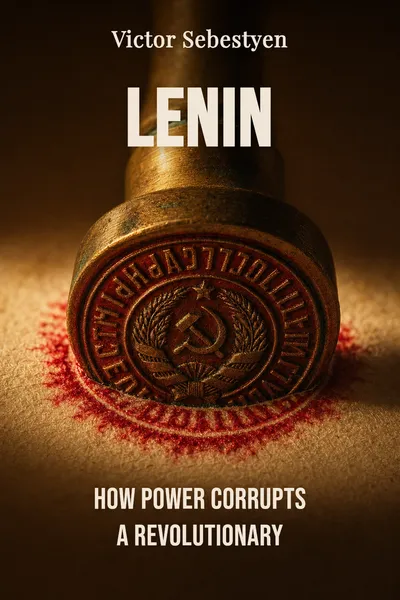
Lenin
How power corrupts a revolutionary
Description
On the morning of May 20, 1887, a nineteen-year-old named Alexander Ulyanov was hanged at the Shlisselburg fortress near Saint Petersburg for plotting to assassinate Tsar Alexander III. His younger brother, seventeen at the time, was studying for exams in the provincial town of Simbirsk. The family had been respectable, monarchist, comfortable — their father a school inspector who had earned hereditary nobility. The hanging ended all of that. Neighbors crossed the street to avoid them. And the younger brother, Vladimir Ilyich Ulyanov, later known to the world as Lenin, absorbed a lesson that the biographer Victor Sebestyen places at the root of everything that followed: individual martyrdom was useless. What was needed was organization.
Sebestyen's biography, published in 2017, tracks the distance between that grieving teenager and the man who, thirty years later, would run a state by decree, order hostages shot, and sign off on a secret police with powers no tsar had ever claimed. It is not a hagiography and not a hatchet job. It is a portrait of a man of formidable intelligence and genuine conviction who came to believe that the future he imagined justified almost any present cruelty — and who built the machinery to act on that belief.
The interest of the book is less in the crimes than in the slope. Lenin did not begin as a monster. He began as a bright, bookish, orphaned lawyer's son with a burning sense of injustice. Somewhere between the reading room and the Kremlin, the methods hardened, and the man hardened with them. Where does the line run — and does the revolutionary cross it, or does the power do the crossing for him?
The question we’re asking : How does a serious, principled young idealist become a leader who governs by terror — and how much of that transformation is the man, and how much is power itself?What we’ll see : Sebestyen's account of Lenin from the family tragedy that radicalized him to the emergency state he built, and never dismantled.
Table of contents
01 Chapter 1 — The boy who read Chernyshevsky after his brother hanged
Sebestyen is careful to correct the Soviet myth of a revolutionary born in poverty. The Ulyanovs were bourgeois in the fullest sense — a large, affectionate, intellectually ambitious family, church-going, loyal to the crown. Young Vladimir was the star pupil, top of his class, disciplined to the point of severity. His headmaster in Simbirsk, in one of history's small ironies, was the father of Alexander Kerensky, the man Lenin would one day overthrow. Nothing in the boy's early years pointed toward the barricades.
The turn came with his brother's execution in 1887. Sebestyen argues that Alexander's death did not so much create Lenin's radicalism as give it a target and a temperature. What emerged was not grief that softened him but grief that organized him. He devoured Nikolai Chernyshevsky's novel What Is to Be Done?, a clumsy piece of fiction whose hero, the ascetic revolutionary Rakhmetov, sleeps on nails and renounces all pleasure for the cause. Lenin read it, by his own account, five times in one summer, and it shaped him more than Marx did for years.

02 Chapter 2 — The professional revolutionary who never held a real job
The bulk of Lenin's adult life before 1917 was spent abroad and broke — in Munich, London, Geneva, Paris, Zurich, moving between shabby rented rooms and reading rooms, living off a modest family inheritance and party funds of murky origin. Sebestyen is good on the sheer unglamorous grind of it: the endless factional pamphlets, the splits over doctrine so fine that outsiders could not tell the sides apart, the venomous denunciations of former comrades. This was Lenin's true vocation. He was, in the most literal sense, a professional revolutionary who never held an ordinary job.
His signature idea took shape in these years. In 1902, in a pamphlet he titled What Is to Be Done? after Chernyshevsky's novel, Lenin argued that the working class, left to itself, would never make a revolution — it would settle for better wages. What was needed was a small, disciplined, secretive party of professionals who would lead the masses whether the masses knew it or not. This vanguard party was the engine of everything that came later, and it contained, in embryo, the whole logic of one-party rule.
03 Chapter 3 — October, and the party that seized more than a palace
The February Revolution of 1917 caught Lenin completely by surprise. Bread riots and army mutinies in the capital toppled the three-hundred-year-old Romanov dynasty in a matter of days, and Lenin learned of it from newspapers in Switzerland. His problem was purely practical: how to get home across a Europe at war. The famous solution — the sealed train through Germany, arranged because the German high command reckoned a returning Lenin would wreck the Russian war effort — was one of the war's shrewdest gambles. He arrived at Petrograd's Finland Station in April 1917 to a hero's welcome and immediately astonished his own party by demanding not cooperation with the new Provisional Government but its overthrow.
Sebestyen's account of the months that followed is a study in nerve and opportunism. Lenin's slogans — Peace, Land, Bread; All Power to the Soviets — were brilliantly attuned to what exhausted soldiers and hungry peasants actually wanted. He read the collapse of authority faster and more ruthlessly than anyone else. After a failed rising in July he fled to Finland, disguised, clean-shaven, and wrote furiously. By autumn, with Kerensky's government hollowed out, he returned in secret and browbeat a hesitant Bolshevik leadership into staging an armed seizure of power.
04 Chapter 4 — The state of emergency that never ended
Every measure Lenin reached for after October was framed as temporary — a response to civil war, to famine, to foreign intervention, to sabotage. In December 1917 he created the Cheka, the secret police, as an emergency body to fight counter-revolution. It never went away; it became the ancestor of the OGPU, the NKVD, the KGB. War communism — the forced requisition of grain from the peasantry, the militarization of labor, the abolition of private trade — was sold as a wartime necessity. Terror, Lenin insisted, was regrettable but required, and he signed telegrams demanding that specific numbers of hostages and kulaks be hanged publicly, so that people would see and tremble.
Sebestyen's larger argument is about how the provisional becomes the permanent. Lenin genuinely believed the coercion was a phase, that the state would eventually wither and a freer order emerge on the far side of the emergency. But the emergency became the system. Each crisis justified the next expansion of power, and there was no mechanism, and no will, to reverse the ratchet. When peasants and even the loyal sailors of Kronstadt rose in 1921 demanding the freedoms the revolution had promised, Lenin crushed the revolt and then, with the New Economic Policy, made economic concessions while tightening the political vice further. Dissent inside the party itself was banned that same year.
05 Conclusion
Sebestyen returns, in the end, to the young man of the opening pages — the disciplined student, the loving brother, the reader who wept and then organized. Nothing about him was inevitable, and the book resists the comfort of treating Lenin as a born tyrant. He was a man of real intellect and real conviction who made a series of choices, each defensible in the moment, each narrowing the ground under his feet. The certainty that had once made him formidable in exile made him merciless in power, because certainty, given a state to run, does not tolerate the friction of other people's wishes.
Related books