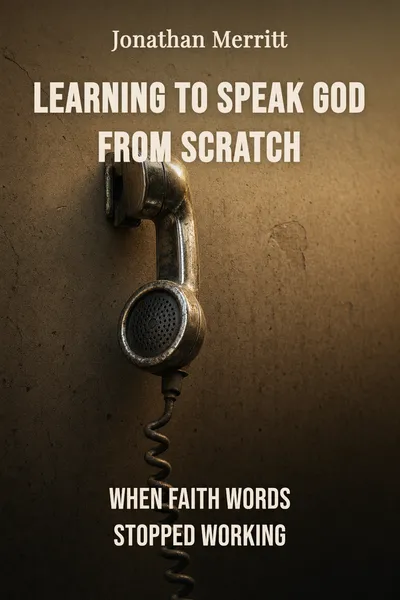
Learning to Speak God from Scratch
When faith words stopped working
Description
Jonathan Merritt grew up in the Bible Belt as the son of a prominent Southern Baptist pastor, in a world where words like grace, gospel, and blessing were the air everyone breathed. Then, in his early thirties, he moved to New York City. The change of address turned out to be a change of language. The sacred words that had once opened conversations and knit him to other people suddenly landed with a thud. Friends went quiet, or squirmed, or heard something he hadn't meant to say. The vocabulary that had described his entire inner life stopped doing its job.
That personal friction sent Merritt looking for numbers, and the numbers told a wider story. In surveys he commissioned and combed through, most Americans said they simply don't talk about faith, spirituality, or God in an average week — even many who consider themselves religious. A whole category of speech that used to be ordinary had gone silent. Words like sin and lost, meanwhile, had curdled into conversation-enders, loaded with so much baggage that saying them felt like slamming a door rather than opening one.
His book, published in 2018, treats this as a quiet crisis rather than a personal quirk — a slow forgetting of how to speak about the things people still, privately, care about most. Merritt's response isn't to mourn the old fluency or to double down on it. It's to ask whether these words can be learned again, word by word, the way you'd pick up a foreign language as an adult.
The question we’re asking : What happens to a culture when its shared vocabulary for faith stops working — and can those words be relearned?What we’ll see : How a move north exposed a nationwide silence, what the data says about it, why the sacred words went stale, and what it might mean to learn them from the beginning.
Table of contents
01 Chapter 1 — A Southerner loses his native tongue
Merritt tells the story as a kind of relocation shock. In the South he'd grown up in, God-talk was the default setting. You could tell a stranger at the grocery store you'd pray for them and get a warm nod. Blessing, testimony, walk with the Lord — these weren't specialist terms, they were how people described ordinary Tuesdays. He'd been fluent since before he could remember, the way you're fluent in the language your parents spoke over the crib.
New York rearranged all of that. It wasn't that people were hostile, exactly. It was subtler and more disorienting than hostility. When he reached for the words that came naturally, he watched them misfire — a friend flinching at gospel, a colleague going carefully neutral at the mention of prayer, a conversation that had been flowing suddenly finding a wall. He wasn't being rejected so much as untranslated. The words meant one thing in his mouth and something else, often something worse, in the other person's ear.

02 Chapter 2 — The data behind the awkward silence
To test whether his experience was representative, Merritt went past anecdote and into research. He drew on survey work — including data gathered with the Barna Group — probing how often Americans actually speak about faith and spirituality in daily life. The headline finding was stark: a large majority reported that they hadn't had a spiritual conversation even once in the past week, and a striking share said they essentially never do. The talk that everyone assumes is happening somewhere turns out to be happening almost nowhere.
The pattern held even among the religious. It wasn't only skeptics and the unaffiliated staying quiet. Practicing believers — people in the pews, people who pray privately — reported the same reluctance to say the words out loud in mixed company. Something had decoupled private conviction from public speech. People still believed, or wondered, or hoped; they just no longer had a comfortable register in which to say so.
03 Chapter 3 — Why the words curdled
The next question is why. Merritt doesn't blame secularism alone, and he refuses the easy story in which an outside culture simply took the words away. A good deal of the damage, he suggests, was self-inflicted, done by the very communities that treasure these words most. The sacred vocabulary went stale partly because it was overused, misused, and weaponized until people could no longer hear it clean.
Take sin. Merritt describes how a word meant to name a real human condition — the gap between who we are and who we might be — got flattened into a cudgel, a way of sorting and shaming other people. By the time it reached the wider culture, sin didn't sound like an invitation to honesty; it sounded like an accusation. Lost worked the same way: a term that once carried tenderness, the ache of not yet being home, hardened into a label the in-group slapped on the out-group. Words designed to draw people in had been retooled to keep people out.
04 Chapter 4 — Speaking God from scratch
Step back and Merritt's project is really an argument about what to do with a broken inheritance. Faced with a vocabulary that no longer works, a culture has three options: keep using the words as if nothing has changed, drop them entirely, or learn them over again from the ground up. The first is denial and the second is surrender. Merritt spends the book making the case for the third, and the title carries the whole idea — you learn to speak God the way an adult learns any second language, from scratch, without pretending you were ever really fluent.
What's striking is that he treats fluency itself as a spiritual discipline rather than a communication tactic. Relearning a word like grace isn't a rhetorical upgrade for winning arguments; it's a way of paying attention again, of refusing to let the deepest terms in your life go slack. When he takes a curdled word and works it back to something usable, the payoff isn't a better pitch. It's that he can once more mean what he says, and be understood by someone who doesn't already share his assumptions.
05 Conclusion
The book began with a man who moved to a new city and discovered his native tongue no longer worked. It ends with him choosing not to fall silent. Merritt's answer to his own disorientation isn't to retreat back to the Bible Belt where the words still land, nor to abandon them for something blander and safer. It's to sit with each stale or wounded term — grace, sin, lost, blessed, gospel — and dig until it says something true again. The silence he traced across millions of Americans, in his telling, is not a verdict but a habit, and habits can be unlearned.
Related books