Kings of the Yukon
The last wild river
Description
In the summer of 2016, a young British writer named Adam Weymouth put a canoe into the water near the headwaters of the Yukon, in Canada's Yukon Territory, and started paddling toward the sea. Ahead of him lay roughly 2,000 miles of river — the longest stretch of free-flowing water left in the United States, running out of the Canadian mountains, across the whole width of Alaska, to the Bering Sea. No dams, no locks, almost no bridges. Four months of current, mosquitoes, fish camps, abandoned gold towns, and the enormous silence of a place most of us will never see. He was not paddling for the adventure of it, though the adventure was real. He was following a fish.
The fish is the king salmon — the Chinook — and Weymouth timed his trip to move downriver at roughly the same pace as the salmon moving up it. For thousands of years the kings have surged out of the Bering Sea and climbed the Yukon to spawn, some of them travelling the full 2,000 miles to the exact gravel where they were born, to lay eggs and die. Whole cultures were built on that return. And in the years before Weymouth arrived, the return had begun to fail. The runs were shrinking. Nobody could say exactly why.
So the trip became something other than a wilderness journey. It became a way of asking what happens to one of the last genuinely wild places on earth when the same pressures rearranging everywhere else finally arrive — quietly, without a headline, in the body of a fish that isn't coming home.
The question we’re asking : What does it look like when the forces reshaping the whole planet reach the one river we thought was too remote to touch?What we’ll see : A four-month descent of the Yukon, following the salmon, and the slow-motion loss it uncovers along the way.
Table of contents
01 Chapter 1 — Four months in a canoe
Weymouth's route is almost absurd on paper. He starts near Whitehorse, in Canada, and finishes at the river's mouth on the Bering Sea, near a village called Emmonak. In between there is one road crossing for hundreds of miles at a stretch. He paddles with a rotating cast of companions and long spells alone, sleeping on gravel bars, hauling the canoe around logjams, learning the difference between the current that helps and the wind that undoes a day's work in an afternoon. The scale of the emptiness is the first thing the book makes you feel — how much of North America is still, in the plainest sense, unpeopled.
But the Yukon is not empty of people, and this is where the trip stops being a nature journal. Weymouth stops at fish camps and villages, drinks tea, sleeps on floors, listens. He meets Han and Gwich'in and Yup'ik families whose calendars still bend around the salmon run, elders who remember when the racks sagged with drying fish, younger people wondering whether the life they were raised for will exist when they're old. He is careful not to romanticize them. He lets them contradict each other, and he lets them contradict him.

02 Chapter 2 — The fish that hold the river together
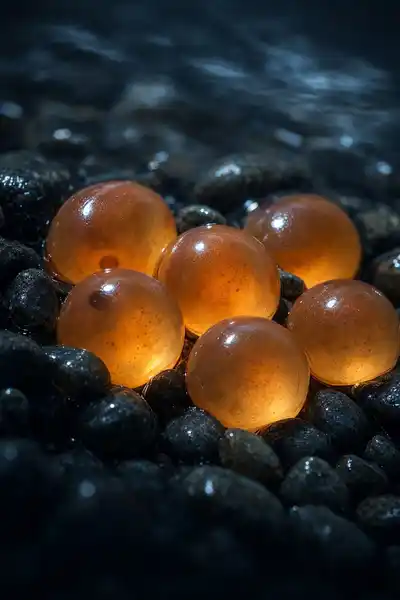
To understand what the Yukon is losing, you have to understand what the king salmon actually is. It is born in freshwater gravel far inland, migrates out to the ocean, spends years fattening in the Bering Sea, and then, driven by something we still only partly understand, turns around and swims back — up the same river, against the current, for as long as two months and as far as 2,000 miles, without eating, using its own body as fuel until there is nothing left. It spawns. Then it dies. That is the whole design.
What that design does to a river is extraordinary. The salmon drags the wealth of the ocean upstream and deposits it, as its own decaying body, in the poorest headwaters of the continent. Bears, eagles, wolves, and gulls carry the carcasses into the forest. Scientists have traced marine nitrogen into the trees along salmon rivers — the spruce grow taller because of fish that died at their roots. The run is, in the most literal sense, the river feeding itself. Take the salmon out and you are not removing one species; you are switching off a pump that has run for ten thousand years.
03 Chapter 3 — A collapse nobody can quite name
Here is the hard part of the story: the king salmon are declining, badly, and no one can fully explain it. Weymouth does not arrive with a villain in his pocket, and the book is stronger for refusing to invent one. The Yukon kings have been getting fewer, and also smaller and younger — returning at four years instead of six or seven, at a fraction of the old weight. Managers have shut down fishing on the river for years running, and the runs still don't recover the way anyone hoped.
The candidate causes stack up without a clear winner. Warming ocean and river temperatures. Industrial trawlers in the Bering Sea scooping up salmon as bycatch while chasing pollock — the fish that becomes fast-food fillets and fish sticks. Disease. Shifts in the ocean food web the salmon fatten on. Competition from hatchery fish released by the millions elsewhere. Weymouth walks through each one, and the honest conclusion is that it is probably all of them at once, tangled together in ways no single study can isolate.
04 Chapter 4 — What the river carries downstream
Step back from the canoe and the Yukon becomes an argument about the word wilderness itself. We tend to picture the wild as the place the modern world hasn't reached yet — a reserve, a somewhere-else, safe by virtue of being far. Weymouth's river dismantles that comfort mile by mile. The Yukon is about as far as North America gets, and it is already being remade by warming water, by distant fishing fleets, by an atmosphere that doesn't recognize borders or remoteness. There is no downstream from the modern world. Everywhere is downstream now.
That is the deeper thing the salmon are telling us. A fish that migrates 2,000 miles is stitched into the entire system — the open ocean, the coastal shelf, the inland gravel, the climate over all of it. It cannot be protected in one place, because it does not live in one place. Trying to save the Yukon king by regulating only the Yukon is like bailing one end of a boat. The animal's whole life is an indictment of the idea that a wild place can be walled off and kept.
05 Conclusion
After four months, Weymouth reaches the Bering Sea, where the river finally spreads out and dissolves into salt water and fog. It is an anticlimax by design — no dramatic estuary, just the land flattening until you can't tell where the Yukon stops and the ocean begins. Somewhere out there are the kings that survived, fattening for a return that fewer of them will complete. He has followed one run of one fish down one river, and in doing so has drawn a line connecting a village smokehouse to a trawler's net to a warming sea.
Related books