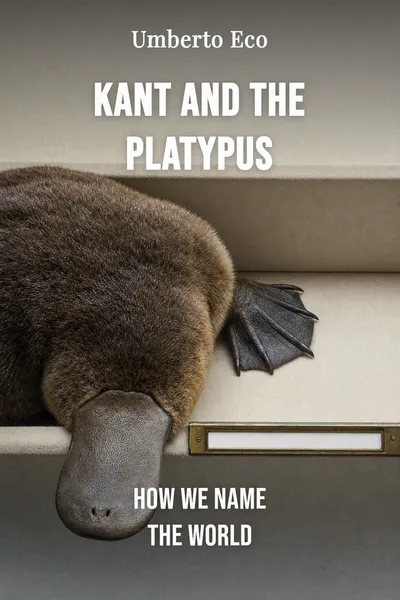
Kant and the Platypus
How we name the world
Description
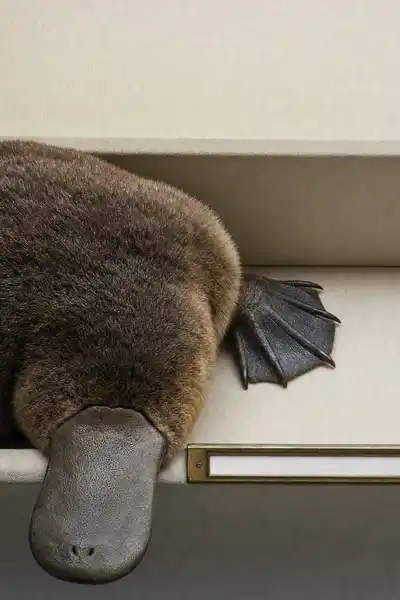
In 1798, the year Immanuel Kant published his last major work, a strange skin arrived in London from the new colony of New South Wales. It had the bill of a duck, the fur of a mole, the feet of something webbed, and it laid eggs while also nursing its young. British naturalists suspected a hoax — surely some prankster had stitched a beak onto a mammal. But the animal was real, and it had no drawer in the vast cabinet of categories that European science had spent two centuries building. The platypus did not fit. And so the men whose job was to name the world had to sit with an object that refused, politely but firmly, to be named.
Two centuries later, Umberto Eco borrowed that scene for the title of a book. His question was not really about the animal. It was about the gap the animal exposed — the space between a thing arriving in front of us and the moment we manage to say what it is. Kant had wondered how the mind imposes order on the raw data of the senses, how we get from a scatter of impressions to the judgment "this is a house." But Kant never had to name a creature that broke his own categories. The platypus is what happens when the world hands us something our concepts weren't ready for.
Eco, a semiotician who spent his life studying how signs latch onto things, treats this as the central puzzle of perception itself. We move through a world we seem to grasp effortlessly, calling a cat a cat without a second thought. But underneath that ease sits a genuine mystery about how words and things ever meet at all.
The question we’re asking : When something new arrives in front of us, how do we get from raw sensation to the word that finally holds it — and who is really doing the deciding, the world or our language?What we’ll see : A tour through Eco's six essays on perception, where a duck-billed anomaly becomes the doorway into how naming actually works.
Table of contents
01 Chapter 1 — The explorers who met an impossible animal
Eco opens with the platypus not as a curiosity but as a working problem, because he wants us to feel what naturalists felt when the specimen landed on their tables. Here was a body assembled from parts that belonged to different kingdoms of the classification system. For roughly eighty years, from the first descriptions in the late 1790s onward, scientists argued about where it went. Was it a mammal that happened to lay eggs, which the category of mammal was supposed to forbid? Was it a reptile with fur? The debate wasn't a failure of intelligence. It was the sound of concepts straining against an object that had never asked their permission.
What Eco draws out is that the confusion was productive. The naturalists did not simply throw up their hands. They observed, dissected, compared, argued, and slowly the category of mammal itself was renovated to admit an egg-laying exception. The thing did not fit the drawer, so eventually the drawer was rebuilt. This is the small drama Eco keeps returning to: the world presents an object, our existing language fails to cover it, and something has to give — usually the language, reshaped under pressure.

02 Chapter 2 — Before words, the thing pushes back
The deepest move in the book is Eco's insistence that there is something prior to language, and that this something is not passive. He calls it, borrowing and reworking a phrase, the resistance of being. Before we have named a thing, before we have even fully perceived it as a distinct object, there is a hard fact: reality does not let us say just anything about it. We can call the platypus many things, but we cannot successfully call it a fish. The world says no. Eco is fascinated by that no.
This matters because Eco spent much of his career associated with the idea that meaning is a matter of signs referring to other signs, an endless chain of interpretation with no final anchor. Here he pumps the brakes on his own tradition. Yes, interpretation is open, and yes, we build our concepts. But there is a floor. Being pushes back. It won't confirm every story we tell about it, and the stories it refuses are what keep perception honest. Eco treats this pushback almost as a partner in the conversation — not something we perceive, exactly, but something that constrains what our perceptions can become.
03 Chapter 3 — The cat, the schema, and the deal we strike
From the exotic animal Eco moves to the domestic one, because the truly interesting question is not how we handle the platypus but how we handle the cat. We recognize a cat instantly, across breeds and postures and lighting, whether it is asleep or leaping. How? We are not consulting a checklist of features. Something in us holds a flexible pattern — Eco is comfortable calling it a schema, or in his terms a cognitive type — that lets us match a live, varied, moving animal to the stable word "cat."
The elegance of the cat, for Eco, is that it hides the negotiation the platypus exposed. With the cat, the fit between thing and concept is so practiced, so culturally reinforced, that we forget any work is being done at all. We were taught the word as children, pointed toward examples, corrected when we called a dog a cat. By adulthood the schema runs silently. But it is still a construction, still the residue of a long collective agreement about which creatures go under which sound.
04 Chapter 4 — What it means to say the world is there
Step back from the animals and a larger claim comes into view, the one Eco's whole book is quietly defending. He is trying to hold two positions that philosophers usually treat as enemies. On one side, the realists, who say the world is simply out there and our job is to describe it accurately. On the other, the constructivists, who say we make the world through our languages and categories and there is no neutral "out there" to check against. Eco refuses to choose, and the platypus is his proof that he doesn't have to.
His middle path is that reality is real and independent — being pushes back, remember — but that we only ever reach it through the negotiated instruments of language and cognition. There is no view from nowhere, no moment when we see the thing stripped of all concepts. Yet the concepts are not free inventions either, because the thing keeps vetoing the wrong ones. Truth, in this account, is neither a perfect mirror of the world nor a story we tell ourselves. It is what survives the negotiation between what we say and what refuses to be said falsely.
05 Conclusion
The platypus is now firmly a mammal, its egg-laying tucked into a category built specifically to hold it. The argument that consumed naturalists for the better part of a century looks, from here, like a slow victory of observation over convenience. But Eco's interest was never in the resolution. It was in the interval — the years when a real animal sat in front of qualified people who could not yet say what it was, and had to reshape their language before they could.
Related books