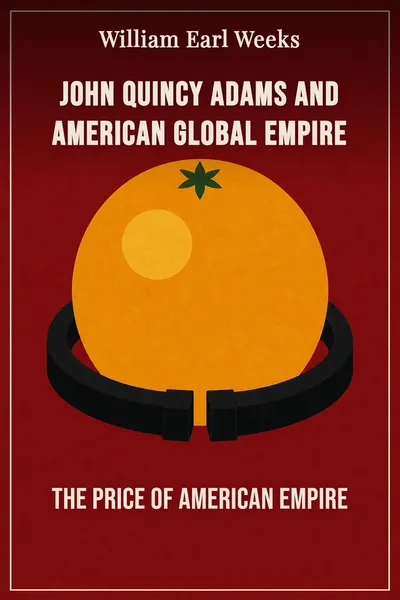
John Quincy Adams and American Global Empire
The price of American empire
Description
On February 22, 1819, in Washington, a fifty-one-year-old secretary of state signed a treaty with the Spanish minister Luis de Onís and went home to write in his diary that it was the most important day of his life. John Quincy Adams did not exaggerate easily. The son of a president, a former minister to Russia and to Britain, a man who had negotiated the end of the War of 1812 at Ghent, he had spent two years untangling one of the most complicated diplomatic knots the young republic ever faced. The document he signed handed the United States Florida, drew a boundary that ran clear to the Pacific, and quietly settled a continent's worth of claims.
Most historians still rate Adams the greatest secretary of state the country ever had, and the Transcontinental Treaty is the reason why. But in his book John Quincy Adams and American Global Empire, the historian William Earl Weeks reads the treaty as something larger than a border settlement. He argues it was the first deliberate step toward an American empire that would reach across a continent and out toward the markets of Asia. What looks in the textbooks like tidy expansion was, in Weeks's telling, a project — and Adams was its architect.
There is a second story folded inside the first. The same statecraft that made Adams great cost him something he could not put a price on. The Florida he acquired strengthened a slave society he would spend his last decades fighting. The diplomacy he mastered involved compromises he came to regard, in private, as sins. Weeks follows both threads at once: the triumph and the reckoning that followed it.
The question we’re asking : How did one treaty lay the foundation of an American empire, and what did it cost the man who built it?What we’ll see : How Adams out-negotiated a fading Spain, opened the road to the Pacific and the Orient, and how the architect of it all turned against what his own masterpiece had served.
Table of contents
01 Chapter 1 — The most valuable diplomat in the room
When Adams became secretary of state in March 1817, he inherited a mess. Spain still held Florida, or claimed to. The western edge of the Louisiana Purchase was a matter of guesswork and grievance. Spanish America was in open revolt, and the question of whether to recognize the new republics pulled Washington in every direction at once. Andrew Jackson was itching to march into Florida with or without permission. Adams walked into a room where nearly every problem touched every other one, and he had to solve them without starting a war he could not win.
Weeks is careful to show that Adams's advantage was not charm. It was preparation and patience. He had grown up inside diplomacy — as a boy he had accompanied his father to European courts — and he read the balance of power more coldly than almost anyone around him. Spain was exhausted, broke, and losing its colonies. Britain was watching. The United States was weak but growing, and time was on its side. Adams understood that a diplomat who is willing to wait, and who knows the other side cannot, holds most of the cards.

02 Chapter 2 — How Spain lost a continent
The immediate prize everyone talked about was Florida. It had been a running sore for years — a haven for runaway slaves, for Seminole raids, for adventurers Spain could no longer control. When Jackson stormed across the border in 1818, hanged two British subjects, and seized Spanish posts, he handed Adams a crisis and, paradoxically, a lever. Rather than disavow the general, Adams turned the invasion into an argument: Spain plainly could not govern Florida, so it might as well cede it. Weeks shows how coolly Adams used a reckless act he privately disapproved of to strengthen his own position.
But Florida, in Weeks's reading, was almost the smaller half of the bargain. The part that mattered for the future was the line. As the two sides haggled, Adams pushed the western boundary of American territory step by step across the map — up the Sabine, along the Red and the Arkansas, and then, in the move that changed everything, straight west along the forty-second parallel to the Pacific Ocean. Spain gave up its claim to the Pacific Northwest. On paper, in a Washington drawing room, the United States became a continental power reaching two oceans.
03 Chapter 3 — The door to the Pacific
Why did a boundary line reaching the Pacific matter so much to Adams and to the administration he served? Weeks answers that the point was never the empty coast itself. It was what lay beyond it — the trade of Asia. American merchants had been sailing to Canton for decades, and the vision that animated men like Adams was of a republic whose commerce spanned the globe, with a Pacific frontage that opened the road to the markets of the Orient. The treaty was not the end of expansion. It was the door to the sea, and the sea was the road to trade.
This is where Weeks connects a border settlement to the grand strategy that followed it. Commercial access to the Pacific was a central objective of James Monroe's administration, and the Transcontinental Treaty delivered it. Once the United States could plausibly claim a stake on the western ocean, a larger doctrine became thinkable — a claim that the Americas were not open to further European colonization. Adams, more than Monroe, drafted the language and the logic of what history would call the Monroe Doctrine, announced in 1823. Weeks presents it as the natural sequel to 1819: first secure the continent, then declare the hemisphere off limits.
04 Chapter 4 — What virtue costs when it serves power
The most striking thing in Weeks's book is what happened to Adams afterward. The man who acquired Florida for a slaveholding republic became, in his later years, one of the fiercest opponents of the slave power in American public life. Back in Congress after his single unhappy term as president, he fought the gag rule that silenced antislavery petitions and argued the Amistad case before the Supreme Court. The architect of expansion had turned against much of what his expansion served.
Weeks reads this as more than a change of politics. Adams kept a diary his whole life, and it records a man tormented by conscience. He came to see that the Florida he had won strengthened a slave society, that the Jacksonians who inherited the continent were, in his eyes, rapacious and grasping, and that his own conduct as secretary of state had involved compromises he could not square with the moral standards he set himself. The private guilt is not a footnote in Weeks's account. It is the point toward which the whole story bends.
05 Conclusion
The treaty Adams signed in February 1819 did what he said it would. Florida became American, the boundary reached the Pacific, and the logic that carried the country to two oceans and then toward the markets of Asia was set in motion. Weeks makes the case that this was the first deliberate step in the building of an American global empire, and that no one built it more deftly than the secretary of state who called it the most important day of his life.
Related books