Israel's Border Wars, 1949-1956
The raids that sparked 1956
Description
When the 1948 war ended, it did not end cleanly. The armistice agreements Israel signed in 1949 with Egypt, Jordan, Lebanon and Syria drew lines on maps, but those lines cut through orange groves, wells, villages and grazing land that families had used for generations. On the far side of the new frontiers sat roughly 700,000 Palestinian refugees, many of them within walking distance of the homes they had fled or been driven from. The guns had gone quiet at the level of armies. At the level of the border itself, something else was starting.
In his study of the years between the 1949 armistice and the 1956 Sinai campaign, the historian Benny Morris reconstructs what that something was: a slow, grinding, largely undeclared war conducted not by soldiers in uniform but by infiltrators crossing at night, and by the Israeli units sent to punish them. Most of the crossings, Morris found, began as attempts to harvest a crop, retrieve belongings, smuggle goods or visit relatives. Over seven years they turned into something harder — sabotage, ambush, killing — and drew from Israel a response that escalated in step, until the two logics met on the road to war.
Morris built the account largely from Israeli military and government archives that opened decades after the events, and the picture that emerges complicates the tidy story of a single Egyptian decision triggering an invasion. The frontier had been bleeding for years before the tanks rolled into Sinai. Working out how a scattered nuisance became a casus belli is the task the book sets itself.
The question we’re asking : How did thousands of small, mostly civilian border crossings harden into the low-intensity war that helped push Israel into Sinai in 1956?What we’ll see : How the armistice lines were lived, what drew people across them, how Israel chose to answer, and how those years set the terms for a much larger conflict.
Table of contents
01Chapter 1 — The armistice lines and the people who kept crossing them
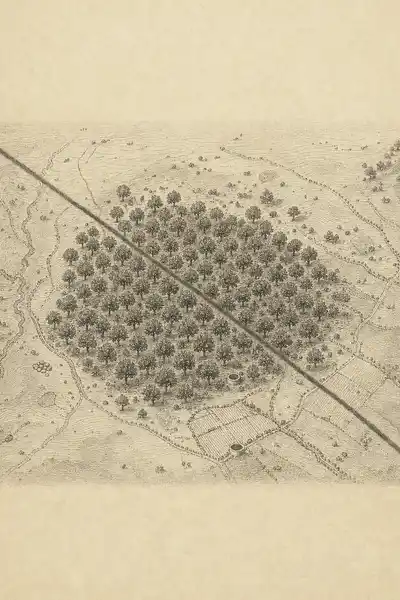
The armistice lines of 1949 were never meant to be permanent borders, and everyone involved knew it. They were cease-fire lines, frozen roughly where the fighting had stopped, and they had the arbitrary quality of a photograph taken mid-motion. A line might run down the middle of a village, leaving the houses in Israel and the wells in Jordan. It might separate a farmer from his fields or a shepherd from his pasture. Along the Gaza frontier, a dense population of refugees was packed into a narrow strip, staring across a fence at the villages many of them had lived in eighteen months earlier.
Given that geography, Morris argues, the striking thing is not that people crossed but that anyone expected them not to. In the early years, from 1949 into the early 1950s, the overwhelming majority of infiltrations were economic and social rather than military. Refugees came back to reap wheat they had sown before the war, to dig up buried valuables, to reclaim livestock, to steal irrigation pipe or laundry off a line, or simply to walk to a relative's house in a now-Israeli town. Smugglers moved hashish and goods across the same lines. The border, in practice, leaked constantly.

02Chapter 2 — What the infiltrators were actually after
One of the book's central efforts is to sort out motive, because motive was exactly what the shooting in the dark obscured. Drawing on Israeli intelligence assessments as well as later analysis, Morris breaks the crossings into rough categories, and the ordering matters. Economic recovery came first: the harvest, the buried gold, the abandoned herd. Then came theft, which shaded into organised smuggling. Then family reunion and the simple pull of home. Political and military infiltration — sabotage, intelligence-gathering, killing — was real, but in the early years it was a small share of the total.
This finding cut against the official Israeli understanding of the time, which tended to see an organised Arab campaign of aggression behind the crossings. Morris argues that for the first several years there was no such campaign. The Arab governments, including Egypt and Jordan, were not orchestrating infiltration; in many cases they were actively trying to suppress it, since a quiet border served their own interests. The crossings were a grassroots phenomenon born of dispossession and proximity, not a state policy.
03Chapter 3 — The policy of reprisal and how it hardened
Israel's answer to infiltration evolved through stages, and Morris tracks the evolution closely because it is where the war was incubated. The first response was defensive and preventive: minefields, patrols, fences, a shoot-to-kill posture along the lines, and the forced clearing of Arab populations from sensitive border zones. This stopped a great deal of crossing and killed a great many crossers, but it did not stop the problem, and it did nothing to satisfy a public that felt exposed and a military leadership that wanted to hit back.
So the policy shifted toward reprisal — cross-border raids meant to punish the villages and states from which infiltrators came, and to force Arab governments to police their own side of the line. The pivotal instrument was Unit 101, a small commando force established in 1953 under a young Ariel Sharon, later merged into the paratroops. Its operations were deliberately punishing. The raid on the Jordanian village of Qibya in October 1953, launched in reprisal for the killing of an Israeli woman and her two children, left dozens of civilians dead in demolished houses and drew international condemnation, including a rebuke from Israel's own allies.
04Chapter 4 — The road from the border to Sinai
The turning point Morris identifies is the Gaza raid of February 1955, when Israeli paratroops struck an Egyptian army base and killed dozens of soldiers. Until then Egypt, like Jordan, had largely tried to keep its border quiet. The raid humiliated Gamal Abdel Nasser and changed his calculation. Rather than continuing to suppress infiltration, Egypt began to organise it, recruiting and training Palestinian fedayeen — irregulars sent across the line specifically to sabotage and kill. The grassroots crossing of the early years had, by state decision, been turned into an instrument of policy.
This is the heart of the book's larger claim, and it is deliberately unglamorous. The 1956 Sinai campaign is usually narrated as a chapter of grand strategy — the Suez crisis, the collusion with Britain and France, Nasser's nationalisation of the canal, the geopolitics of the Cold War. Morris does not deny any of that. But he insists that the war also grew from the ground up, out of seven years of shooting in orange groves and reprisals in border villages. The fedayeen attacks that Israel invoked as justification for invading Sinai and Gaza were the culmination of a border war that had been running, largely unnoticed by the wider world, since the armistice ink dried.
05Conclusion
Morris ends where the war begins, with the reader now able to see the Sinai campaign not as a bolt from the blue but as the loud end of a long, quiet process. The frontier that looked, on the map, like a settled cease-fire line had in fact been a zone of continuous low-grade violence, in which the great majority of the dead were people crossing to reclaim what they had lost. Egypt's decision to arm and direct the fedayeen after 1955 did not create the conflict; it weaponised one that had been simmering since 1949.
Related books