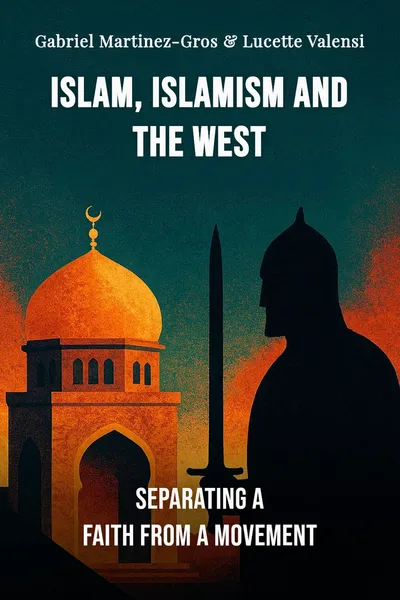
Islam, Islamism and the West
Separating a faith from a movement
Description
There is a word that does a great deal of work in Western newsrooms, parliaments and dinner conversations, and it does that work by staying blurry. The word is Islam. Depending on the sentence, it names a religion practiced by roughly a quarter of humanity, a nineteenth-century political ideology born in reaction to colonial defeat, or a foreign-policy problem measured in oil, borders and armed groups. The three things get folded into one another until they become indistinguishable, and the fold itself becomes the argument. Say Islam and you have already decided a great many things you never actually examined.
Gabriel Martinez-Gros, a historian of the medieval Muslim world, and Lucette Valensi, a historian of the Maghreb and the Ottoman Mediterranean, spent their careers inside the archives that the word papers over. Their short book is an attempt to pull the fold apart again — to hold a faith, a movement and a geopolitical relationship at arm's length from each other and see what each one actually is. They are not defending anything and not accusing anyone. They are doing the unglamorous work of a historian who insists that a fourteen-century religion and a slogan shouted in 1979 are not the same object, even when they share a name.
What makes the exercise urgent is that the confusion is not innocent. When a faith, a political program and a set of oil-and-border interests all answer to the same syllable, a headline about one becomes an accusation against all three. The book's wager is that most of what the West thinks it knows about the Muslim world is really a story about the West's own anxieties, wearing an Arabic name.
The question we’re asking : When we say Islam, which of three very different things do we actually mean — and what happens when we can no longer tell them apart?What we’ll see : Two historians take apart a single overloaded word and follow each of its meanings back to where it really comes from.
Table of contents
01Chapter 1 — A faith with fourteen centuries behind it
Start with the least contested layer, which is also the one most often skipped: Islam as a religion. It appears in Arabia in the early seventh century, spreads across a vast arc from Spain to Central Asia within a century of the Prophet Muhammad's death in 632, and settles into the ordinary business of belief — prayer, law, poetry, philosophy, mysticism, dispute. Martinez-Gros knows this world from the inside, having spent decades on the great medieval historians and on the empires that governed those lands. What he sees there is not a monolith but a civilization: plural, argumentative, capable of Averroes and of the Sufi orders, of jurists who spent lifetimes disagreeing about the smallest point.
The point the authors press is that this religion was, for most of its history, remarkably good at coexisting with power rather than being power. The great Islamic empires — Umayyad, Abbasid, Ottoman — were not theocracies run by clerics. They were states, with soldiers, taxes and dynastic quarrels, in which religion supplied legitimacy and law but rarely ran the administration. Scholars interpreted the sacred texts; sultans and viziers ran the world. The two coexisted, sometimes uneasily, for a thousand years.

02Chapter 2 — The moment religion became a program
Islamism — political Islam, the movement that wants the state itself to be an instrument of the faith — is a modern invention, and the authors are precise about its birthdate. It belongs to the late nineteenth and twentieth centuries, and it is born in defeat. The Muslim world that had built the empires of chapter one found itself, by 1900, largely colonized, carved up or humiliated by European powers whose ships, factories and armies it could not match. The old order had failed. Something had to explain why.
One answer, which the authors trace through figures like the Egyptian founders of the Muslim Brotherhood in 1928, was that Muslims had failed because they had strayed from a pure original Islam, and that recovering it — as a total system governing law, economy and state — would restore the strength that had been lost. This is the crucial move. It reads a fourteen-century religion backward through the lens of a nineteenth-century wound, and it turns faith into an ideology of retrieval and grievance. It is, in that sense, a very modern response to a very modern problem, closer in structure to other twentieth-century revolutionary movements than to the medieval world it claims to be restoring.
03Chapter 3 — The West as mirror and antagonist
The third reality is the one the West is most fluent in and least aware of: the geopolitical relationship. Here Islam is neither a faith nor an ideology but a name for a set of interests, borders and confrontations — oil, migration, the map drawn by European powers after the Ottoman collapse, the wars and interventions that followed. And in this arena, the authors argue, the West is not an observer of the Muslim world. It is a participant, often the more powerful one, and it has been for two centuries.
This is where the book turns its attention homeward. The Western fear of Islam, they suggest, is partly a projection — a way of externalizing anxieties about decline, security and identity by locating the threat in a foreign faith. Colonial history, the Cold War's manipulation of religious movements, the arming of some groups and the toppling of some governments: the West has repeatedly shaped the very forces it later describes as alien and menacing. The relationship is a mirror in which each side reads its own dread.
04Chapter 4 — When words do the work of thought
Step back from the three layers and the deeper stake comes into view. The book is finally about what happens when a single word is allowed to carry three incompatible meanings at once — because a word in that state stops describing the world and starts deciding it for us in advance. When faith, movement and geopolitics all answer to Islam, any fact about one automatically implicates the other two. A bombing becomes evidence against a religion; a religious custom becomes evidence of a strategic threat; a diplomatic quarrel becomes proof of civilizational incompatibility. The fusion is not a mistake of vocabulary. It is a machine for producing conclusions no one had to argue for.
Martinez-Gros and Valensi are historians, and their instinct is that this collapse is what history exists to resist. A historian's basic discipline is to notice that things that share a name were not born at the same time, do not do the same work, and answer to different explanations. The medieval empire, the twentieth-century ideology and the contemporary confrontation are three objects with three different histories. The refusal to distinguish them is not a strong opinion about Islam; it is a decision not to think about it.
05Conclusion
The whole book turns on an act of separation that ought to be obvious and almost never is. A religion that spread across three continents in the century after 632; a political program invented in the shadow of colonial defeat and consolidated in 1979; and a geopolitical relationship in which the West has been an active hand for two hundred years. Three objects, three timelines, one overloaded syllable. Martinez-Gros and Valensi spend their pages prying them apart, not to soften anything but to make it possible to see anything at all.
Related books