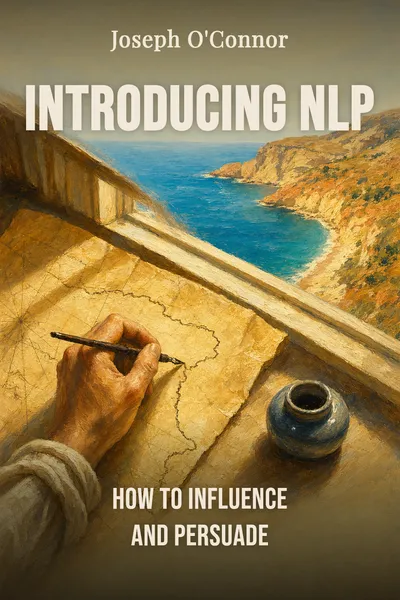
Introducing NLP
How to influence and persuade
Description
In the mid-1970s, at the University of California, Santa Cruz, a mathematics student named Richard Bandler and a linguistics professor named John Grinder became fascinated by the same question: why did a handful of therapists get results that everyone else could only admire from a distance? Virginia Satir with families, Fritz Perls in his Gestalt work, the hypnotherapist Milton Erickson — each produced changes in people that looked almost like sleight of hand. Bandler and Grinder decided not to theorize about why it worked. They watched, recorded, imitated, and tried to reproduce the exact patterns these masters used, often without the masters themselves being able to explain them.
Out of that copying came Neuro-Linguistic Programming, a name that tries to hold three things at once — the neurology that runs our experience, the language that shapes and reflects it, and the patterns of behavior we run, often on autopilot. Joseph O'Connor and John Seymour, in their primer Introducing NLP, take this sprawling, sometimes over-promised toolkit and lay it out plainly: rapport, sensory sharpening, language patterns, the modeling of excellence. Their claim is modest and large at the same time. Much of what we call talent, charisma, or influence is not innate. It is structure, and structure can be studied.
That is a bold thing to say about the most human corners of life — persuading a colleague, calming an argument, changing a habit we thought was fixed. O'Connor and Seymour don't sell it as magic. They present NLP as a way of paying attention, closely, to how we and others actually build meaning, and then doing something useful with what we notice.
The question we’re asking : Can the way skilled people influence others be broken down into patterns anyone can learn?What we’ll see : How a discipline built by imitation turns perception, rapport and language into practical tools for changing exchanges.
Table of contents
01Chapter 1 — A discipline built by copying what already worked
O'Connor and Seymour open with the founding move, because it explains everything that follows. Bandler and Grinder were not building a theory of the mind from first principles. They were reverse-engineering results. They took three exceptional communicators and asked a narrow, almost engineering-flavored question: what, precisely, do these people do? Not what they believe, not what school of thought they belong to — what sequence of behaviors, tones, questions and gestures produces the outcome. This practice of extracting the working structure of a skill and passing it on is what NLP calls modeling, and the authors treat it as the beating heart of the whole enterprise.
The insight underneath is that expertise is often invisible to the expert. A gifted therapist, a persuasive negotiator, a teacher whose students never forget them — most of them cannot tell you how they do it. They say things like "I just get a feel for the person." Modeling assumes that this feel is not a fog but a set of steps that can be observed from the outside and reassembled. If you can find the pattern, you can teach it, and someone with no natural gift can learn to produce a version of the same result.

02Chapter 2 — The map is not the territory
The phrase belongs to the semanticist Alfred Korzybski, and O'Connor and Seymour make it the philosophical spine of NLP. None of us deal with the world directly. Between reality and us sits a map — a model built from what our senses let in, what our language names, and what our past has taught us to notice. Two people in the same meeting walk out with two different meetings. The territory was identical; the maps were not. This sounds like a truism until you watch what the authors do with it.
Because we mistake our map for the territory, we treat our version of events as simply the way things are. The colleague who "clearly doesn't respect me" is a conclusion drawn from a map, not a fact read off the world. NLP's practical wager is that if we can loosen the grip of our own map — and get curious about someone else's — we gain room to move. Influence, in this view, starts with recognizing that the other person is operating from a model as coherent to them as ours is to us.
03Chapter 3 — Rapport, or the art of leading by first following
If maps differ, the question becomes how to build a bridge between them. NLP's answer is rapport, and O'Connor and Seymour treat it as the single most important interpersonal skill in the book. Rapport is the sense of connection that makes another person feel understood and willing to be influenced. We recognize it instantly when it's there — the conversation flows, agreement comes easily — and we feel its absence just as sharply. The authors' claim is that rapport is not luck or chemistry. It is something we can deliberately create.
The mechanism they describe is matching. When two people are in genuine rapport, they tend, without noticing, to mirror each other — posture, gesture, pace of speech, tone, even breathing drift into alignment. NLP takes this natural byproduct and reverses the causation: instead of waiting for rapport to produce matching, you match, gently and respectfully, and rapport tends to follow. Adopt something of the other person's rhythm and posture, and a signal of similarity is sent below the level of conscious attention. The authors are firm that this must be subtle. Crude, obvious mimicry reads as mockery and destroys the very thing it was meant to build.
04Chapter 4 — The words that move before we notice them
The linguistic strand of NLP is where the debt to Grinder shows most clearly, and where O'Connor and Seymour make their sharpest practical case. Language, they argue, doesn't just report our map — it constructs it and, crucially, it can reshape someone else's. Every sentence we utter is a heavily compressed version of a fuller inner experience. We delete, distort and generalize in speech just as we do in perception. The skilled communicator learns to hear what has been left out and to ask the question that fills it in.
The authors lay out what NLP calls the Meta Model — a set of questions for recovering the missing pieces. When someone says "nobody listens to me," the generalization invites a question: nobody, ever? When they say "this is impossible," the deletion invites another: what specifically stops you? These questions are not clever traps; they gently return a person to their actual experience rather than the collapsed summary of it. Much of what feels stuck in a conversation, the authors suggest, is stuck only in the language, and precise questioning loosens it.
05Conclusion
NLP returns, in the end, to the move it started with. Bandler and Grinder didn't ask why Erickson or Satir worked; they asked how, and then copied the how. O'Connor and Seymour's whole primer runs on that same conviction — that rapport, sensory attention, and language patterns are not gifts but structures, and that structures can be observed, learned and put to use. Influence stops being a matter of personality and becomes a matter of what you actually do in the room.
Related books