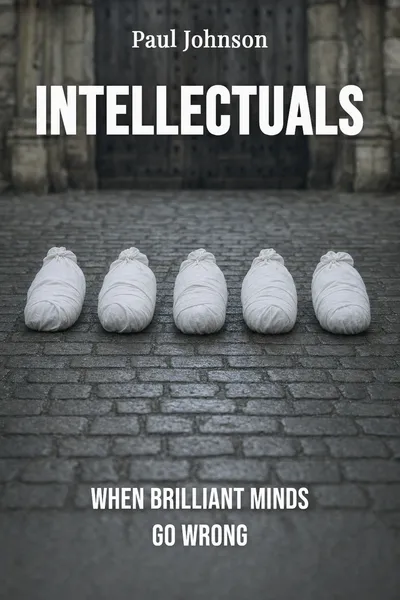
Intellectuals
When brilliant minds go wrong
Description
In 1745, Jean-Jacques Rousseau, the philosopher who would soon teach Europe how to raise its children, handed his first newborn over to a Paris foundling hospital. He did the same with the four that followed. The infant-mortality rate in those institutions ran terribly high, and Rousseau never traced what became of any of the five. A decade later he published Émile, a treatise on tender, natural education that moved a whole continent. This is the collision Paul Johnson builds his book Intellectuals around: the tenderness on the page, the abandonment in the life.
Johnson, a British historian writing in 1988, set out to do something that sounds almost rude. He took the men modern culture had elevated into moral guides — Rousseau, Shelley, Marx, Ibsen, Tolstoy, Hemingway, Brecht, Sartre and others — and asked a blunt question of each. Not whether their ideas were clever, but whether the people who produced them were fit to advise the rest of us on how to live. He read their letters, their bank accounts, the testimony of the wives, servants, lovers and children who lived close enough to see the gap.
The book was a provocation, and it was received as one. Johnson has a case to make and he does not pretend otherwise; the reader can feel the prosecutor in him. But the method is worth taking seriously precisely because it refuses the usual courtesy — the one that lets us admire the doctrine while looking away from the man. What emerges is less a set of scandalous anecdotes than a pattern, repeated across two centuries and several countries, that Johnson thinks we ought to notice.
The question we’re asking : When someone builds a philosophy of how humanity should live, does the way they treated the humans around them count as evidence?What we’ll see : A historian puts a line of celebrated thinkers on trial, weighing their doctrines against the lives they actually led.
Table of contents
01Chapter 1 — The man who loved humanity and abandoned his children
Johnson opens with Rousseau because Rousseau, in his reading, invents the type. Before the eighteenth century, moral authority belonged to priests and to the tradition behind them. Rousseau proposed something new: a private individual who, by the force of his own feeling and reason, could tell society how to reorganize itself from the ground up. He was, Johnson argues, the first secular intellectual in the modern sense — a man who claimed the right to reshape the world without the sanction of church or crown.
The trouble is what Johnson finds when he looks at the man behind the claim. Rousseau wept easily over the suffering of mankind in the abstract and was consistently cruel to the people in front of him. He quarrelled with nearly every friend who helped him — Diderot, Hume, the patrons who housed and fed him — and turned each falling-out into a story of his own persecution. Thérèse Levasseur, the seamstress who lived with him for decades, was treated less as a partner than as a servant kept at a careful distance. And there were the five children, each one sent away at birth by a man who would go on to write the century's most influential book on how to love and raise a child.

02Chapter 2 — The gap between the theory and the household
Having set the template, Johnson moves through his gallery, and the same seam keeps opening between doctrine and domestic life. Percy Bysshe Shelley preached universal love and the liberation of women while leaving a trail of abandoned partners; his first wife, Harriet, drowned herself. Karl Marx wrote the century's most powerful indictment of exploitation while, in Johnson's telling, exploiting the people nearest to him — living off Friedrich Engels's factory money, borrowing relentlessly, and never paying wages to Helene Demuth, the family servant who worked for him for life and who, the evidence suggests, bore him a son he refused to acknowledge.
The pattern is not identical in each case, and Johnson is careful about the differences. Marx's scholarship, for instance, he treats with a historian's scepticism about the sources; the man who claimed to speak for the industrial worker had, Johnson notes, barely set foot in a factory and got much of his data at second hand. Henrik Ibsen, the dramatist who taught Europe to question bourgeois respectability, guarded his own respectability, medals and social standing with an almost comic ferocity. In each life Johnson finds the theory pointing one way and the private conduct pointing the other.
03Chapter 3 — When the private life leaks into the public doctrine
The book's darker argument is that these private failings do not stay private. Johnson's contention is that the same qualities which wreck a thinker's household — the contempt for ordinary people, the willingness to sacrifice the individual to the idea, the certainty that one's own vision justifies any means — travel straight into the doctrine and out into the world, where they can do damage on a scale no household could contain.
Leo Tolstoy is his study in this. The novelist who preached poverty, chastity and non-violence lived on a large estate, quarrelled bitterly with the wife who bore his thirteen children and copied his manuscripts, and imposed his ascetic gospel on a family that had not chosen it. Johnson reads Tolstoy's late religious phase less as humility than as a bid for a kind of sainthood — a man who wanted to be worshipped as a prophet and who bent everyone around him to that need. The love of humanity, again, comes at the expense of the humans nearest to hand.
04Chapter 4 — The dethroning of the secular priest
Step back from the individual portraits and Johnson's broader target comes into view. It is not any one of these men but the role they collectively created and that we have kept alive: the intellectual as secular priest, the figure we consult on how to live now that the old authorities have lost their grip. Johnson's whole book is an argument that we granted this figure his authority too cheaply — that we mistook fluency for wisdom and eloquence for virtue, and forgot to ask the ordinary question we ask of anyone else offering advice on life, which is whether their own has gone well.
His deeper point is about the nature of the expertise on offer. A physicist earns deference within physics; a surgeon within surgery. But the intellectuals in Johnson's gallery claimed authority over the largest questions of all — justice, love, how societies should be arranged — while possessing, he argues, no special competence in any of them and often a striking deficit of the everyday virtues that competence there requires. They lacked, in his account, practical judgement, empathy, the humility to test a theory against a single unhappy household before applying it to a nation. What they had instead was the gift of making a vision sound inevitable.
05Conclusion
The book closes where it began, with the gap Johnson has been circling from the first page — between the tears shed for humanity and the treatment of the human being in the next room. Rousseau by the foundling hospital, Marx and his unpaid servant, Tolstoy and his exhausted wife, Sartre lending his name to regimes he would never have to endure: the anecdotes accumulate into a single, uncomfortable proposition, that the love of mankind in the abstract has repeatedly gone hand in hand with a cool indifference to men in particular.
Related books