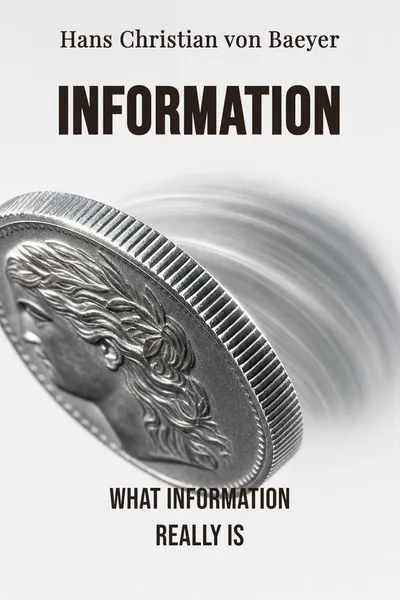
Information
What information really is
Description
For most of human history, nobody could tell you how much information a sentence, a photograph, or a heartbeat contained. We had the word, and we used it constantly, but it pointed at something we couldn't measure. Then in 1948 an engineer at Bell Labs named Claude Shannon published a paper that gave information a unit, a formula, and a number. Suddenly a phone call, a page of Shakespeare, and a strand of DNA could all be put on the same scale. This is where the physicist Hans Christian von Baeyer starts his book — with the strange fact that one of the most powerful concepts of the modern world is barely older than the transistor.
Baeyer is a physicist by trade, and his interest is not really in telephones or hard drives. What draws him is a suspicion that has crept through physics over the last few decades: that information might not just describe the world, but somehow constitute it. That behind atoms and energy, the deepest layer might be answers to yes-or-no questions. It sounds like a stretch. He spends the book making it sound less so, moving patiently from the practical to the physical to the almost metaphysical.
What makes his account worth following is that he refuses to let the idea float free of the arithmetic. Every leap toward the grand claim is anchored in something concrete — a coin toss, a shuffled deck, a warm cup of coffee cooling on a table. He wants us to feel the concept before we're asked to believe anything large about it. So the book behaves less like a lecture and more like a walk that keeps climbing.
The question we’re asking : What is information, really — a measure of messages, a property of matter, or the thing the universe is made of?What we’ll see : How a wartime engineer turned a vague word into a number, and why physicists then started wondering if that number goes all the way down.
Table of contents
01 Chapter 1 — The word that meant nothing until 1948
Before Shannon, information was a word you could gesture at but never pin down. A newspaper had information, a rumor had information, a gene had information — but there was no way to say one contained twice as much as another. Baeyer opens by reminding us how recent our precision is. The concept feels ancient because language and memory are ancient, but the ability to quantify a message is roughly the age of a person's grandparents. That gap, between how old the word feels and how young the measure is, is the small mystery the whole book unfolds from.
Baeyer traces the long approach to the idea. He touches on Aristotle, on the arrival of the alphabet, on the printing press, on the telegraph, each of which changed how humans stored and moved knowledge without ever asking how much of it there was. The telegraph mattered most here. Once messages traveled as electrical pulses down a wire, engineers had a commercial reason to care about efficiency: fewer symbols meant lower cost. The abstract question of quantity started to become a practical one.

02 Chapter 2 — Shannon's bet: strip out the meaning
Shannon's central move, Baeyer explains, was to define information as the resolution of uncertainty. Before a message arrives, there are many things it might say. After it arrives, only one remains. The amount of information is a measure of how much doubt got cleared away. A message that tells you something you already knew carries none; a message that could have gone a thousand ways and picks one carries a great deal. Meaning, importance, truth — Shannon set them all aside as someone else's problem.
This is where the coin flip earns its place. A single fair coin has two equally likely outcomes, and learning the result clears exactly one unit of doubt. Shannon called that unit a bit, short for binary digit. Two coins give four possibilities and two bits; ten coins give a thousand-odd possibilities and ten bits. Baeyer is patient with this arithmetic because everything downstream depends on it. Information doubles with each added yes-or-no question, which means it grows not by counting outcomes but by counting the questions needed to name one.
03 Chapter 3 — From coin flips to the physics of a bit
The chapter where the book turns is the one where Baeyer connects Shannon's formula to a piece of nineteenth-century physics: entropy. Physicists had long used entropy to measure disorder — why heat flows from hot to cold, why a smashed cup never reassembles. When Shannon looked for a name for his measure of uncertainty, the mathematician John von Neumann reportedly told him to call it entropy, partly because the formula matched and partly because, in an argument nobody could win, the word would give him an edge.
Baeyer treats that coincidence as anything but coincidental. The entropy of a warm gas measures how many microscopic arrangements of its molecules would look the same from outside — which is exactly a measure of how much we don't know about the specific arrangement. That is missing information, expressed in the language of heat. Suddenly a concept from steam engines and a concept from telephone lines turn out to be the same concept wearing two costumes. This, for Baeyer, is the hinge of the whole book.
04 Chapter 4 — When the universe starts looking like a message
Having tied information to physics, Baeyer steps back to the boldest question the subject raises — one associated with the physicist John Archibald Wheeler and his phrase "it from bit." Wheeler's suggestion, which Baeyer treats with equal parts caution and enthusiasm, is that physical reality does not merely carry information but derives from it. Every particle, every field, every measurement might ultimately reduce to answers to yes-or-no questions posed to nature. The stuff of the world would be, at bottom, resolved uncertainty.
Baeyer is careful not to sell this as settled science, and that restraint is what makes his handling of it persuasive. He points to quantum mechanics, where the act of measurement is fundamental and where what we can ever know about a system is sharply limited. In that setting, framing physics in terms of information stops looking like a metaphor. The theory already speaks in probabilities and observations, in what can and cannot be known — the native vocabulary of Shannon's bit rather than of solid billiard-ball matter.
05 Conclusion
The book began with an embarrassment — that we could not measure the very thing our age is named after — and ends by proposing that this same unmeasured thing might be the bedrock of everything else. Shannon supplied the arithmetic, entropy supplied the bridge to physics, and Wheeler supplied the vertigo. Baeyer's achievement is to move across that whole distance without ever losing the thread, so that the reader who started with a coin flip arrives at the edge of cosmology feeling that each step was earned rather than smuggled in.
Related books