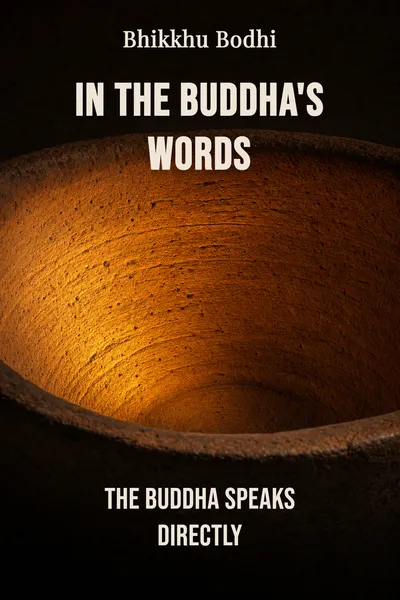
In the Buddha's Words
The Buddha speaks directly
Description
For most of us, the Buddha arrives secondhand. We meet him through a meditation app, a quote on a mug, a paraphrase in a self-help book, a statue in a spa. He becomes a mood more than a person — serene, vaguely Eastern, endlessly agreeable. What almost never reaches us is the thing itself: the actual words attributed to a man who walked northern India roughly twenty-five centuries ago and spent forty-five years talking to farmers, kings, merchants and skeptics about why life hurts and what can be done about it.
That gap is exactly what Bhikkhu Bodhi, an American-born monk and one of the most respected translators of the early Buddhist texts, set out to close. His anthology In the Buddha's Words does something deceptively simple. It pulls passages straight from the Pali Canon — the oldest surviving record of the teaching — and arranges them so that the Buddha, more or less, speaks for himself. No modern voice smoothing him into a wellness brand. Just the suttas, translated and sequenced.
The result is stranger and sharper than the mug version. The Buddha of these pages argues, jokes, refuses to answer loaded questions, and talks about death without flinching. He addresses people where they actually stand — worried about money, family, dying parents — before he says anything about enlightenment. What emerges is less a religion than a method, and it is worth meeting on its own terms.
The question we’re asking : What does the Buddha actually say when we stop paraphrasing him and let the early texts speak?What we’ll see : How one scholar-monk turned a vast, scattered canon into a readable path, and what surfaces when the teaching is met directly.
Table of contents
01Chapter 1 — When the teacher speaks
The core problem Bodhi confronts is one of access. The Buddha left nothing in writing. What survives is the Pali Canon, an enormous body of discourses — the suttas — preserved orally for centuries by communities of monks who memorized them, then finally committed to writing. It runs to thousands of pages, organized not by theme but by length and by the collections that happened to form around them. Opening it cold is like being handed a library with no catalog. You can read a hundred pages and have no idea where a given teaching fits in the whole.
Bodhi's move is to treat the canon as raw material and build an arc through it. He selects roughly ten broad stages, from the most down-to-earth concerns of ordinary life up to the final goal of liberation, and slots authentic passages into each. Every excerpt is the Buddha's reported speech, or close to it — the familiar formula 'Thus have I heard,' the naming of the town, the person who came to ask a question. Nothing is invented. What Bodhi adds is order and a running commentary that tells us where we are on the map.

02Chapter 2 — The everyday questions the teaching answers
One of the quietly radical choices in the anthology is where it begins. Not with meditation, not with nirvana, but with what Bodhi calls the human condition — and then, before anything lofty, with the ordinary good life. The early sections gather teachings on how to earn a living honestly, how to treat parents and children, how friends should behave toward one another, how a household should handle money. The Buddha, it turns out, had a great deal to say about wealth: earn it fairly, enjoy it without clinging, share it, and don't ruin yourself with debt.
This matters because it corrects a common distortion. The popular image treats Buddhism as world-renouncing from the first breath — everyone shaving their heads and heading for a cave. The texts show something more layered. The Buddha spoke to two audiences at once: those who had left ordinary life behind, and the far larger number who hadn't and never would. For the second group he offered a graduated teaching, meeting them at the level of a decent, generous, well-ordered life.
03Chapter 3 — The path laid out in stages
Once the diagnosis is in place, the anthology follows the Buddha into the method. Here the material becomes more technical, and Bodhi's sequencing does real work. The teaching is not a single insight but a graduated training, and the texts describe it as exactly that — a path with stages that build on one another, each preparing the ground for the next rather than a menu of practices to sample.
At the center sits the framework most people have heard named without quite grasping: the Four Noble Truths. There is dukkha; it has a cause, which the Buddha locates in craving — the restless grasping for things to be other than they are; that cause can cease; and there is a way to bring about its ceasing, the Noble Eightfold Path. Bodhi's selected discourses show the Buddha presenting this not as dogma to believe but as something to be tested, the way a physician diagnoses and prescribes. The famous instruction is to come and see for oneself.
04Chapter 4 — Reading a life's work into a doorway
Step back from the contents, and the more interesting object is the anthology itself — the act of a twenty-first-century monk shaping an ancient, unwieldy canon into something a stranger can actually walk into. Bodhi is not neutral here, and he knows it. Choosing which passages to include, in what order, under which headings, is an interpretation. He argues that his sequence reflects the internal logic of the teaching, the graduated structure the Buddha himself used. But any arc imposes a shape on material that originally had none, and Bodhi is transparent that this is a doorway he has built, not the whole house.
This raises a question every living tradition has to answer: how do you keep old words readable without rewriting them? The two easy failures are opposite. You can freeze the texts into untouchable scripture that only specialists can approach, or you can dissolve them into whatever the present moment finds comforting — the mug, the app, the slogan. Bodhi's anthology tries to hold a narrow middle. Keep the words exactly. Change only the framing that lets a newcomer find the entrance.
05Conclusion
The Buddha most of us carry around is a composite of secondhand impressions — calm, agreeable, quotable. What Bodhi's anthology offers instead is the man reconstructed from his reported speech: a teacher who meets people at the level of their debts and their grief before he speaks of freedom, who refuses questions that lead nowhere, and who presents his whole method as something to be tested rather than believed. Arranged as a single arc, the scattered discourses turn out to describe not a mood but a graduated training, running from the ordinary decent life all the way to the end of craving.
Related books